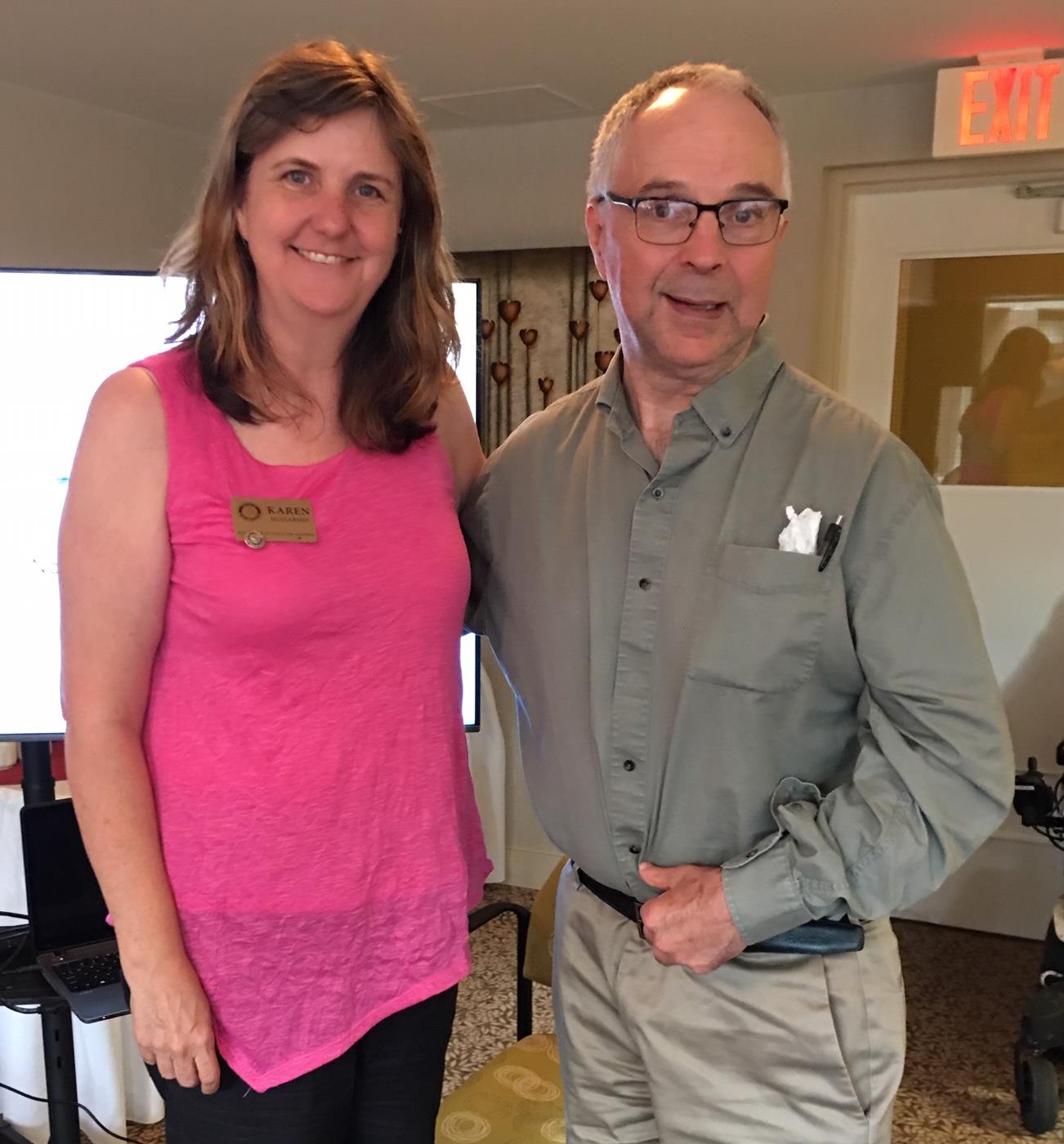
Karen McDiarmid presented to us a most enlightening talk respecting ASTTBC, essentially an organization designed to bridge the gap between Persons With Disabilities (termed PWDs) and employers or other entities operating in other fields of assistance to the work- or inherently-disabled diaspora. With her she brought Warren, an employee who recently suffered a stroke and has since been unable to work in his chosen profession, but who bore testimony to the virtues of the Association, one of which, reaction would suggest, very few of us are aware. She described the group in general terms as an association of technical specialists, but one in chronic need of more volunteers and skilled rehabilitative specialists. At this time, Karen indicated that the Association subsumes some 10,000 technicians and specialists, who themselves have many “diverse abilities” required to service a large spectrum of “diverse disabilities”. Though no small organization (currently it ranks as B.C.’s third largest regulatory agency) the diversity of needs is sometimes masked by the facts of the ‘duty too accommodate’, but which valuable mandate is of course often only possible for large employment entities to adequately embrace.
One of the inherent problems for the organization is awareness of its existence, but just as importantly there is a whole range of factors which militate against PWDs coming forward with their issues. These include ‘stigma and myths’, workplace culture, and concern about dismissal from employment. Thus there is in fact a far greater need for the Association than is recognized, but at present a singular problem is that ASTTBC could not in fact properly service that need if all those who actually are in need of its services decided to come forward.
Among the charts provided by Karen was a useful one that reflected what employers can do to assist PWDs, including the participation in industry training, the recruitment of PWDs, and providing feedback as to the need for the Association’s services. Your correspondent noted that the Association, obviously not well known to the larger community (at least as reflected in our Club’s membership) may be reflective of the need for skilled specialists, as those who do not know of its existence are not likely to themselves offer to assist (Karen reported that technical assistance is already provided by a very diverse group, including the holder of a Masters in Physics degree and a BA in Political Science … and even the holder of a Masters’ degree in English Rhetoric! Unfortunately, there was no time to explore what services the last-named could possibly provide!).
One of the inherent problems for the organization is awareness of its existence, but just as importantly there is a whole range of factors which militate against PWDs coming forward with their issues. These include ‘stigma and myths’, workplace culture, and concern about dismissal from employment. Thus there is in fact a far greater need for the Association than is recognized, but at present a singular problem is that ASTTBC could not in fact properly service that need if all those who actually are in need of its services decided to come forward.
Among the charts provided by Karen was a useful one that reflected what employers can do to assist PWDs, including the participation in industry training, the recruitment of PWDs, and providing feedback as to the need for the Association’s services. Your correspondent noted that the Association, obviously not well known to the larger community (at least as reflected in our Club’s membership) may be reflective of the need for skilled specialists, as those who do not know of its existence are not likely to themselves offer to assist (Karen reported that technical assistance is already provided by a very diverse group, including the holder of a Masters in Physics degree and a BA in Political Science … and even the holder of a Masters’ degree in English Rhetoric! Unfortunately, there was no time to explore what services the last-named could possibly provide!).