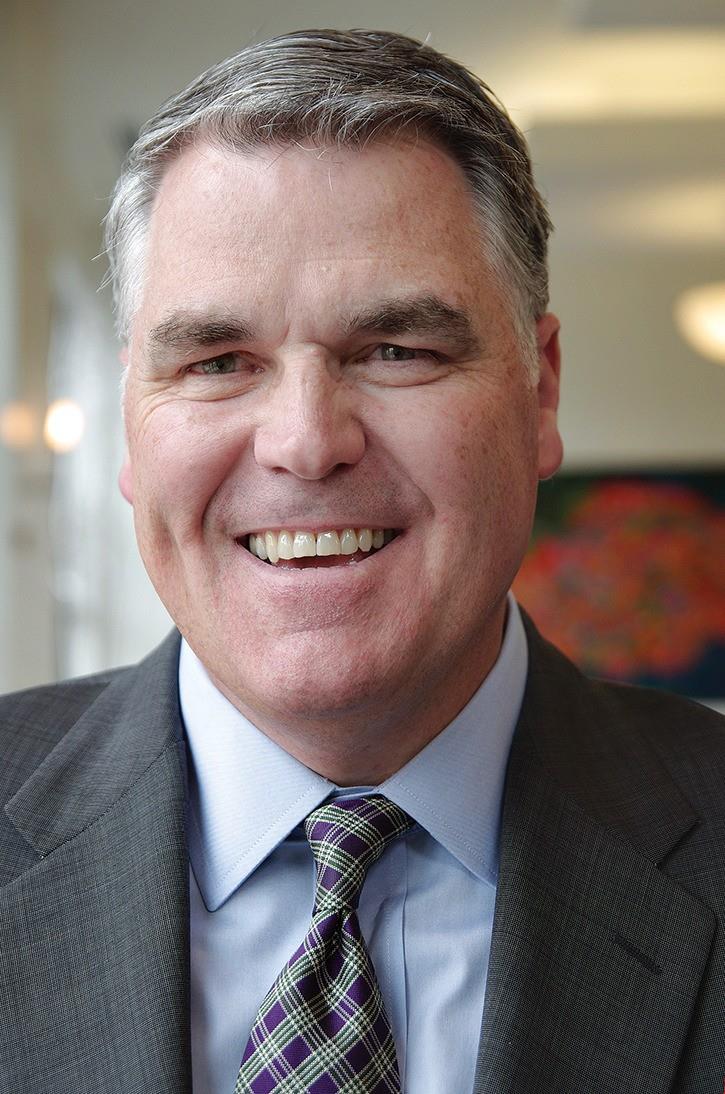
Chris Motion introduced Jim Allworth, a strategist at RBC Securities. Jim has been a long time resource for Chris and always has good information to impart.
Jim began by saying that when thinking about the times we are experiencing now, the word that come to mind is uncertainty. For a bit, there was massive uncertainty. It has taken a toll on the economy and financial markets and it’s hard to see where we go from here.
Some conventional wisdom: Remind ourselves of how quickly things changed – January to mid-February the stock market was going up. COVID seemed to be China’s problem, there had not been a direct hit on Europe nor North America.
Well minds changed very quickly after mid-Feb. Went into deep dive in the stock market. There was a wholesale revision of expectations for the economy. Ideas started developing on projections of how things will proceed with respect to the virus. As things declining then loosening restrictions. Cases are decreasing faster, new deaths declining even faster than new cases, at least in the Western world and the EU. The trajectory of the virus and its impact has changed. It is unlikely that there will be any further surge of demand with the related demand for healthcare and swamping of resources. As the number of cases fall, the issue turns to reopening and restarting the economy.
Opening has gone beyond discussion.Trump & the US put pressure on regarding opening restrictions. Reopening is underway whether appropriate or not. Still don’t know where the virus will track. There is talk of second wave. Virtually all pandemics, except SARS, this has been the case. When we get there, we won’t be facing the same dire issues, e.g., lack of equipment (PPE access, ventilators, hospital preparation, medical experience for treating, treatments being developed).
Vaccines are in development. At least one anti-viral has gone to clinical trials and looks promising. Lots of others being tested. 40-50 vaccines under development. Big pharma companies are ramping up production so once approved will be able to get quantities out there as quickly as possible.
All of this has a calming effect on populations.
In March, the financial markets had frozen. Central banks, governments stepped in and have provided tremendous liquidity to allow the markets to function, heading off a credit crunch. There was a sparked fiscal response (US, Can, JP, Europe) to protect jobs, keep consumer floating. Though we don’t know how effective the fiscal response to the direct government aid to help businesses and individuals get through the gulf will be, we are headed in the right direction economically. Will be a long haul; 2nd quarter will be the abyss, 3rd quarter in July see some recovery, 4th quarter
It will be at the very earliest, the end of 2021 into 2022 before we see full recovery, maybe even not until the end of 2022, into 2023. Scaling back expectations for corporate earning. Plenty of ways that we are getting curve balls thrown at us. On the other hand, it may be that well see some unexpected good surprised. Anything that produces increased confidence to the consumer will help the broad economy.
Markets could be impacted by other factors as well. E.g., Italy, a large country with more deaths, other than Greece, per capita to date. They have done particularly well financially. The Italian debt crisis could prompt another credit crisis. Another example, Mexico, a country most dependant on oil and tourism, both of which are in the penalty box. It is very possible that we could see Mexican debt as a problem. A possible Mexican default will definitely spoil the party.
One of Jim’s colleagues has a favourite saying, “Never one cockroach.” Things can be difficult and then can become more difficult because of these things we didn’t see or anticipate happening.
We think the markets have behaved remarkably well. It doesn’t seem to be behaving in a way that makes sense to people. It’s going up every day. This is what happens with a bear market. Economy is shrinking, earnings are shrinking, markets are going up. Turns out investors are looking at long term value, vs short term.
We’ve had any number of important disturbing events over the last 100 years – wars, nuclear disasters, strikes. When they were over, they were over. They did not cast a long shadow over the economy. The Spanish flu was much worse than COVID; it predominantly killed young adults, and it happened on the heals of a world war. And yet, the economy was back up and running a year to a year and half after it was over.
This was also true of the great depression. Most people think with the crash in 1929, the market continued to fall into 1933. World war II brought the markets back. In 1934 the economy grew by 11%, 1935 by 16%, 1936 by 11%, and 1937 by 7%. Would have gone on growing except US gov’t put limits on it that put a stop to this growth. It wasn’t the war that pushed it.
Saying that when they are over, they are over and these events don’t cast a long shadow on the economy, they certainly do cast a long shadow on people’s perceptions. The latest recession was over in 2009, most people didn’t believe it. Same goes here – the world will never be the same. If that’s the case it will be the first time ever.
Most likely 2022 things will be back running well. If you are thinking of buying a business, thinking of future profitability, over coming years. Well think about it this way: if you blow up this year and next year’s earnings, they still have a huge proportion of that business to look forward to. For the current situation to make a permanent loss, you need to make a crazy large loss. If you look forward, normalcy will still be a lower growth rate than in the last dozen years or so, but will grow.
One question: concern over business and government deficits – not too concerned. Everyone is in the same boat. Shorten a recession, and avoiding a depression would be valuable. Cost of financing is low meaning the cost of carrying this incremental debt is minimal to the country. Only problem they should do more long term financing, e.g., 50 year bonds. Canada went into this event with a pretty healthy balance sheet (debt to GDP). There is worry is that it could create an inflation problem in the future but if so, it is probably 2-5 years out. We have blown the doors off with current situation but so has everyone else.
So far, so good.
Inflation is always a result of too much money chasing too few goods. Recall after the financial crisis ended, it didn’t happen as predicted. Missing link, lots of money, but there was also lots of goods available. Today there is real money printing-handing money to businesses and people. Still not too few goods, with the economy shut down. Need to get consumer and business spending ramped up to get rid of excess cash available.
The breakdown of global supply chains is perhaps a potential for inflationary potentials, but not drastically so. Changes happen, businesses plan to work differently to compensate. It is really more of a political issue.
With regards to the Canadian energy sector, they are working against a lot – limited access to markets, collapse of demand. Our own forecast looking at oil high $30, predicted low $40s next year. This still won’t be enough to resurrect the industry in Canada. Most development opportunities we have are high cost… long slow grind. Energy industry around since 1850, has always either been boom or bust. Busts have been progressively longer over time.
Forecast for CDN$ vs US$: currencies move around mostly because of relative interest rates. Capital flows across the border are significantly larger than trades. The control is with Central Banks who set the rates. For a strong Canadian dollar, you need some expectation that the Bank of Canada will raise rates faster than reserves. Central Banks are committed to keeping rates low for some time. The view for our dollar will remain low for some time.
The markets are saying things are strong now, the economy says otherwise; is this a concern? Markets never say anything that you should count on. They are a rough approximation of value over time. A lot of the view regarding it being overvalued was based on what it was at the end of March. Trying to square the circle of markets vs economy is a never ending exercise. Focus on the long term, short term is too uncertain.
All that said, there is a reasonably optimistic view moving forward.