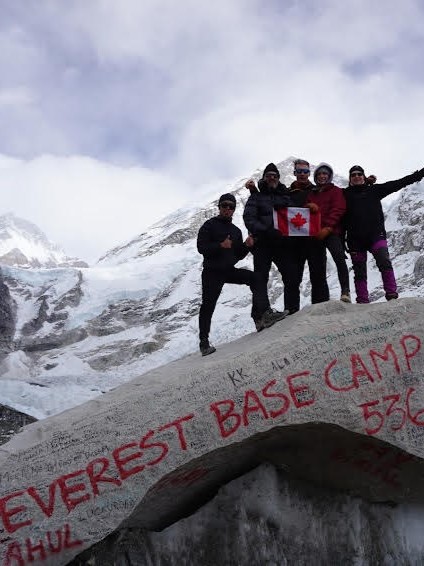
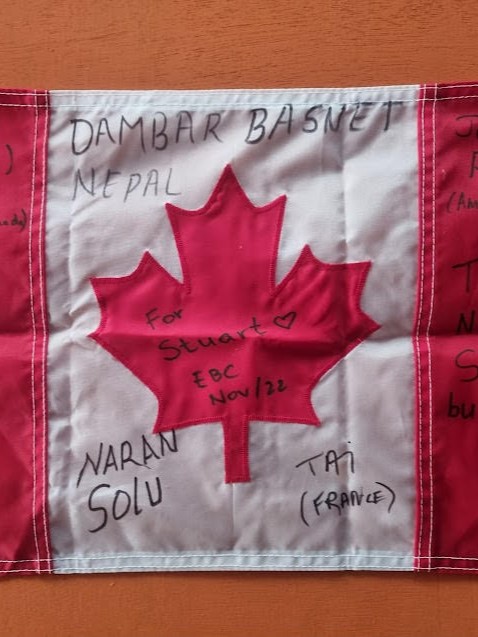
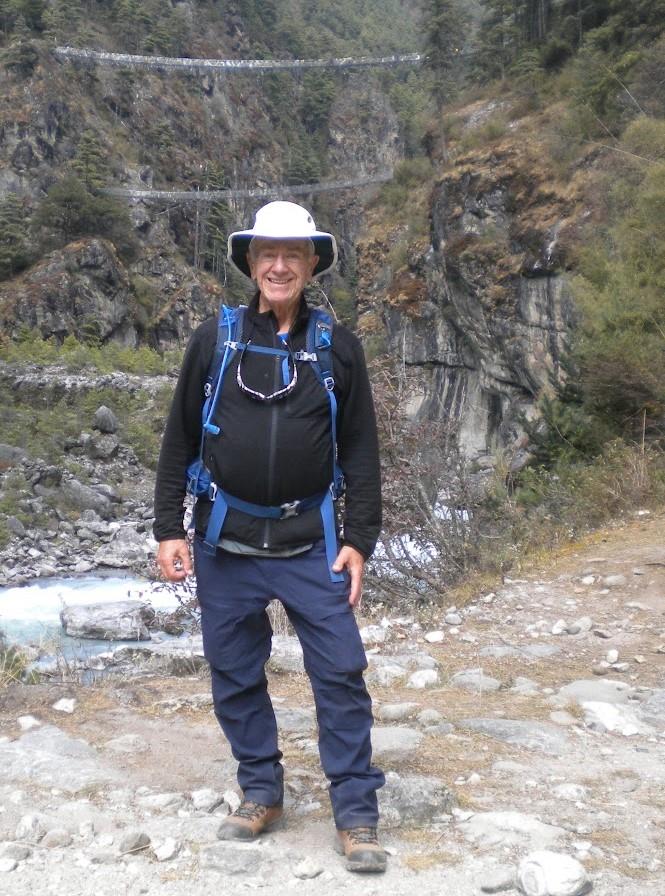
Stu went on the trip, trekking to the south Everest base camp in Nepal, with another couple from Pender Harbour. It was exciting and such a memorable experience. Between then, when all was told, they had over 5,000 pictures.
They arrived in Kathmandu after a 26 hr plane trip. Kathmandu is sprawling city with a population in the city and surrounding suburbs of 2.9 million. It is one of the oldest “continuously inhabited places in the world” (per Wikipedia), founded in the 2nd century CE. It is home to various religions, various ethnic groups, and various languages, with most able to speak English.
With the mass of people moving about constantly the air is usually quite polluted, however, on a clear day you can see Everest from the city.
In 2015 the city experienced a massive earthquake that left almost 9,000 lost lives and very significant structural destruction. Though the rebuilding efforts have been ongoing there is still evidence of the damage to be seen.
The trekking group Stu was part of was quite an eclectic group of 15 who hailed from various parts of the globe. They started with a flight to their trail head in Lukla once weather was good enough to go. Lukla sits at a little over 9,000 ft (2.8K m). It is a small town where trekkers start the journey to head to the next village, Namche Bazaar, a two day trek away covering 13.5 km.
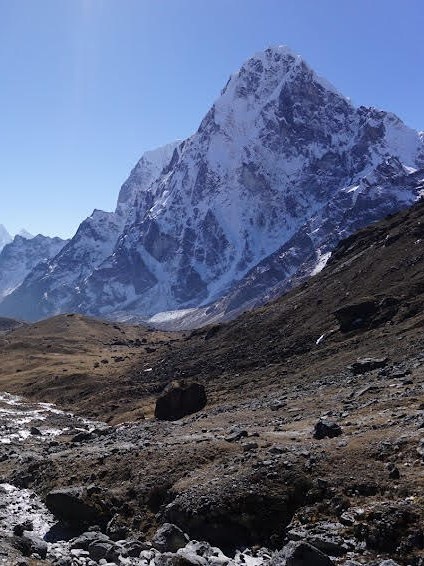
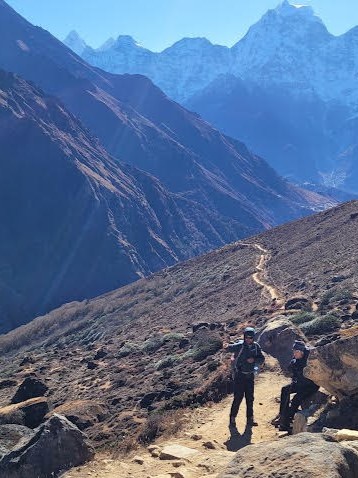
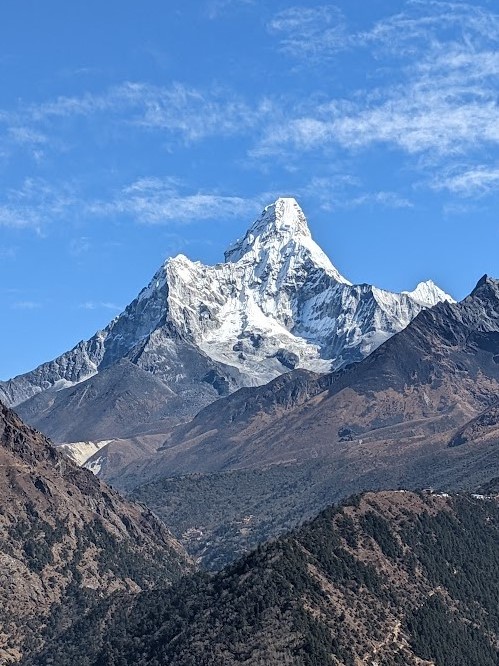
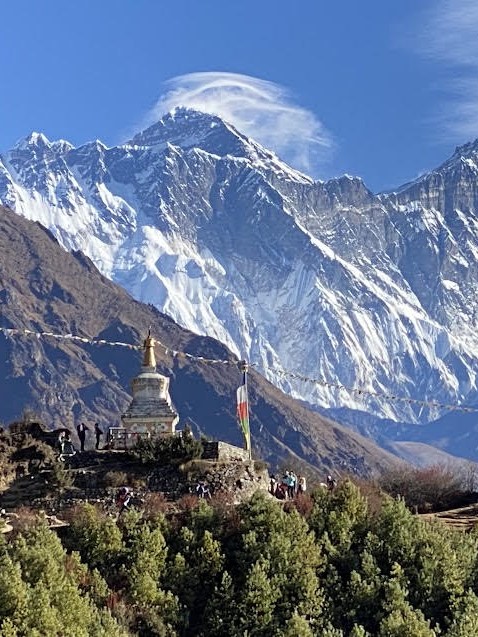
The trails are busy; there are prayer flags everywhere. The terrain is challenging – cart path, lots of rocks, definitely rugged. There are lots of suspension bridges to cross. The scenery is absolutely spectacular.
The local population is working hard to encourage all trekkers to keep the area clean. What you take in, take out, including water bottles, oxygen bottles, etc.
Interestingly there were toll gates along the way. Toll gates along the way. Need to be prepared to make the necessary payments.
One of the highlights was to cross the Hillary Suspension Bridge. It was deceivingly close to look at, on two miles away. It took 2.5 hours to travel those two miles. The elevation certainly affects your body and how well it functions. The bridge is about 125 meters high providing some gorgeous views. Just thinking of following in the footsteps of such a great man, Hillary, was awe inspiring.
Namche was only 2 more hours or so from the bridge.
There is a hospital up there, mainly for the use of the sherpas but can be used by everyone. Namche Bazaar is the highest altitude town at about 11,200 ft (3,440 m). It is the main trading center for the region. It is here where trekkers work on their altitude acclimatization. There are lots of bakeries, cafes, restaurants, and supply vendors. Definitely a place that caters to trekkers.
Part of the group went to the Hillary lookout, a 2.5 hr hike starting off with 180 stairs. Unfortunately Stu lost the group along the way and missed the turnoff. So he went off on his own short walk in a different direction, eventually meeting up with the group back at the town. This “mini” trek gave the group, both from the Hillary lookout and from Stu’s vantage point, their first real view of Everest.
One could see memorial stones along the way. One of the most popular ways of disposing of bodies there is cremation. These stones are a remembrance to those who have passed.
It was after Namche that the vegetation changed. They were moving above the tree line and with it came sparce vegetation. They walked up, they walked down. There was no straight course. Other checkpoints along the way; more stairs, more stairs, and even more stairs.
Elevation sickness started affecting some of the trekkers. It was getting tough. They were about 14,000 ft. and it was getting colder. They were tired and cold. When resting it was natural to basically curl up and look down trying to revitalize, warm oneself, and gather to energy to continue. Here was one of the things Stu learned: he passed a Swiss guy who was on his way back down. He said, “Don’t look down at your dirty boots, look up and take it all in.” Sage words as all around was absolutely spectacular views that cannot be seen anywhere else in the world.
They arrived at Gokyo Lakes in the Sagarmatha National Park. These lakes are 15,400-16,400 ft (4,700-5,000 m) making them the highest freshwater lake system in the world.
Finally they reached approximately the same elevation as the south Everest base camp in Nepal, 17,598 ft (5,364 m). They were testing everyone’s oxygen every day. Two fellows got altitude sickness. One had to medi-vac out, the other had to trek down to lower altitudes.
Faced with another two day trek, each 12 hours, to make it to the base camp. 5 of the 15 trekkers made it to the top. Stu decided it was best if he stopped his journey at this point. He chose to helicopter back to Lukla, then on the Kathmandu. It took 7 days to hike up and only 12 minutes to fly down. A decision he definitely does not regret. It was a fantastic journey. Maybe one he will do again.
So where did his talk title come from? Every place you went you could get lemon ginger tea. It always had bits of ginger in it which was understandable but where did the lemon come from? The response was “Easy peasy, lemon powder”.

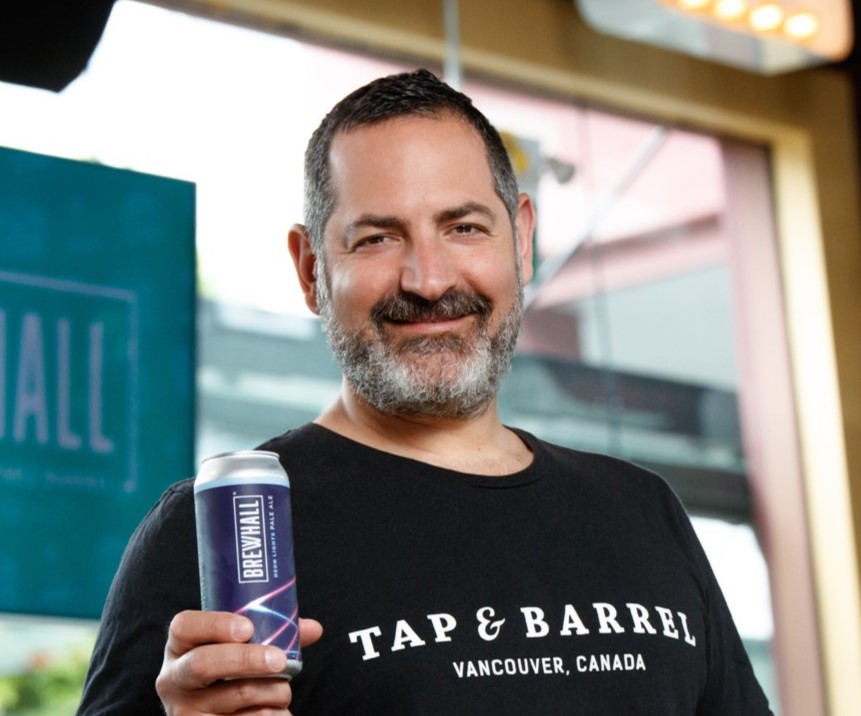 One of the hardest things for any founder and entrepreneur is to “let go.” The only way to fully scale an organization and set it up for sustainable success is to empower others; to put the right people on the right bus in the right seats. Once you create a high-performance culture and put the aces in their places, the possibilities are endless! Daniel Frankel, Founder and CEO of Tap & Barrel Group will share lessons from his journey which ultimately taught him to put his faith in others and made him realize that he’s only truly successful once he renders himself obsolete.