Jim Evans introduced this week’s speaker, Micheal Vonn, CEO of PHS Community Services Society (PHS). Her topic was Radical Pragmatism – Bringing a Harm Reduction Approach to the Crises of Homelessness and Overdose Deaths.
PHS Community Services Society provides housing, healthcare, harm reduction & health promotion for marginalized people. They are North American pioneers in their approach to low barrier housing and harm reduction services. They provide supportive housing with “wraparound” medical care and mental health supports as well as safe consumption sites, medical clinics, affordable dentistry and a credit union branch.
PHS started the 1st legalized drug injection site in North American, Insight. It was founded in 2003, has had over 6,000,000 supervised visits, and has successfully intervened in over 6500 ODs.
These are difficult subjects: opioid poisonings, homelessness, mental illness. What is the way ahead for a highly marginalized and stigmatized community?
Opioid poisoning is distinct from past drug issues. Since 2016 we have seen a medical emergency situation where toxic drugs are the leading cause of deaths for those aged 19-30. The drugs themselves are becoming increasingly deadly. We are on track for over 2,000 avoidable deaths this year.
Providing safe alternatives to toxic street drugs is a gamechanger. The solution to lethal drugs is non-lethal drugs. Safe supply brings stability to chaotic lives. Opioid agonist therapy – offering opioid alternatives (methadone and slow release oral morphine) to provide some stability in the lives of those dependent upon the drugs. It is evidence based that this approach reduces OD deaths, related medical issues, and reduces criminal activities. However, more of these approaches are needed.
SAFER supply is a broader program. It catches those who are not eligible for the opioid alternative programs. There has been a soft launch already with the official launch to be in early 2022.
Supportive Recovery Programs are run both in Victoria (a 22 residential program) and in Vancouver. It is a different approach in that it’s not an abstinence based program. It supports respite and/or transition to therapies. It does include 12-step program which is optional if clients are ready for it and want it. The thought is that this is to be a stepping stone to full recovery.
In Vancouver the supportive recovery centre is Onsite, works with Insite, to provide respite. It provides medically supported detox and post detox recovery. There are additional indigenous wellness programming, leading to permanent housing.
PHS has the ability to move people through the continuum of their services to full recovery.
Canada is a world leader in managed alcohol programs, something not well known. The low profile programs are currently running in 20 cities in Canada. Community Managed Alcohol Program (CMAP) is a program applying harm reduction principles to alcohol consumption. Engaging people who may otherwise be consuming non-beverage alcohol – substances not meant for human consumption (e.g., hand sanitizer and mouthwash). It works to establish healthy boundaries with alcohol and help manage medical issues. The program substitutes limited amounts of beer and wine, brewed by participants themselves, daily along with medical supports. Using research supported interventions, the program increases quality of life, decreases the use of medical services, interactions with police, and violence.
In Vancouver, seniors are the fastest growing demographic experiencing homelessness. Seniors are being seen throughout the continuum of services. More and more in local encampments in and around the city. Shelters are not an answer to homelessness. It is, however, a bridge between homelessness and homed.
In Victoria, PHS used modular semi-enclosed living spaces within an arena during the most acute times of COVID. It demonstrated a quick way to move to stability, over 50 people moved from here to permanent housing.
They are using the same model in one portion of the old Army & Navy store in Vancouver – a 70 bed shelter open 24/7. What makes it so successful is the stability it brings to individuals.
PHS also runs the New Fountain Shelter, a 16 bed unit. It is a leader in best practice for generally low-barrier shelters. It is unique in that it brings in those who are turned away from other shelters. Couples can stay together. It is co-ed with some separated areas. Pets of all kinds are welcome. Critically, street drugs can be brought in. They encourage open use of drugs as they want to be able to respond quickly if needed to prevent OD deaths.
One of their proudest initiatives is the Pigeon Park Savings bank. It provides access to basic financial services to people living on low incomes on the downtown eastside, is supported by VanCity and is run by PHS on Hastings Street. They use a low barrier strategy and have approx. 4,000 members. The 1st and often repeated step is getting individuals proper identification. Tis is a huge portion of their work. The staff are not bankers, but rather individuals whose primarily training is in mental health issue support and then financial education. It was the only bank open in the downtown eastside during the worst of COVID shutdowns ensuring their clients were not left stranded.
Pigeon Park Savings has been such a success at providing basic services. It is a huge point of pride for their individual clients to be able to manage their lives at this basic level.
It is important to provide friendly and accessible community resources all along the continuum of care. One of the primary things PHS focusses on is that people are met where they’re at. They work at community building among the most marginalized of us.
If you’d like to learn more:

 Kristi Blakeway, a principal from Maple Ridge, will join us with one of her high school students, Maya. They will be share their advocacy work in Greater Vancouver helping homeless citizens reconnect with friends or family through greeting cards, phone calls and face to face reunions. Project HELLO (Helping Everyone Locate Loved Ones) was meant to be a one day fieldtrip but has spiralled into more than a decade of giving. To date they have helped over 900
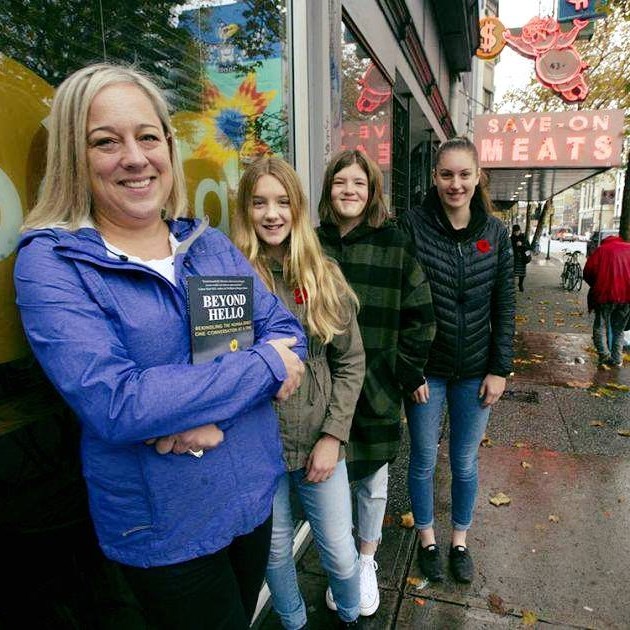 people reach out to friends or family. Their talk will remind us all to connect with compassion -- every one of us has a story worth hearing.
 Alison manages discretionary portfolios for private clients and clients in the non-profit sector. Her focus on comprehensive wealth management brings in elements of financial and estate planning. Alison develops an understanding of her clients' financial goals and personal values in order to identify their investment, retirement, tax and estate planning needs. She then creates a customized strategy that is monitored and adjusted to accommodate the changing market environment and the evolving needs of her clients. Communication is an integral part of this approach; her goal is to gain a thorough knowledge of her clients' financial affairs so she can provide valued advice for the management of their wealth. She has a personal interest in the non-profit sector and is actively involved in several organizations in her community.