
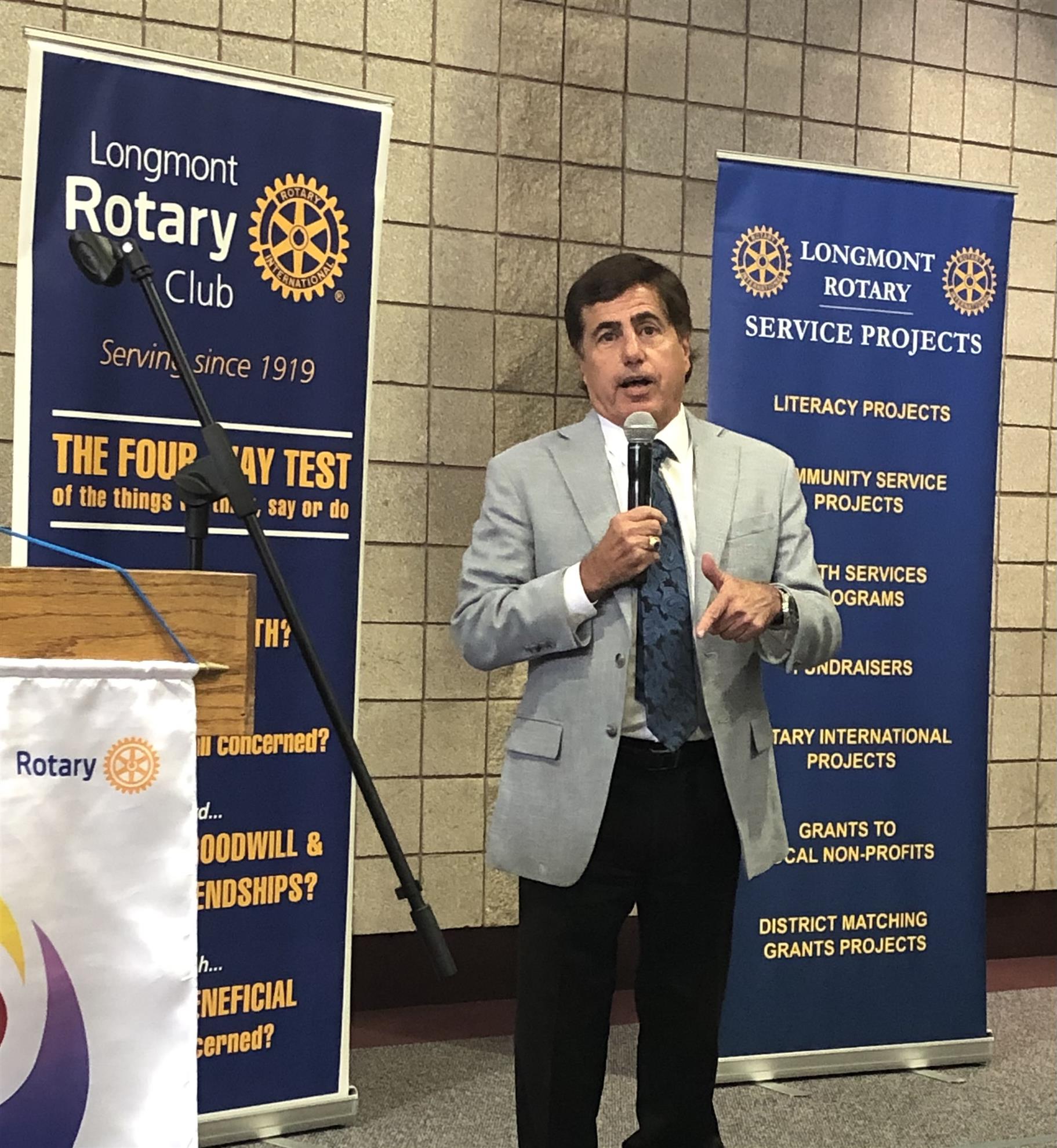
 It’s very evident that Dr. Don Haddad loves his job. His passion is reflected in his message and love for the St.Vrain Valley School District (SVVSD). Dr. Haddad, spoke to Longmont Rotary on August 8th at their weekly club meeting. He has served 40 years in education with 23 years as the Superintendent of Schools for SVVSD.
The school district is a “preK through 14 system”, which translates into significant academic opportunities for students. For Dr. Haddad, early learning is essential to a students academic success long term. All 28 elementary schools have a high quality preschool program with a certified teacher. The state of Colorado just adopted Universal Pre-K, and full day kindergarten, however, SVVSD had already been doing this for over 15 years.
“We have Alignment in our standards, curriculum, our instruction, and our assessment, which makes for ‘a system by design’. No matter where you go to school in this district you can count on a consistent learning experience”.
Dr. Haddad closed some of the sub-par school buildings. “Students need a quality space to learn, one that is safe, bright and warm, offering the elements that can promote learning and encourage a student and teacher to want to be there”.
The vast majority of St. Vrain high schools offer over 20 advanced placement courses. All the middle schools offer algebra, geometry and honors courses. The district also has a multitude of career and tech programs, offering students a head start to their career path. Students can also earn an Associates degree through the P-tech (Pathways through Technology) at no cost to the student.
Dr. Haddad spoke about the national fixation with school student test scores, which he added does not provide an accurate reflection of what is really happening in schools.
“SVVSD graduation rates are nearing 94% with Hispanic graduation rate nearing 90%. Drop out scores continue to be low, 0.8 % even with a third of our students living at or below the poverty line”.
Dr. Haddad closed with this..” All this is important for building up our communities. If kids don’t graduate they are more likely to get in trouble or experience incarceration. We need our schools to succeed. It is integral to a successful community. Nobody wants to move into a neighborhood with failing schools. The future of our country is dependent on our kids. 90% of our kids are in public school. Second only to parenting, the future of our country is dependent on our public schools.”