
When Jason Vallery took the stage at our recent Rotary meeting, he brought both a big personal announcement and a eye-opening look into the world of artificial intelligence. Vallery shared that on August 3, he is officially launching a Front Range AI consulting firm alongside his son, a computer science student at CU Boulder, to help regional businesses roll out and scale AI technology effectively.
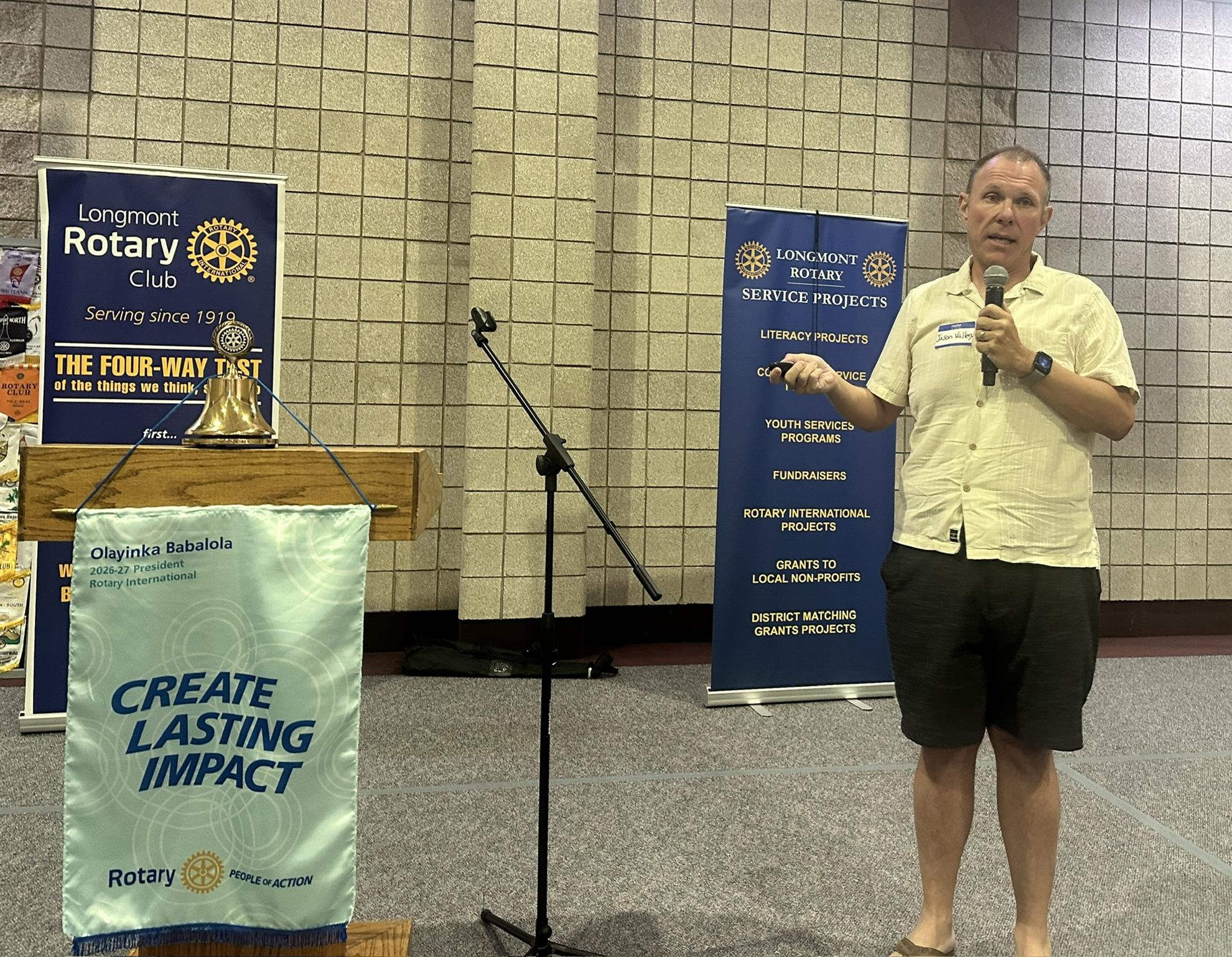
He painted a vivid picture of how rapidly the industry is moving, pointing to OpenAI’s massive supercomputer in Texas that quadrupled in size over just 18 months to prepare for training next-generation models like GPT-7. Innovation is no longer waiting on clever algorithms; it is now driven by raw computational power and data access. Addressing common environmental concerns, Vallery demystified data center operations, explaining that modern facilities have replaced water-intensive evaporative cooling with zero-water industrial heat pumps. However, because today's massive gigawatt-scale power demands exceed standard electrical grids, facilities are increasingly powered by on-site natural gas microgrids—a reality that makes energy access the main bottleneck in the global AI race with competitors like China.
Vallery brought the technology home by showcasing local, real-world applications. He highlighted a project with Longmont's Sunshine Club, where AI transcribed and organized over 10,000 historical handwritten cursive notes into a fully curated historical timeline, biographies, and financial records. He also shared how he uses AI in his own greenhouse to analyze weather forecasts and automatically fine-tune climate controls for optimal efficiency.
Ultimately, Vallery reframed how we should view AI: not as a replacement for human judgment, but as a force multiplier where one person can direct a team of AI agents. While AI excels at research, coding, and routine tasks, critical decisions requiring morals, ethics, and human connection remain uniquely ours. Looking to the future, Vallery suggested that access to AI computing power will eventually need to be managed, governed, and distributed much like a public utility.