
5/15/15 Cyber Security, Dr. Glenn Wilson
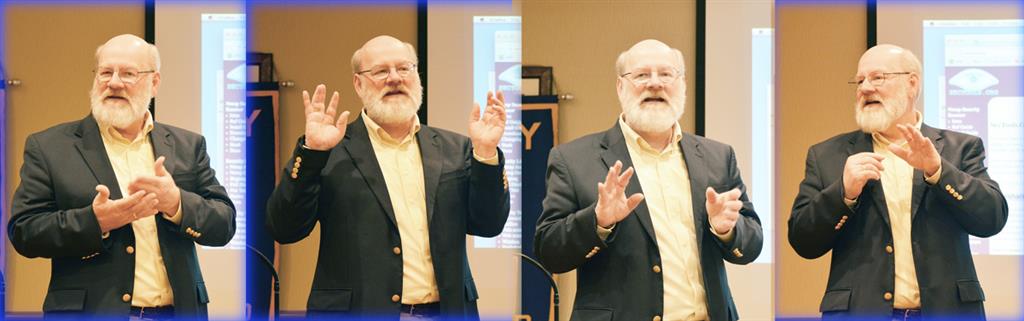
When you hear the term “hacking,” you think of the email you got last week from an “old friend” who asked you to open an attachment that clearly did not feel on the up-and-up. That’s the easy one to spot. Last Friday, we heard from Dr. Glenn Wilson, a USM professor who provided just enough information regarding “phishing,” “hacking” and “exfiltration” to concern and perhaps scare each of us. With worldwide organized crime now making more money on cyber attacks than drug deals, this topic is not going away any time soon. So, rather than ignore it and “hope for the best,” we were warned to expect cyber crimes and, for our own protection, to learn how to recognize them. “Hacking” has been around since folks tried to decipher the Morse code at the turn of the last century. But, in the last decade, since the explosion of the internet and personal computing devices, the efforts to steal personal information (ex-filtration or data extrusion) have grown to the point whereby the largest theft on record involved over one billion emails. With the very public and publicized thefts of data from Home Depot and Anthem in the past year, internet security has become part of the lexicon of daily life in the U.S. In Maine, the government website was hacked just last week.
While much of the early crime was attributed to disgruntled employees looking for “payback” against employers, the current wave of internet criminals are very well educated and fully funded by organized crime or even nation-states throughout the world. Social media and point-of-sale purchases are regular conduits for attacks, which can take many forms. Hundreds of online tools are available online for the individual to protect him/herself and can be found at sectools.org.
The individual is still vulnerable to simple attacks, such as “teasing” information online or even in-person chats and, much more often, the “phishing” emails that we all receive and are still tried and true methods of gleaning data that can be used for fraudulent activity or to produce chaos. State and Federal government offices continuously seek solutions and attempt to offer some protection to companies, individuals and, perhaps most importantly, to our nationwide operating systems. President Obama’s 2012 Executive Order to seek “Critical Infrastructure Protection” aided in the fight but, in reality, we are still vulnerable to a major cyber event. This could come in the form of an electromagnetic pulse released in the outer atmosphere (ominously called an “EMP Cannon”) or some other global event whereby the internet or major system is attacked by the newest form of terrorist, one who simply points and clicks.
|
Links to Cyber Security information:
Visual Representation of Current Attacks (Now) History of Hacking, ciphers, cracking, and ?
Formal History of computer hacking:
Click Here Hacking from the inside? Big hacking from the outside? Reliable Sources: Snowden, hero or traitor? |