04/03/15 Gulf of Maine Research, Don Perkins, Ex. Dir.
|
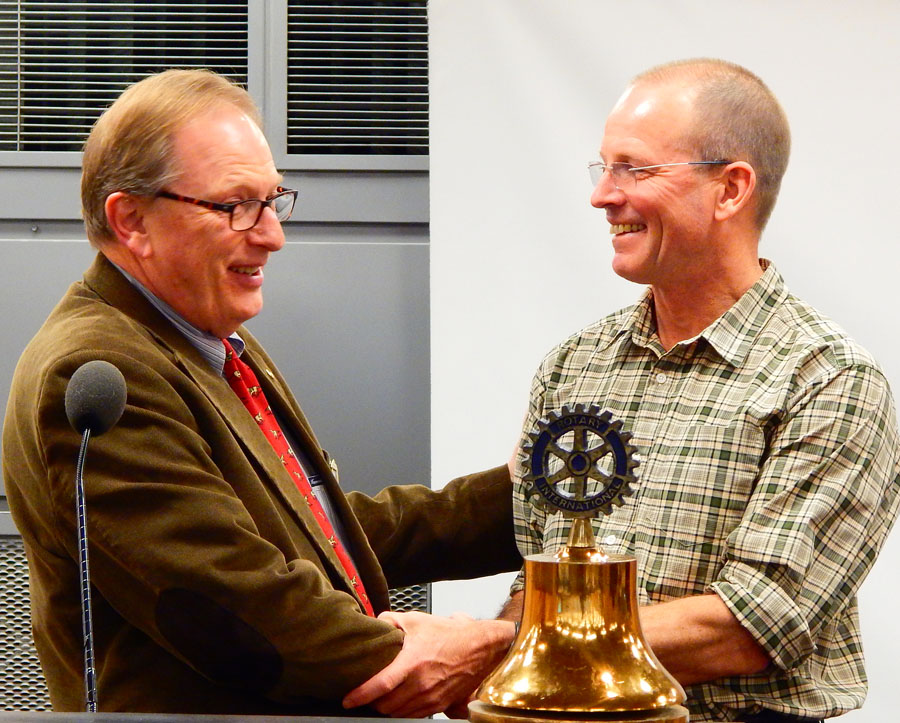
(Photo: Bob Martin and Don Perkins) |
Bob Martin introduced our program speaker, Don Perkins, Executive Director of the Gulf of Maine Research Institute (GMRI). Don shared with us the workings of GMRI and the impact that it has on the state and the globe. “We live on an ocean planet,” he said. “two-thirds of the planet is water. The next century is an ocean century. How the ocean changes and adapts is the focus of our challenge.” |
Don shared that GMRI has an operating budget of about $8 million annually, and is known internationally for its education and research programs. One of their major initiatives is a program for 5th and 6th grade students to help them learn more about science and math. “We want to get them engaged before they reach middle school,” he said. “We are committed to driving Maine as a science and math state.” Don said that the GMRI program involves students in various labs to get them involved in world-class research. “Through the state’s laptop program, we can continue the lab work with the kids back in their classroom, so they can participate in efforts to solve problems in science.”
Don described the monitoring system GMRI maintains in Casco Bay as part of their effort to unravel the mystery of fishing stocks with the assistance of fishermen who volunteer to participate. “We have twelve lobstermen who volunteer to work at night to run a search for herring,” he said. “They are the key to the ecosystem.” Knowing the condition of the herring population helps to determine the future of lobster. “One of the outcomes of this work has been to help retool fishing gear. This has the potential of increasing the value of sustainable fishing in these waters by $160 million through redesign.” Don also reported that projections for increases in aquaculture revenues were substantial as the industry developed more sustainable methods of harvesting. “Kelp, mussels, seaweed are now a $3 million industry, but have the capacity to be $100 million.”
Don said that despite reports to the contrary, the ocean was very productive. “Even though some species, like cod, are declining, red fish, pollock, and others are abundant.” In response to a question about haddock, Don pointed out that haddock supplies were increasing, as were scallops, due to the combination of currents and temperature helping to create a situation where larvae were able to stay in one place long enough to grow and strengthen. “This is research that’s really important for us,” he said. “What sets us apart is the integration of skills from science, education and the community.”
GMRI’s research also helps to develop forecasting tools to help fishermen adjust their harvest times to avoid oversupply in the marketplace, which leads to lower prices. He also pointed out that fisheries are in transition. “We’ve traditionally thought about each kind of fishing separately. That’s old news,” he said. “The aquaculture industry is now driven to think collaboratively.”
Finally, Don said that while this is an ocean planet with global effect, GMRI is focused on creating solutions that have a local impact. “That means, however, we are involved in projects in Indonesia, Chile, the Gulf of Mexico, and are involved with technology transfer with universities in Texas. Maine is an unbelievable place to operate from in a global context.”