AI and the Visual Arts
to view meeting: https://youtu.be/tEilWHTl0KQ
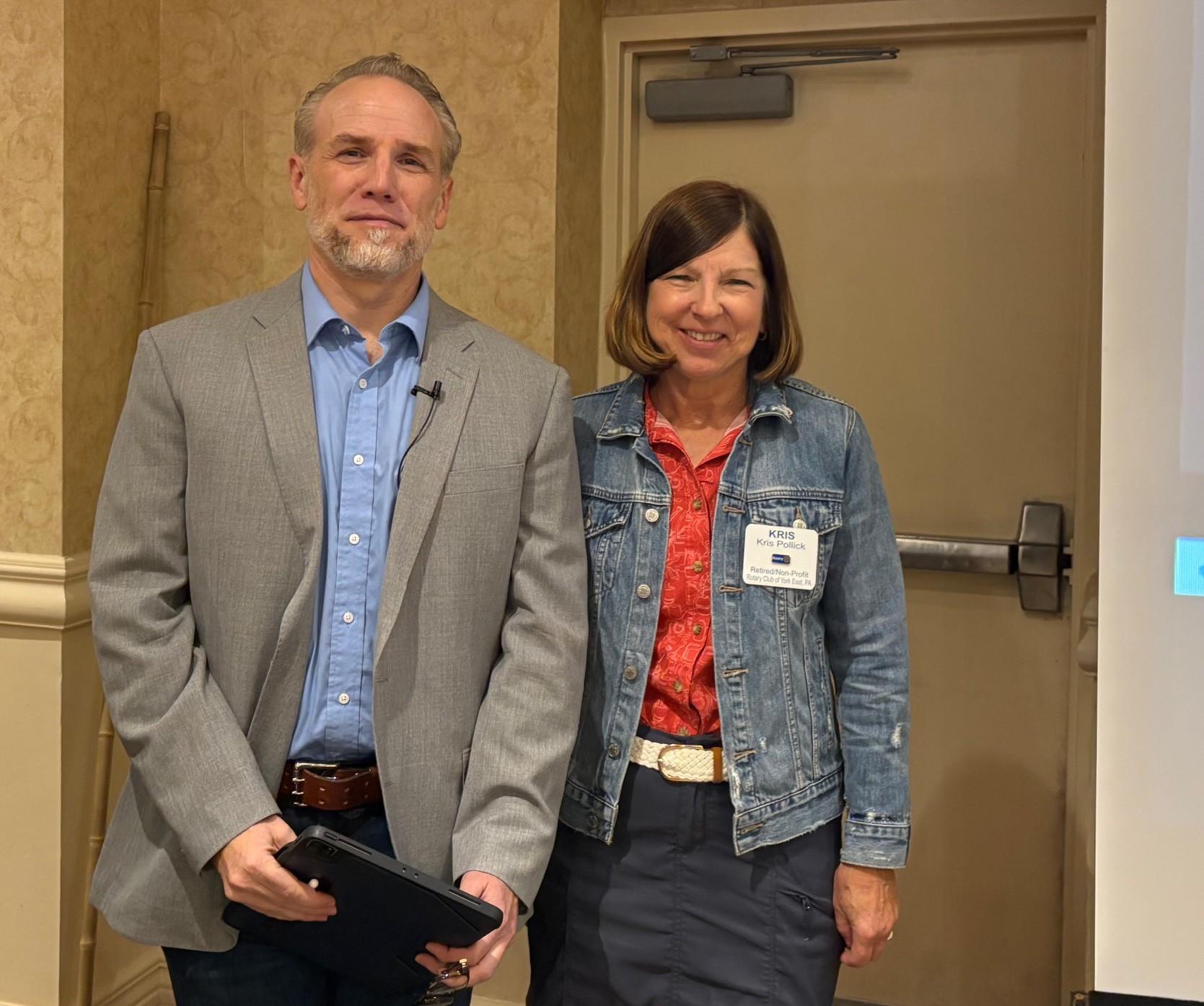
September 30, 2025— At its weekly gathering on Tuesday morning, the York East Rotary Club welcomed Professor M. Ry Fryar, M.F.A. of York College of Pennsylvania, who spoke candidly about the changing landscape of the classroom in an age of generative artificial intelligence. The artist-educator, whose official title is Assistant Professor of Art (Drawing and Painting) at York C Professor Fryar began his remarks with a reflection on his early years teaching traditional drawing and painting courses. In the decades since earning his MFA at the University of Minnesota, he has seen the visual arts expand well beyond physical media. That evolution accelerated rapidly with the rise of generative AI tools (e.g. image synthesis, style transfer, text-to-image models). Fryar said he initially approached AI skeptically, concerned that it might dilute the rigor and craft of studio practice. But over time, he and his students have discovered ways to integrate AI as a meaningful adjunct rather than a replacement.
He described three major shifts he’s observed in his classes:
Idea generation and iteration
Students often begin with a prompt or conceptual kernel and use AI image generators as a “sketching partner.” The AI can produce rapid visual variations, suggesting compositions, lighting, or stylistic treatments they might not have otherwise considered. Fryar encourages students to treat AI output as raw material to remix, deform, or reinterpret — not as finished art.Technical exploration and hybrid workflows
In upper-level courses, students might combine AI-generated base layers with traditional painting, drawing, or digital overlay techniques. One student, for example, used an AI-generated forest scene as an underpainting, over which they built delicate figurative elements by hand. Fryar emphasized that the tool choice should always serve the concept, not the other way around.Critical reflection and ethics
Perhaps most importantly, he ensures AI does not become a black box in the classroom. Students are prompted to question the biases, datasets, and creative limitations behind any model they use. Discussions include attribution, authorship, and when AI output might flatten or misrepresent marginalized visual traditions. Fryar sees that ethical literacy as as essential as technical fluency in this era.
Yet Fryar remained optimistic. He sees AI not as an existential threat but as a fresh chapter in visual tools, a new kind of “brush” in the artist’s kit. Just as photography or digital illustration once felt disruptive, he argues AI will settle into a normalized role in studio pedagogy.