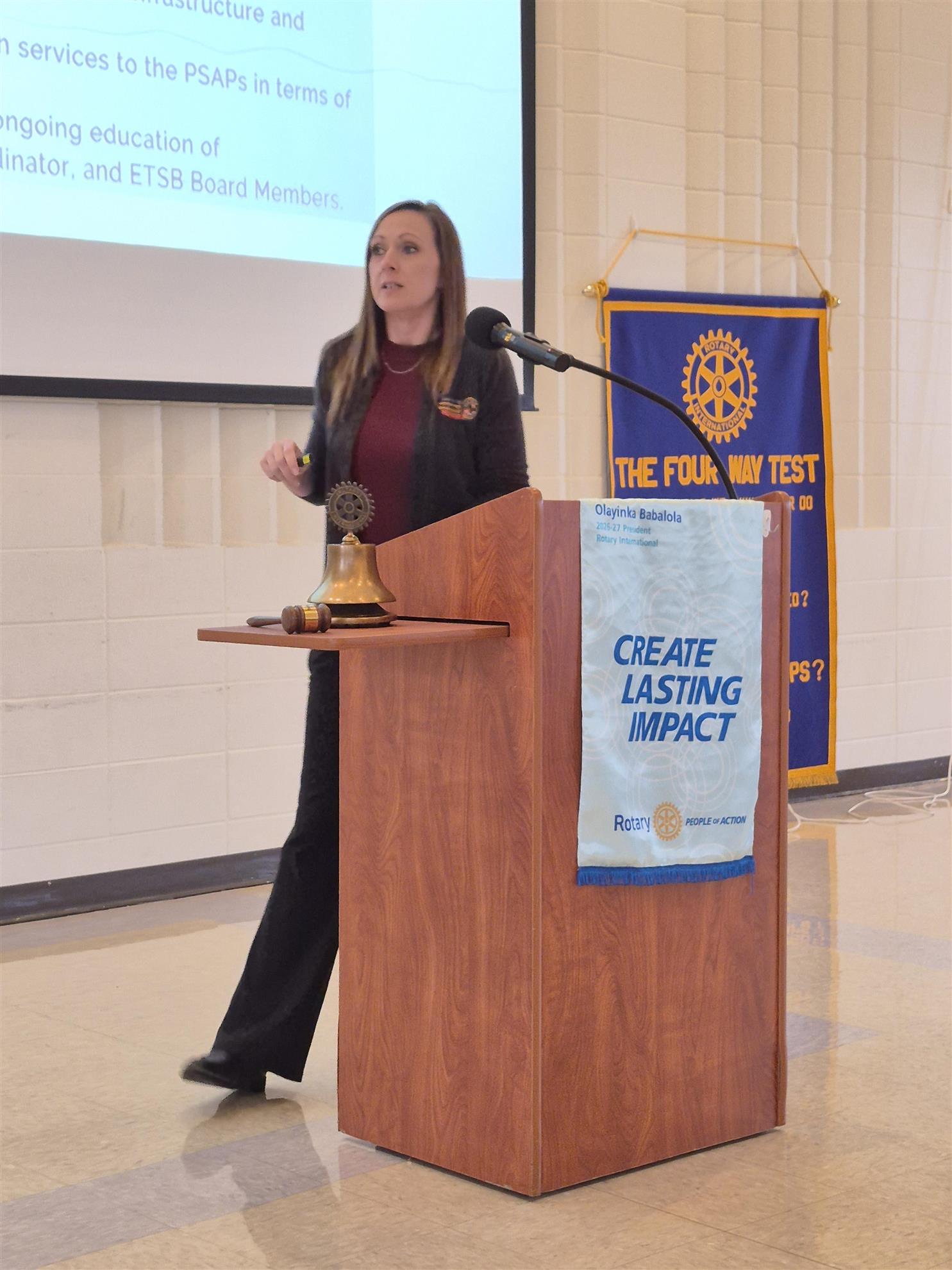
Heather Butler serves as 9-1-1 Coordinator for the DeKalb County Emergency Telephone Safety Board (ETSB).
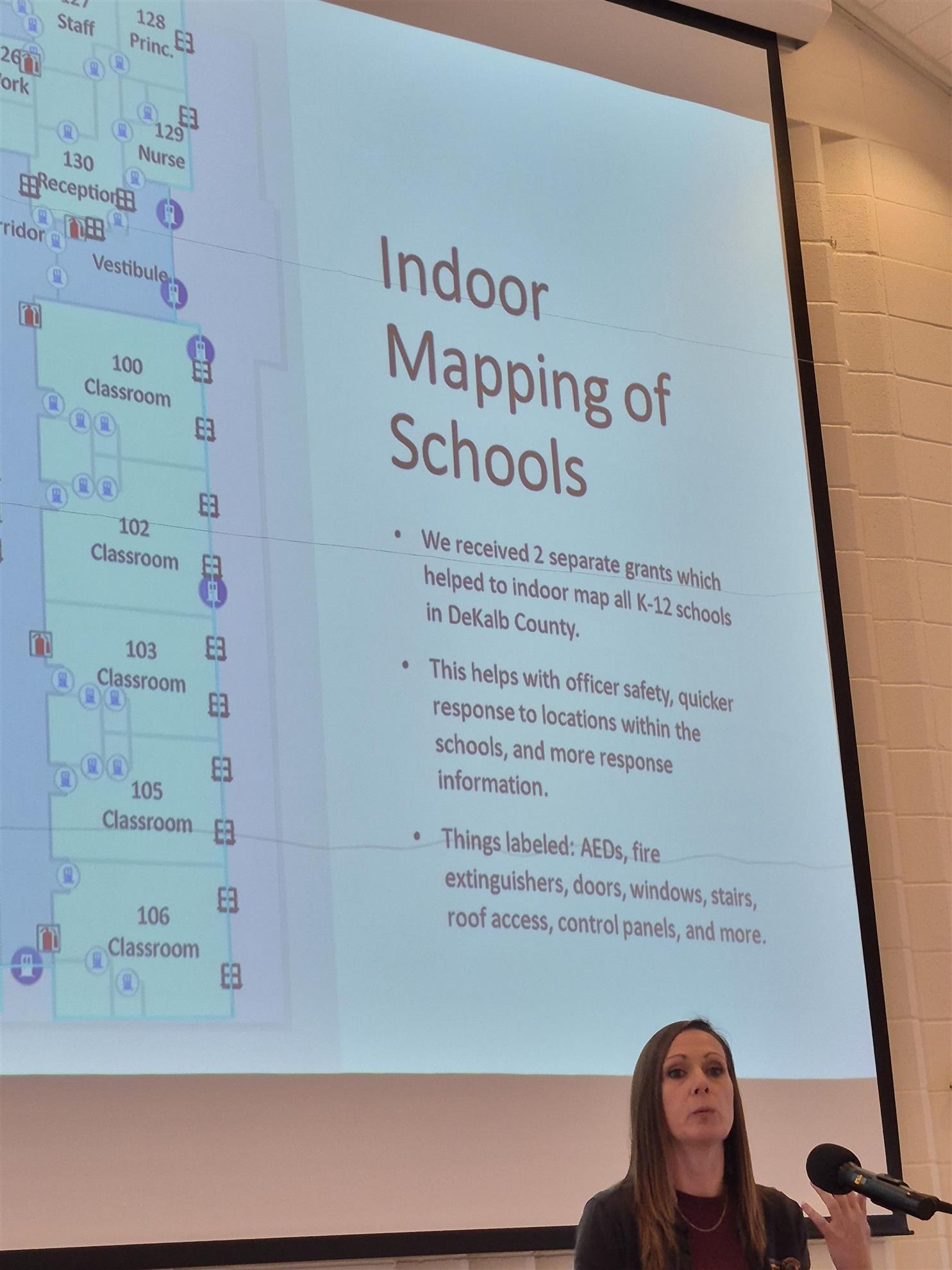
Heather tells club members about the effort to implement indoor mapping of floor plans for all K-12 school buildings in DeKalb County. The DeKalb County ETSB currently has grant funding to complete 22 buildings within Sycamore School District 427 and DeKalb School District 428. This level of mapping will help with officer safety, quicker response to locations within the schools, and more response information. Items mapped/labeled include AEDs, fire extinguishers, doors, windows, stairs, roof access, control panels, and more.
Heather Butler, 9-1-1 Coordinator for the DeKalb County ETSB (Emergency Telephone System Board), shared lots of great information with the club during her presentation this week.
Heather started her presentation with a few quick tips that we should all keep in mind:
Store emergency medical information and emergency contact in your phone; make sure you are sharing this information.
Set up a profile at www.emergencyprofile.org; when emergency information is shared in phone or via the profile, dispatchers receive this information via RapidSOS.
Check your phone setting to see the ways 9-1-1 can be called.
The DeKalb County ETSB has 11 members:
DeKalb County Sheriff’s Office, as designated by the Sheriff.
DeKalb County Sheriff’s Office PSAP, as designated by the Sheriff.
DeKalb Police Department, as designated by their City Manager/Mayor.
DeKalb Police Department PSAP, as designated by their City Manager/Mayor.
DeKalb Fire Department, as designated by their City Manager.
Sycamore Police and Fire Departments, as designated by their City Manager/Mayor.
Sandwich Police and Fire Departments, as designated by their City Manager/Mayor.
NIU Police Department, as designated by a Vice President or their designee.
Public Member for Northern Rural Communities, as designated by the Sheriff.
Public Member for Southern Rural Communities, as designated by the Sheriff.
DeKalb County Board Member, as designated by the County Administrator.
The mission of the DeKalb County ETSB is to efficiently and equitably administer 9-1-1 surcharge funding to its 9-1-1 Public Safety Answering Points (PSAPs) to provide reliable state-of-the-art 9-1-1 infrastructure for the professional and effective dispatch of first responders to meet the public safety needs of the citizens, students, motorists, and visitors of DeKalb County.
Each PSAP will have the necessary 9-1-1 infrastructure, equipment, network, staff support, supervision, training, and education to effectively respond to emergencies and efficiently dispatch calls for service.
The core responsibilities of the DeKalb County ETSB include:
ETSB Administration: Provide the framework, operating practices, budget, policies, and strategic planning functions of the ETSB.
ETSB 9-1-1 Coordinator: Provide and fund the position of ETSB 9-1-1 Coordinator for the administration of all ETSB operations.
9-1-1 Administration: Provide the necessary funding to the PSAPs for the infrastructure and administration of 9-1-1 services.
Dispatch Services: Provide the appropriate funding of dispatch services to the PSAPs in terms of both equipment and personnel.
Training and Education: Provide funding for the training and ongoing education of Telecommunicators, PSAP supervisory staff, ETSB 9-1-1 Coordinator, and ETSB Board Members
Strategic Plan Areas of Focus include:
9-1-1 Infrastructure: Provide and maintain a state-of-the-art Next Generation 9-1-1 System for DeKalb County. This includes the necessary equipment, network, redundant connectivity, mapping, upgrades, and IT support to effectively maintain the 9-1-1 system for maximum reliability and efficiency.
Computer Aided Dispatch (CAD) System: Provide and maintain a modern CAD system for the effective dispatch of calls for service and the accurate maintenance of 9-1-1 records.
PSAP Maintenance & Equipment: Provide funding for the necessary maintenance and equipment of each PSAP, to include complete workstations and related items.
Radio Dispatch Capabilities: Provide and maintain PSAP radio consoles for the dispatch of calls for service and provide funding for the maintenance of infrastructure items of the County radio system and fire station alerting systems.
PSAP Staffing: Provide reimbursement to the PSAP agencies for a portion of the wages of 9-1-1 Telecommunicators, with the percentage of wage reimbursement not to exceed the percentage of time spent on 9-1-1 calls.
Training and Education: Provide or fund the initial training, required certifications, and ongoing education for 9-1-1 Telecommunicators. Provide funding for attendance at professional development seminars, specialized training sessions, and state and national 9-1-1 conferences.
Mobile Communications: Provide funding for 9-1-1 equipment in mobile command vehicles for use during community events, mass gatherings and emergency situations.
PSAP Consolidation: Provide the foresight, planning, and funding for potential future PSAP consolidation measures within DeKalb County.
Heather explained that the ETSB is funded through phone line surcharges of just $1.50 per phone line (landline or wireless) based on billing address. ETSB receives about 91 cents of the $1.50. The ETSB also accesses grant funding. The State of Illinois has yearly grants available for consolidation and NG911. DeKalb ETSB received about $1.2M in consolidation grants when we went from four PSAPs down to two. The ETSB has also received NG911 grants for voice loggers, call handling equipment, EMD protocol integration, and indoor mapping of schools.
DeKalb County’s Public Safety Answering Points (PSAPs) include:
DeKalb Police Department
DeKalb PD
DeKalb Fire
NIU PD
DeKalb County Sheriff
Reminding police, fire, and EMS in county.
Also enter all warrants, OOP, and other hot files into state system.
Together our PSAPs support 12 law enforcement agencies, 13 fire and EMS agencies, and staff on average 35 telecommunicators. They answer more than 40,000 emergency calls each year and on average 130,000 non-emergency calls for assistance.
So what does the future hold? Heather and her colleagues from other counties are working on Next Generation 9-1-1.
DeKalb County is a part of a 9-county alliance called NINGA (Northern Illinois Next Generation Alliance).
Worked together to be one of the first in the state and in the nation to have NextGen911, an IP based 9-1-1 system replacing failing old copper phone lines and creating more resiliency and redundancy.
About 90% of our 9-1-1 calls are wireless, the remaining being VoIP and landline. Also receive digital alerts for alarms and crash notifications.
September 28, 551 BC – Chinese philosopher Confucius is born in Zou, Lu state, China. He grew up in poverty but eventually got a minor government job and began teaching, amassing a huge following of believers in his advice for morality, social relationships, and good governance. Upon his death, his students compiled his sayings into a book handing down thoughts such as “Real knowledge is to know the extent of one’s ignorance.”
September 29, 1901 – Nuclear physicist Enrico Fermi is born in Rome. He created the world’s first nuclear reactor and is called “the father of the nuclear age.”
September 30, 1924 – Writer Truman Capote (known for “Breakfast at Tiffany’s” and “In Cold Blood”) is born in New Orleans.
October 2, 1869 – Indian political and spiritual leader Mohandas (Mahatma) Gandhi is born in Porbandar, India.
September 30, 1955 – Actor James Dean was killed in a car crash in California at age 24. Although he made just three major movies, he remains one of the film industry’s most influential actors.
October 1, 1971 – The iconic Florida amusement park and resort Walt Disney World opens to visitors. Envisioned by Walt Disney as a second park to supplement Disneyland in California, it was constructed under the guidance of Walt’s brother Roy following Walt’s death in 1966. It covers 25,000 acres but only half has been used.
October 1, 1908 – Henry Ford’s Model T goes on sale for the first time. More than 15 million would be made before production ended in 1927.
October 2, 1967 – Thurgood Marshall is sworn in as the first African American Associate Justice of the U. S. Supreme Court.
________________________________________
BOARD OF DIRECTORS, 2026-2027
President – Becky Springer
President Elect – Matt Nelson
Director (President Designee) - To Be Determined
Past President – Jonelle Bailey
Treasurer – Dr. Michele Jurkovic
Secretary – Pat Shafer
Sergeant at Arms – Paulette Renault
Monthly Committees
July: Board of Directors
August: Brandon Diviak, Jeff Keicher, Pat Shafer
September: Dave Hamilton, Jeff Jacobson, Jim Stoddard
October: Paul Callighan, Matt Nelson, Scott Schramer
November: Sue Emberson, Dr. Jeff Frank, Phil Meyers
December: Kristen Campbell, Ray Dembinski, Riley Oncken
January: Joyce Klein, Tim Neubert
February: Jonelle Bailey, Tasha Sims
March: Jim Buck, Becky Springer, Brendan Wilson
April: Bob Hammon, Jeff Petersen
May: Bob Brown, Steve Kuhn, Julie Sgarlata
June: Paul Barnaby, Paulette Renault
Standing Committees
Fellowship: Paulette Renault, Sue Emberson, Dave Hamilton, Pat Shafer
Foundations:Matt Nelson, Jim Stoddard, Sue Emberson, Jim Buck
Membership: Jonelle Bailey, Ray Dembinski, Brandon Diviak, Bob Hammon, Jeff Jacobson, Steve Kuhn, Phil Meyers, Matt Nelson, Riley Oncken, Jeff Petersen, Bob Wildendradt
New Generations: Becky Springer, Julie Sgarlata, Brandon Diviak
Public Image: Bob Brown, Paul Callighan, Jeff Keicher, Joyce Klein, Tasha Sims
Scholarships:Tim Neubert, Ray Dembinski, Phil Meyers, Dr. Michele Jurkovic, Steve Kuhn
Service: Brandon Diviak, Dr. Jeff Frank, Dr. Michele Jurkovic, Tim Neubert, Brendan Wilson