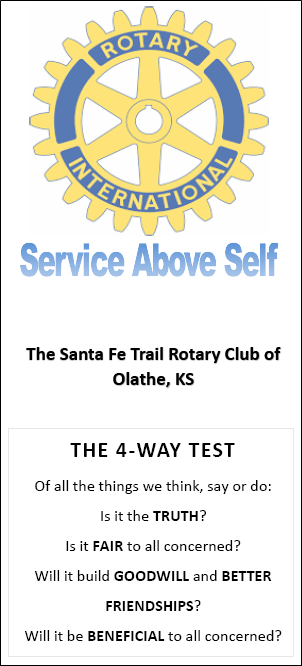
This is a quick way to reference the 4-way test which is recited at every meeting. Herbert J. Taylor, a Chicago Rotarian and president of Rotary International, invented the 4-Way Test in 1932. Taylor created the 4-Way Test after being assigned to save the Club Aluminum Products Company from bankruptcy. He believed the company needed a simple set of ethics that everyone could use. The test became a guide for the company's employees, and helped the company survive. Taylor shared the test with others, and in 1943, Rotary International adopted it. In 1954, Taylor gave Rotary International the copyright to the test.
The 4-Way Test is a set of questions to help people determine if their actions, statements, policies, or plans are right or wrong. The questions are: Is it the truth, Is it fair to all concerned, Will it build goodwill and better friendships, and Will it be beneficial to all concerned. The 4-Way Test is one of the most widely quoted and printed statements of business ethics in the world. It's a central part of Rotary's structure and is used to encourage ethical practices in business and personal life.