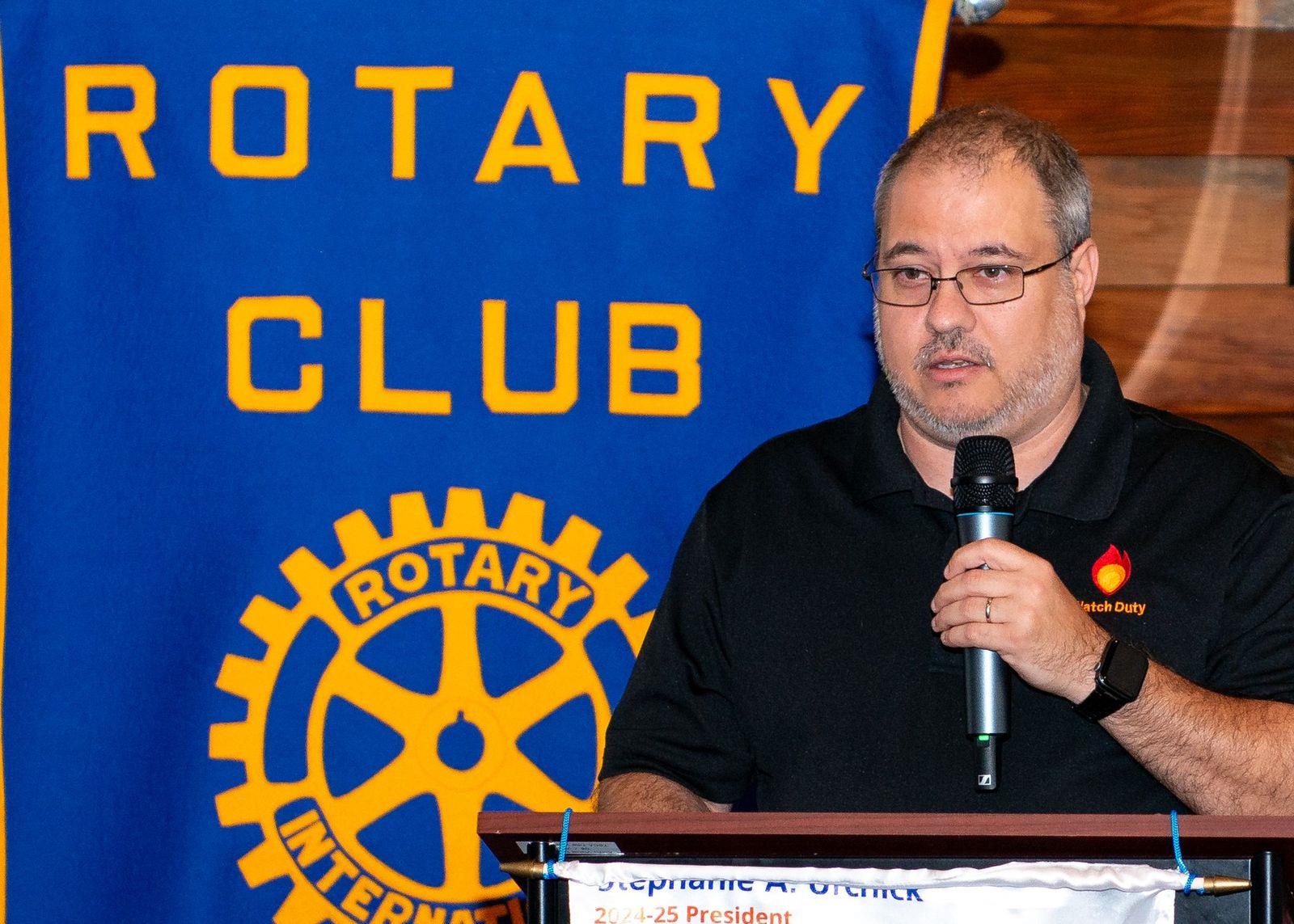
Our guest speaker for August 8, 2024, was Josh Leone, a member of the founding team and reporter with Watch Duty, a fire awareness non-profit focused on disseminating fire-related public safety information in real time from verified sources. Josh is a 3rd generation resident of the Russian River area and is well known for his reporting on fires, floods, and other disasters. He’s sometimes known as the “Fire Mayor of Guerneville.”
Watch Duty’s mission is to provide a fast, comprehensive, and actionable source of reliable information for civilians and first responders. As we in Sonoma County know so well, wildfires are a huge problem and getting worse. 32% of Americans live in an area of significant wildfire risk and 21.8 million Americans live within 3 miles of a large wildfire. Five out of the biggest 10 wildfires in the country occurred in the last 10 years. Yet we have very little reliable real-time information about wildfires as they occur, largely because first responder tech infrastructure was not built for the fast flow of information. Watch Duty was designed to fix that problem. It now has 5 million users in 13 states (doubling since the Park Fire). Watch Duty is also working to include hurricane and tornado information on its app. The key pillars of Watch Duty are data capture, validation, and notification. Watch Duty prides itself on knowing about fires as soon as, if not before, first responders! Fire data is obtained from online sources, reporters themselves listening to reports, and connections in the background. The information is validated with a variety of sources and then, if significant, an alert is pushed out in the app. They have someone watching the entire county 24-7. Notifications always go out when an Air Attack plane goes out from Sonoma County.
Data capture includes access to multiple data sources. They’ve invested lots of time and money into developing bots that capture information from these sources’ feeds that allow them to collaborate in Slack to help determine what they are going to do. Slack’s owner, Salesforce, has also provided them with a lot of funding to help with the cost of obtaining and verifying information from the various sources. Some parts of California don’t have the software-based scanners we have in Sonoma County. So, Watch Duty built their own Echo Radios and stashed them throughout the state and in Oregon and Washington. These Echo Radios allow Watch Duty to snoop in on conversations and then broadcast them out to the public. It’s a game changer! Watch Duty has also expanded to help provide information about prescribed burns, which allows the public to distinguish between “good” and “bad” fires. Watch Duty’s long term vision is to create a platform for disaster preparedness, actionable preventative measures, and useful insights and news.
Josh reminds us to download the Watch Duty app and start getting notified! Many thanks to Josh for the informative and interesting discussion of the work done by Watch Duty to show us how Watch Duty is working hard to keep us informed about fires throughout the state and beyond. Great job!
Click HERE to see a limited time recording of Josh Leone's presentation.
On a regular basis, our resident photo pro Warren Smith, submits pictures of what is going on at the weekly meetings. You can always find the most recent pictures at the websites photo journal called "Meeting Sighting" Please note that all the meeting photos for the entire Rotary year are at this location with the most recent on the last page.
Thanks for all the great pictures Warren!Link to Meeting Sightings. The most recent are on the last page!
August 20 is the UN Happiness Day. The United Nations General Assembly recognizes that happiness is a fundamental human goal that promotes the happiness and well-being of all peoples. And calls for “a more inclusive, equitable and balanced approach to economic growth.”
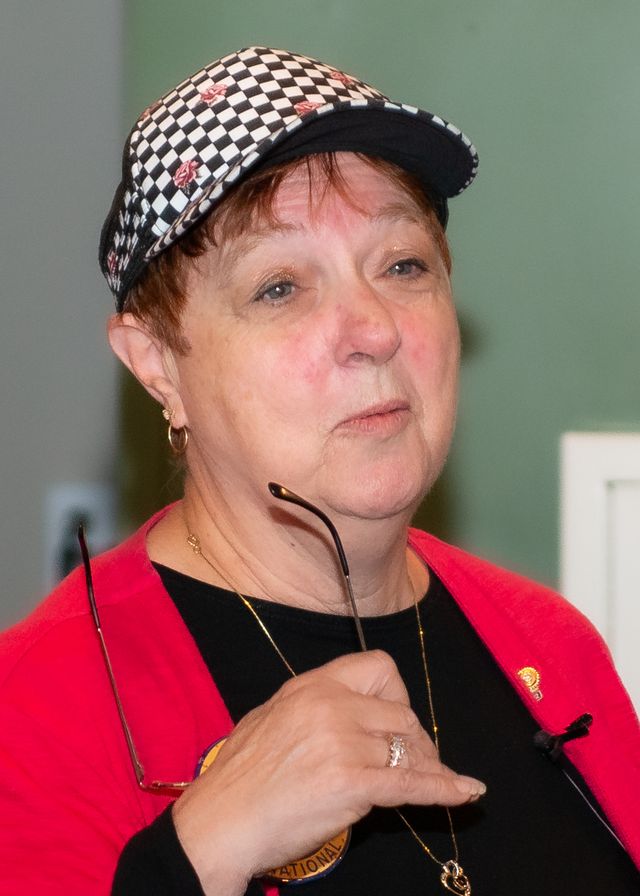
Shauna Lorenzen recognized this day and this goal as part of her opening remarks during the August 8 membership meeting. Known as "The Hat Lady" throughout past years, Shauna sported a colorful cap that reminded her of the happiness she experiences when driving her convertible.
Last week from Hiroshima Japan, the efforts of international peacebuilders were noted at the site of atomic cataclysm. This past two weeks in Paris France brought together world athletes to compete under a peaceful umbrella of friendship. "Faster-Higher-Stronger" is the Olympic Motto and inspires personal and team excellence.
Turkish Past District Governor Ayda Özeren's article which follows narrates the arc toward diversity and inclusiveness in Olympic participation.
Rotary Voices
Stories from around the world
Celebrating diversity in the 2024 Olympic Games
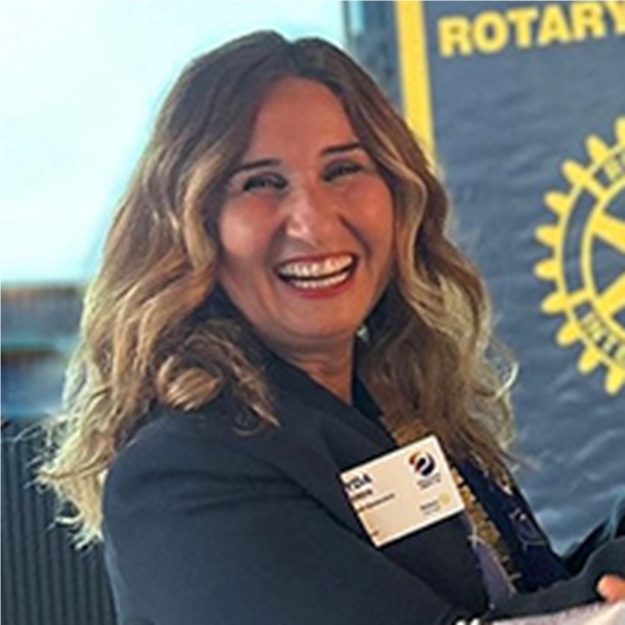
By Ayda Özeren, past governor of District 2440 (Türkiye)
The Olympic Games in Paris are especially delightful this year. They mark a historic milestone in gender equality. After 128 years, an equal number of male and female athletes are participating.
For the first time, the number of male and female athletes will be equal in 28 of the 32 sports that will award medals. The number of mixed-gender events where women and men compete together will increase from 18 to 20. Women will compete in 152 events, while men will compete in 157 events.
We wouldn’t be here if it weren’t for a woman named Stamata Revithi. One hundred and twenty-eight years ago, Revithi became the catalyst for an incredible uprising in sports history when she insisted on running a marathon. She was around 30 and had moved to Athens, Greece, with her two children to find work. She loved long-distance running, so she applied to participate in the Olympic marathon. The International Olympic Committee rejected her application.
Paving the way
Revithi was stubborn. To at least show the Athenians that she could do it, she decided to run the 40-kilometer course on her own the day after the official marathon. She started her run at 8 a.m. and finished in about 5 hours and 30 minutes. During this time, she collected witnesses and documents to verify her run. But when she arrived at the Panathenaic Stadium, soldiers prevented her from entering. This historic moment became a symbol of the struggle for women’s participation in the Olympics. Revithi paved the way for women to compete in the next Games.
Since then, diversity, inclusion, and equal opportunity have become the Olympics’ most important values. In the 1936 Berlin Olympics hosted by Nazi Germany, African American athlete Jesse Owens defied the racist rhetoric of the host country by winning four gold medals. His long-jump record remained unbroken for 25 years.
The 1980 and 1984 Olympics failed to provide equal opportunities and inclusiveness due to politics. The United States boycotted the 1980 Moscow Olympics to protest the Soviet invasion of Afghanistan, and the Soviet Union retaliated by boycotting the 1984 games in the U.S. For athletes in both countries, years of preparation were wiped out.
My own country made its first appearance at the Paris Olympic Games 100 years ago, with 40 athletes. All our representatives that year were men. But Turkey did have a commitment to women’s sports. Mustafa Kemal Atatürk considered sports something that determined the level of development of a country. In 1926, to enable women’s participation, specialists were brought from Sweden to train Turkey’s first female physical education teachers at the Çapa Girls’ Teacher School.
The last Olympic Games Atatürk witnessed was the 1936 Berlin Olympics. Here, Turkey not only won its first medals but was represented by female athletes for the first time. Halet Çambel and Suat Fetgeri Aşeni, who competed in fencing, were the first Muslim female athletes to compete in the Games. In this year’s Olympics, a total of 102 Turkish athletes – including 54 women and 48 men – will participate in 18 sports.
Olympic motto
The Olympic motto is “Citius, Altius, Fortius,” or “Faster, Higher, Stronger.” Can we be faster if one of us is missing? Can we reach higher if we separate a few of us? Is there a possibility of being stronger if we do not include everyone? I don’t think so.
I believe the Olympics brings us closer to global citizenship. I believe that sports, like art, will heal us by using the ointments of universality and diversity. I believe that competition under the roof of friendship blunts the power struggles in our souls.
That’s why, Paris, I’m eagerly waiting for you. I wish all our athletes' success.
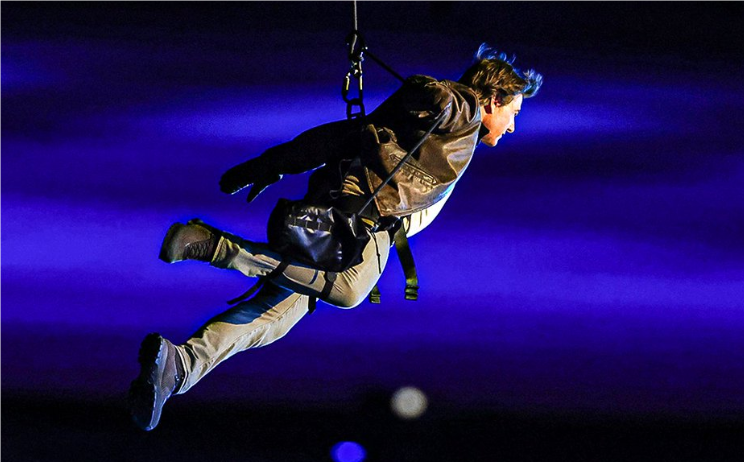
The Olympics closing ceremonies have always served as a nice sendoff for one of the world's biggest sporting events. However, this year's formalities had something extra special on display as well: Tom Cruise.
Earlier this week, it was reported that the legendary actor and stuntman would be performing an "epic stunt" as part of the closing ceremonies.
According to reports, Cruise would rappel into Paris' Stade de France, during the closing ceremonies. That would be followed by a pre-recorded video of Cruise skydiving onto the Hollywood sign in Los Angeles. That report is accurate now in hindsight.
If we are to truly change the world with The Magic of Rotary, it’s up to all of us to foster a sense of belonging in our clubs. But every club should take its own path to get there, and the Action Plan can help you find your way. What does that look like?
Take for instance the Rotary Club of Beveren-Waas in Belgium. It was chartered in 1974 but has evolved with the times, developing both a strategic plan and a membership plan. To find new members, the club analyzes the city’s professions to help focus its search, and all new members are quickly assigned tasks and roles.
The club also mixes up meeting times, alternating between evening and afternoon sessions, making them accessible for all members.
Sometimes, circumstances force clubs to make changes. But as people of action, we know that behind every obstacle is an opportunity.
The Rotary Club of Holyoke in Massachusetts was forced from its meeting place because of rising costs after the COVID-19 pandemic, but members took this setback and turned it into a strength. The club started meeting in a library community room that was available for no charge and catering lunch from a nearby deli. Lunch costs $10 per person but it’s optional, so no one has to spend money to attend a meeting. What a great way to work toward being “fair to all concerned.”
Since making this change, the Holyoke club has gained 13 members. I suspect part of its membership growth is due to the club’s sense of inclusivity — the first step toward belonging.
If you ask members what they expect from the club experience, you might find that your club doesn’t meet expectations. Think of this as an opportunity to reshape your club in exciting ways, as alternative club models are making a positive impact.
For example, a Rotary Fellowship called Beers Rotarians Enjoy Worldwide, or BREW, has worked closely with the Water, Sanitation, and Hygiene Rotary Action Group for the past eight years to assist with clean water projects. In that time, BREW has funneled 25 percent of its dues to those initiatives.
BREW is one of many examples of members pursuing belonging to improve the world.
I can’t stress enough the importance of belonging. Clubs become simply irresistible when all members feel that they are exactly where they need to be. To me, belonging is the spark that ignites The Magic of Rotary.
As you receive feedback from club members and the community you serve, I urge you to pursue that spark. The Action Plan can help you find the path to success, and if you light your way with the spirit of belonging, that path will lead to a bright future for your club, your community, and the world.
You can find all prior "RI President's Messages" at this LINK
I love our many Rotary traditions, especially our emblem: the wheel. Whenever I put on my Rotary pin, admire a new club’s logo, or spot the emblem on a volunteer’s T-shirt, I am inspired by the possibilities that wheel represents.
Early in Rotary, our predecessors envisioned it as a gear, part of a sturdy machine making great things happen. It remains that, and much more. To me, it also symbolizes cycles and movement on our journey of doing good in the world.
August is Rotary’s Membership and New Club Development Month, and I encourage you to think about the cyclical connection between membership and The Rotary Foundation.
When we have engaged members in dynamic clubs, The Magic of Rotary happens. Members — both new and experienced — deepen their commitment to each other and their communities. And that local engagement attracts attention and more members.
Gradually, the new members realize their club is part of a powerful organization that is making lasting change in the world. They learn about the Foundation, support it, and perhaps apply for a grant. They see themselves as part of the movement that will eradicate polio.
As our members’ experience deepens, so does their commitment to Rotary at all levels. The public sees our impact, making Rotary irresistible. New members join, new clubs are formed, and the cycle continues. With each turn of the wheel, we grow Rotary and our Foundation.
There are countless ways this magical connection between clubs and our Foundation can unfold. For instance, 100% Paul Harris Fellow Clubs, where every member is a Paul Harris Fellow, showcase how engaged clubs are directly connected to the Foundation. Some clubs even up the ante, like the Rotary Club of Crescent (Greensboro), North Carolina, whose 125 members are all Paul Harris Fellows, Benefactors, and Sustaining Members simultaneously.
But you do not need to be in such a “triple crown” club to make a difference.
I am asking all Rotary members to remember this month’s goal for what I’m calling Mark’s Magical Markers: Please make the personal commitment to contribute what you can to the Annual Fund by 31 August. Do it right now, before you forget, at rotary.org/give. While you are there, set up a recurring direct donation.
With your help, we can keep that great wheel of Rotary and its Foundation rolling in the right direction, moving toward something greater tomorrow than we can even imagine today.
You can find all prior "Messages from the Foundation Trustee Chair" at this LINK
The Rotary Club of Monrovia is helping train young women to establish microenterprises to make and sell reusable sanitary pads and address “period poverty.” With financial support from the Rotary Club of Loveland, Colorado, the Liberian Rotarians paired with the nonprofit Dignity:Liberia and held two training sessions for 200 women earlier this year in Monrovia, the capital, and in Kakata, a semirural community. “The high, recurring cost of pads makes them out of reach for many families that struggle to make ends meet,” says Monique Cooper-Liverpool, a past president of the Monrovia club. “This leads thousands of girls to miss classes so often that they eventually drop out of school.” The initiative grew out of a partnership between the two clubs to advance reproductive care and treatment for fistulas, an injury often caused by prolonged labor during childbirth.
Northern Ireland
Volunteers led by the Rotary Club of Belfast made improvements to the courtyard garden of a senior home in January. The team of Rotarians, community members, and people in transitional employment through the judicial system cleared weeds, constructed raised garden platforms, and filled them with soil. Cold temperatures scaled back their plans, but it was still a “rather back-breaking” effort, says club member Jenny Boyd. A District 1160 grant of about $1,250 was used to underwrite the expense. Karen Blair, a past president and project leader, recruited colleagues from her law firm to get a little dirt under their fingernails. “This project allows all members to be involved in a very hands-on activity,” Blair says. “And even those with no gardening ability can participate by chatting with the residents over coffee.”
Rotary projects make a difference in communities around the world.


.png)




.png)







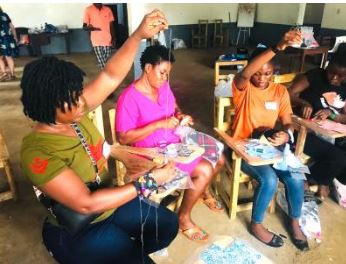 The Rotary Club of Monrovia is helping train young women to establish microenterprises to make and sell reusable sanitary pads and address “period poverty.” With financial support from the Rotary Club of Loveland, Colorado, the Liberian Rotarians paired with the nonprofit
 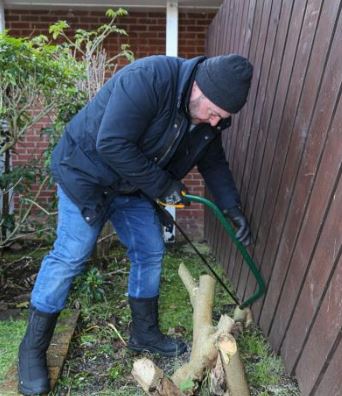 Volunteers led by the Rotary Club of Belfast made improvements to the courtyard garden of a senior home in January. The team of Rotarians, community members, and people in transitional employment through the judicial system cleared weeds, constructed raised garden platforms, and filled them with soil. Cold temperatures scaled back their plans, but it was still a “rather back-breaking” effort, says club member Jenny Boyd. A District 1160 grant of about $1,250 was used to underwrite the expense. Karen Blair, a past president and project leader, recruited colleagues from her law firm to get a little dirt under their fingernails. “This project allows all members to be involved in a very hands-on activity,” Blair says. “And even those with no gardening ability can participate by chatting with the residents over coffee.”