banner
Bulletin Editor
Max Bridges
Meeting Responsibilities
Presiding At Meeting
Shureen, Doug
 
Greeter
Moir, Jim
 
Thought of the Day
Holder, Scott
 
Pledge Leader
Aita, Nancy
 
Sunshine Committee
Tweeten, Eloise
 
Web Site Editor
Lorenzen, Dave
 
Bulletin Editor
Bridges, Max
 
Bulletin Notes
Randolph, Rich
 
Bulletin Notes
Tamanaha, Dicksie
 
Photographer
Smith, Warren
 
Speakers
Apr 05, 2018
Engaging your audience
Apr 12, 2018
Santa Rosa Symphony Youth Orchestra
Apr 19, 2018
Nicaragua: Up Close and Personal
Apr 26, 2018
Sonoma County Economic Update
View entire list
Upcoming Events
April Board Meeting
Interiors Inc.
Apr 10, 2018
5:30 PM – 7:30 PM
 
Puttin' on the Ritz
Saturday Afternoon Club
Apr 14, 2018
4:00 PM – 7:00 PM
 
SCARC April
Apr 26, 2018
6:00 PM – 9:00 PM
 
Elsie Allen - "Zoot Suit" by Louis Valdez
Elsie Allen High School
May 03, 2018 – May 11, 2018
 
May Board Meeting
Interiors Inc.
May 08, 2018
5:30 PM – 7:30 PM
 
SCARC May (Sunrise HOSTING!)
May 30, 2018
6:00 PM – 9:00 PM
 
SCARC May
May 31, 2018
6:00 PM – 9:00 PM
 
June Board Meeting
Interiors Inc.
Jun 12, 2018
5:30 PM – 7:30 PM
 
SCARC July
Jul 26, 2018
6:00 PM – 9:00 PM
 
SCARC August
Aug 30, 2018
6:00 PM – 9:00 PM
 
Birthdays & Anniversaries
Member Birthdays
Steve Amend
April 10
 
Jon Stark
April 11
 
Peter Treleaven
April 12
 
Tom Eakin
April 12
 
Marty Behr
April 17
 
Jim Moir
April 20
 
Dicksie Tamanaha
April 22
 
Doug Shureen
April 23
 
Stacy Drucker-Andress
April 24
 
Ross Jones
April 27
 
Max Bridges
April 28
 
Spouse Birthdays
Marie Treleaven
April 2
 
Joanne Eakin
April 13
 
Terry Stark
April 18
 
Stacy Drucker-Andress
April 24
 
Carol Cercone
April 28
 
Anniversaries
Eloise Tweeten
Jack Strange
April 12
 
Jack Strange
Eloise Tweeten
April 12
 
Olin Leasher
Judith Leasher
April 16
 
Join Date
Harry Coffey
April 3, 2008
10 years
 
Olin Leasher
April 7, 2005
13 years
 
Cindy Gillespie
April 8, 2010
8 years
 
Jim Moir
April 13, 2000
18 years
 
Marina Gachet
April 21, 2016
2 years
 
Steve Amend
April 24, 1997
21 years
 
Links
Links
Partners of Santa Rosa Sunrise Rotary
What Are My Make Up Options?
How to Contact the Sunshine Committee
SR Sunrise Facebook Page
Youth Exchange - District 5130
SCARC Meeting Schedule
Rotary International Business Portal
Latest "Rotarian Magazine"
Executives & Directors
President
 
President Elect
 
President Nominee
 
Secretary
 
Treasurer
 
Past President
 
Rotary Foundation
 
Membership
 
Service Projects
 
Club Administration
 
Public Relations
 
Russell Hampton
National Awards Services Inc.
ClubRunner
Stories
The Program for April 5th

Program for April 5th

Chance Massaro - Engaging your audience

All of your expressions originate from inside your cognitive/emotional being.  Did you know that you can actually use them in the opposite way?  Smiling will make you feel better.  Frowning will make you feel worse.  Standing erect will make you feel confident.  Slouching will make you feel defeated. Chance Massaro from INSOURCE ACCESS will show you how to impact the chemical and electrical systems in your body to create the emotions you want and the healing you need.  He will also help you to be a more effective speaker by suggesting that your meeting or audience members can be ushered into more engagement with what you are sharing.  Join Chance on April Fifth to launch into the power of your own intention.
Meeting Highlights 3/29/18
Meeting Highlights
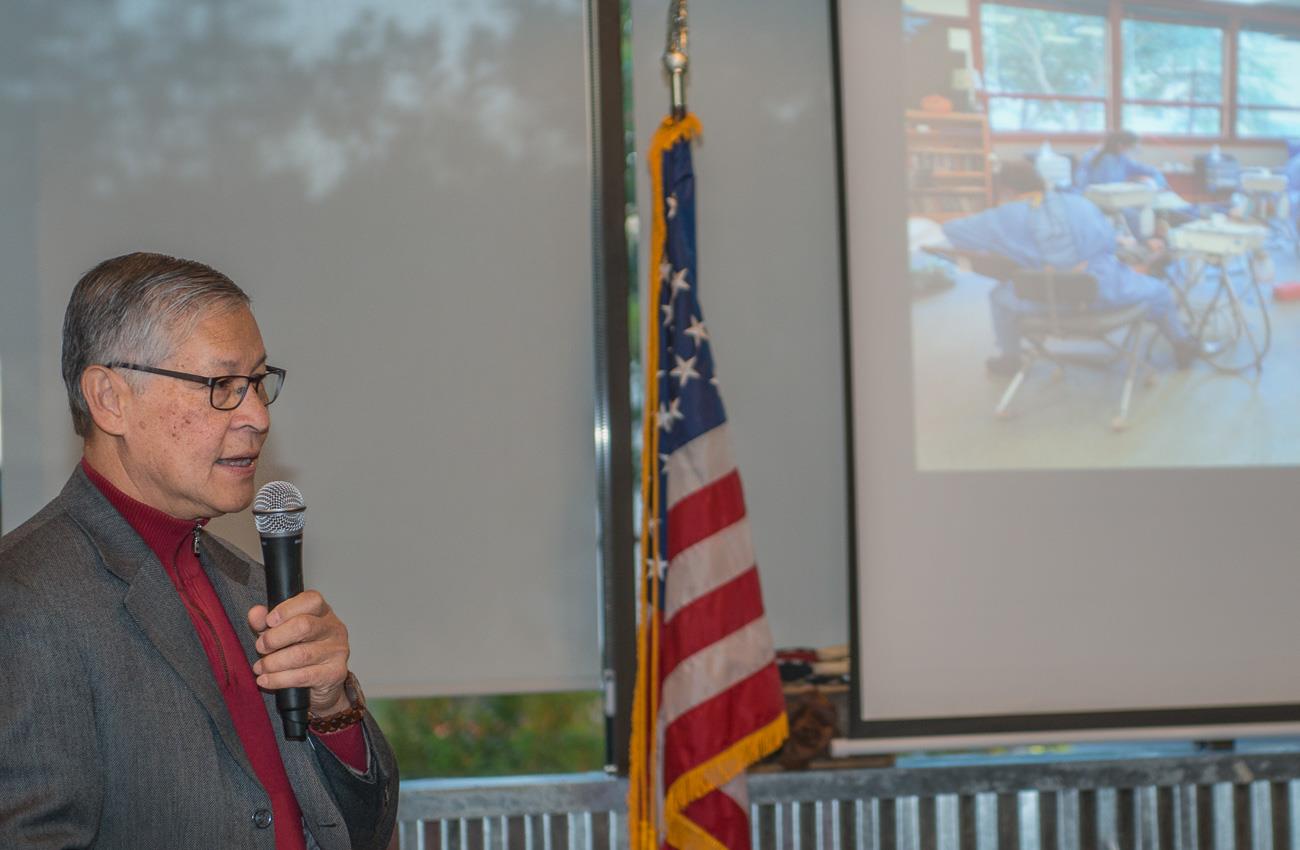
Above, Sunrise Centennial Project Coordinator Ezbon Jen provided an historic overview of the Club's District Award winning outreach of oral health to Sonoma County underserved youth.  Initiated in 2001 during President Steve Worthen's term, the project has grown to an International scale with students from Santa Rosa Junior College Health Sciences traveling to Mexico annually to offer dental care.  Ezbon personally tows the project trailer with supplies and supervises students during their two week clinic.  Closer to home, these resources how reach ten times the original clientele, now in the 3,000 per year range!!
Again, Sunrise Rotarian Mike Kelly has garnered the Bohemian newspaper's recognition as best agent. Congratulations Mike, who still found time to develop and promote the Rotary Peace Project in our District 5130! 
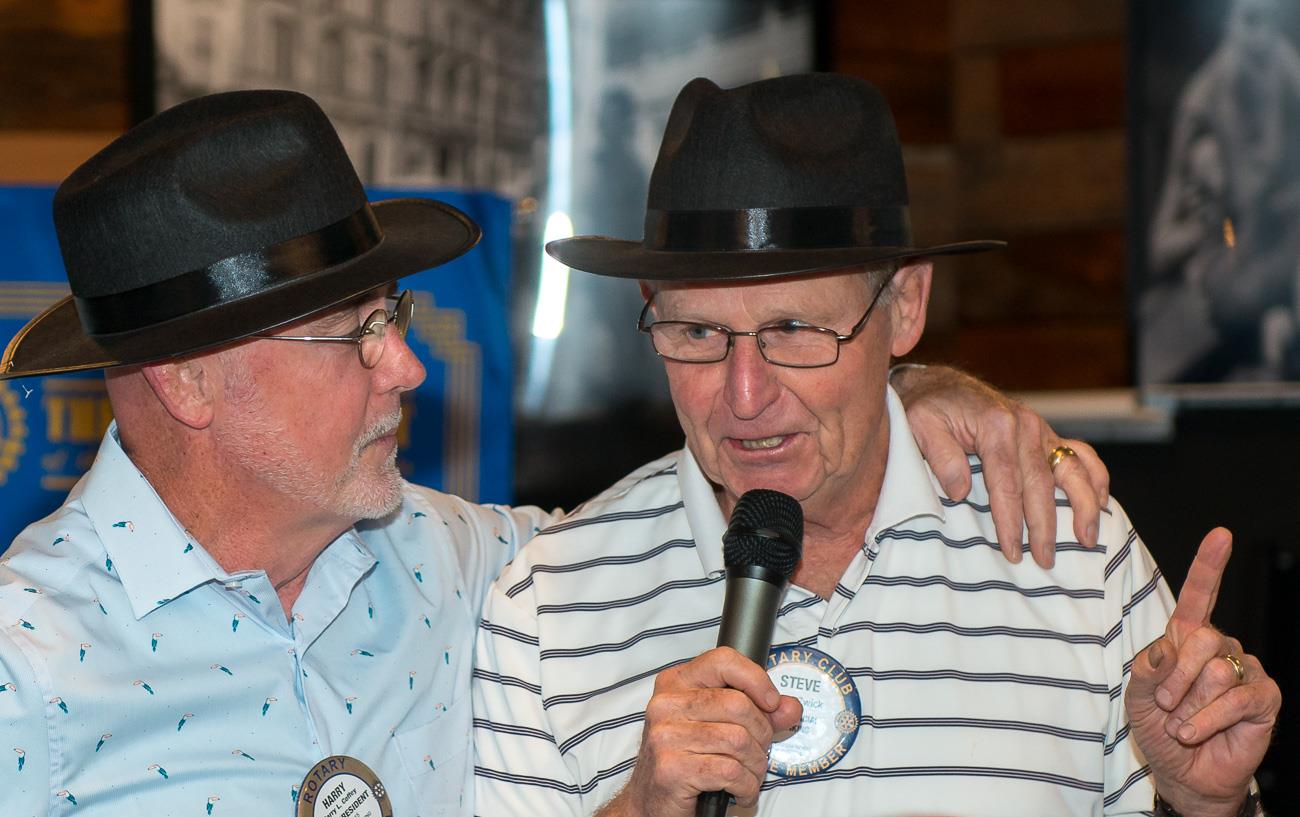
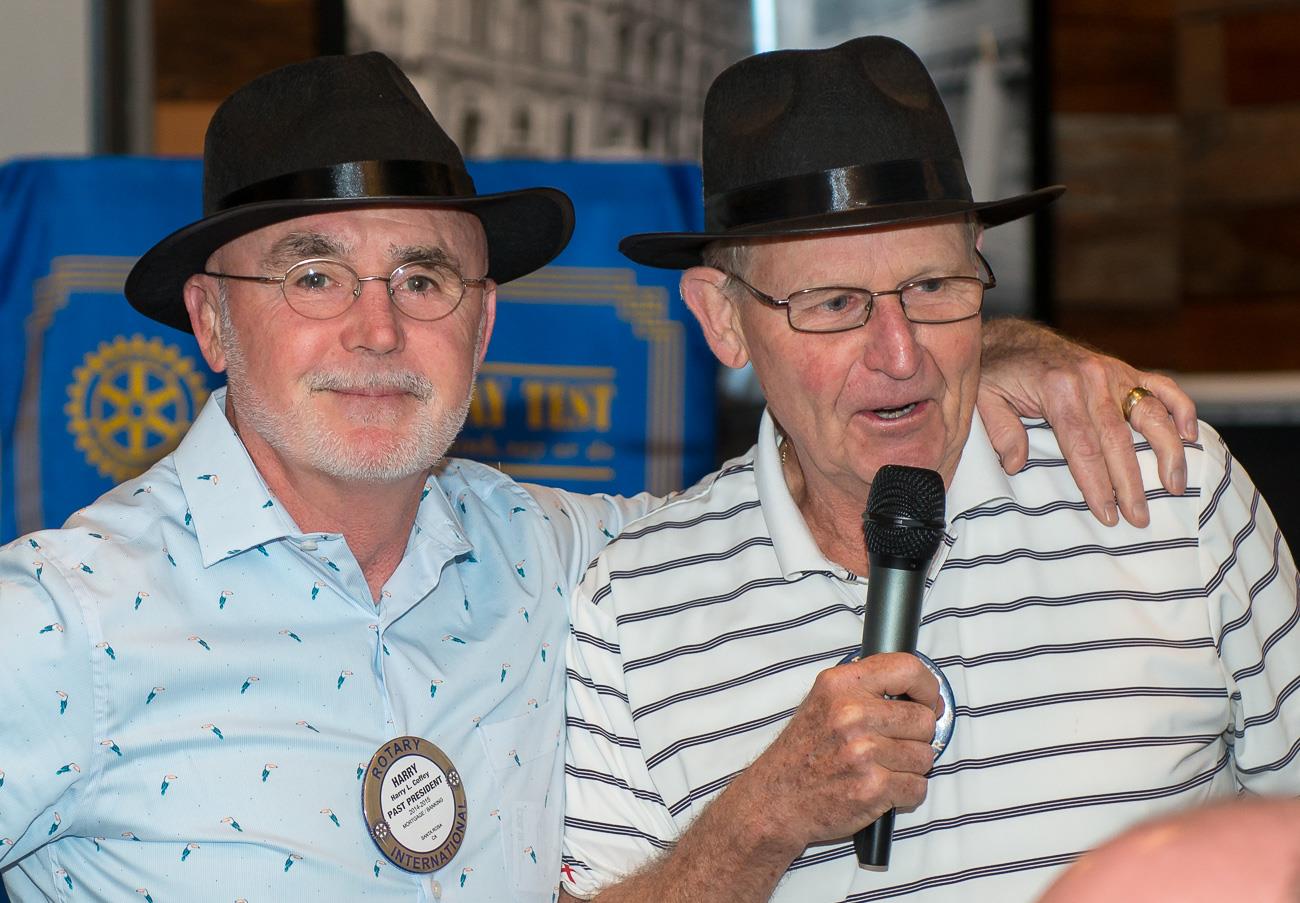
Smiling Harry Coffey and talking Steve Zwick promote our upcoming June 15th Golf Tournament.  Ask Steve for sponsorship details.
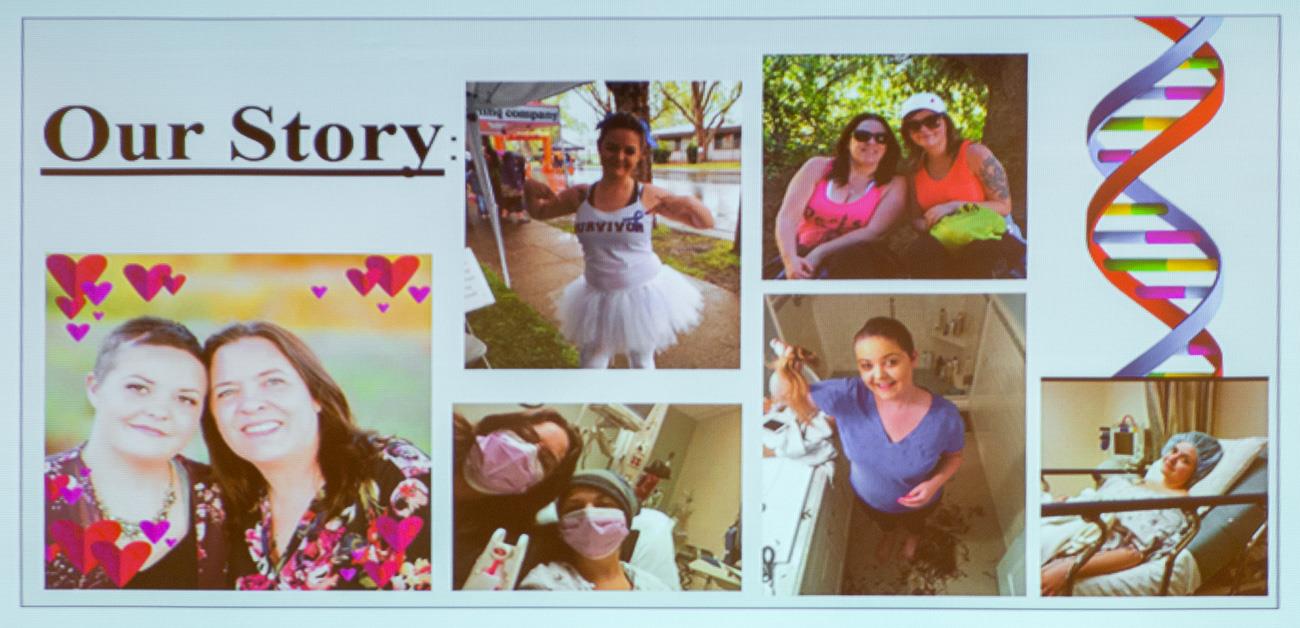
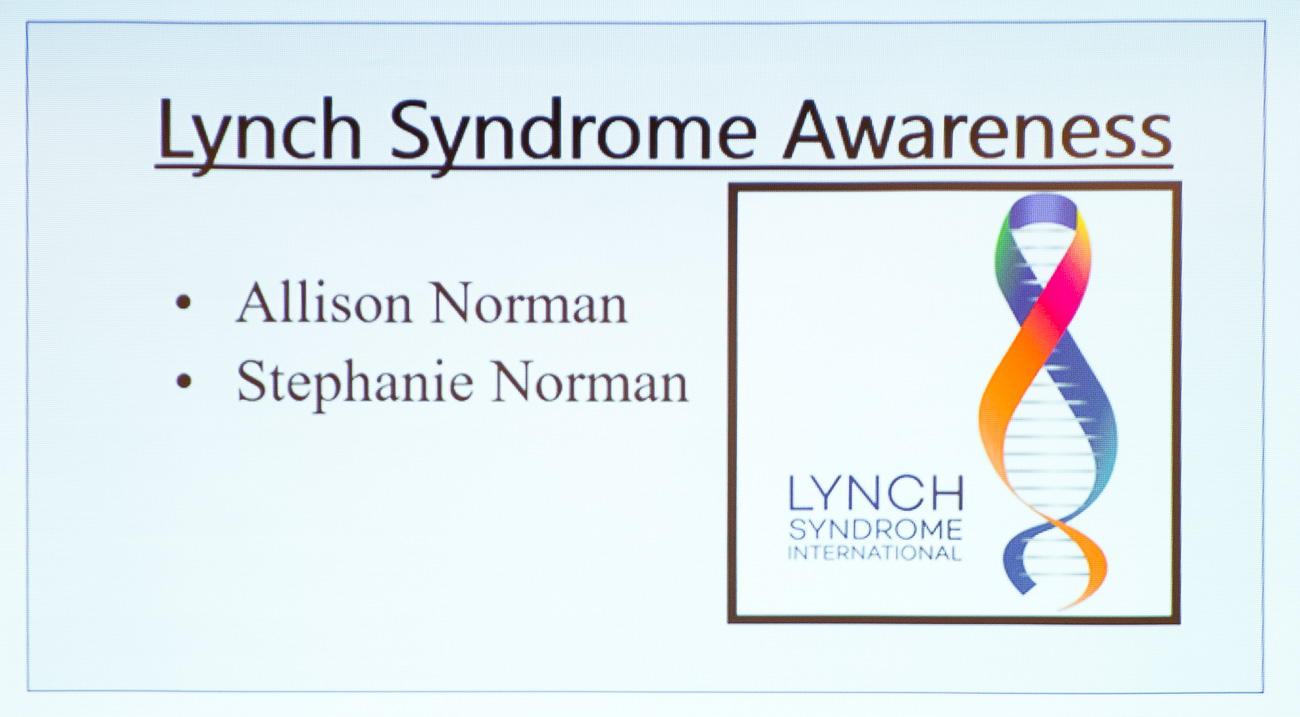
Speakers of the day, Allison Norman and her daughter Stephanie disclosed their ongoing encounter with Stephanie's diagnosis of Lynch Syndrome or LS.  After having undergone treatment for colon caner two years ago, Stephanie was experiencing disturbing symptoms which her doctor attributed to side affects of her previous treatments.  A scan revealed otherwise, a glioblastoma, type of brain cancer.
These two courageous, pioneering women took to a progressive program of education, learning much about the genetic link to susceptibility for a cluster of cancers.  While Stephanie's glioblastoma is not the most common associated risk, the discovery of her familial link has opened many constructive conversations within and beyond her family.  An autosomal dominant trait, meaning both a dominant and recessive gene may be carried by a person, the trait requires the dominant gene be present to express the syndrome.  Described by Stephanie as a "spell check" error, LS involves a defect in the genetic replication process, resulting in crucial errors manifesting as a variety of cancers., especially colon and endometrial.  It can skip a generation, so the importance of advanced knowledge of the possibility of carrying the trait is a key to successful genetic counselling 
 
Lynch Syndrome International provides an up to date website on the condition:http://www.lynchcancers.com.  Give yourself and your family the advantage of the 3-2-1 Screening.  Check out their website!!  Let Allison and Stephanie's experience benefit you, and support their upcoming walk.
 
 
Photo of the Week

Photo of the Week 

On a regular basis, our resident photo pros Warren Smith and Jack Strange submit pictures of what is going on at the weekly meetings. You can always find the most recent pictures at the websites photo journal called "Meeting Sighting" Please note that all the meeting photos for the entire Rotary year are at this location with the most recent on the last page.

Thanks for all the great pictures Warren and Ross! Link to Meeting Sightings. The most recent are on the last page!

Additional photos may be found on the SR Sunrise Facebook Page.
 
 
"Save the Date" Puttin' On The Ritz
 
 
"SAVE THE DATE" For the Annual Golf Tournament
 
 
RI President's Message

RI President's Message

April 2018

Ian H. S. Riseley

President 2017-18

At the 1990 Rotary International Convention in Portland, Oregon, then President-elect Paulo Costa told the gathered Rotarians, "The hour has come for Rotary to raise its voice, to claim its leadership, and to rouse all Rotarians to an honorable crusade to protect our natural resources." He declared a Rotary initiative to "Preserve Planet Earth," asking Rotarians to make environmental issues part of their service agenda: to plant trees, to work to keep our air and water clean, and to protect the planet for future generations.

President Costa asked that one tree be planted for each of the 1.1 million members that Rotary had at the time. We Rotarians, as is our wont, did better, planting nearly 35 million trees by the end of the Rotary year. Many of those trees are likely still flourishing today, absorbing carbon from the environment, releasing oxygen, cooling the air, improving soil quality, providing habitat and food for birds, animals, and insects, and yielding a host of other benefits. Unfortunately, while those trees have kept on doing good for the environment, Rotary as a whole has not carried its environmental commitment forward.

That is why, at the start of this year, I followed Paulo Costa's example and asked Rotary to plant at least one tree for every Rotary member. My goal was to achieve a good beyond the considerable benefits that those 1.2 million (or more!) trees would themselves bring. It is my hope that by planting trees, Rotarians will renew their interest in, and attention to, an issue that we must put back on the Rotary agenda: the state of our planet.

Environmental issues are deeply entwined in every one of our areas of focus and cannot be dismissed as not Rotary's concern. Pollution is affecting health across the globe: More than 80 percent of people in urban areas breathe unsafe air, a number that rises to 98 percent in low- and middle-income countries. If current trends continue, by 2050 the oceans are expected to contain more plastics by weight than fish. And rising temperatures are well-documented: Global annual average temperatures increased by about 2 degrees F (1.1 degrees C) from 1880 through 2015. That this change was caused by humans is not a subject of scientific debate, nor is the likelihood of vast economic and human disruption if the trend continues unchecked. The need for action is greater than ever – and so is our ability to have a real impact.

As past UN Secretary-General Ban Ki-moon put it, "There can be no Plan B, because there is no Planet B." Our planet belongs to all of us, and to our children, and to their children. It is for all of us to protect, and for all of us in Rotary to make a difference.


Message from the Foundation Trustee Chair

Message from the Foundation Trustee Chair

April 2018

Paul A. Netzel

Trustee Chair 2017-18

The new grant model comes up frequently during my visits with Rotarians throughout the world. It is always disappointing to learn that a club or district lacks interest in participating in global grants.

What are the reasons I hear most often? Global grants are too complicated. They take too much work, require too much money. Or the available pool of DDFs (District Designated Funds) may not be large enough to meet the demand.

Yet the numbers tell a story that can be perceived as positive. During 2016-17 – The Rotary Foundation's centennial year – 1,260 global grants were awarded, an 8 percent increase over the previous year. And the figures for the first half of this Rotary year are running ahead of last year.

Your ongoing feedback and suggestions have helped make a difference. Numerous upgrades have been made to the global grant online application process. The time it takes to process global grants has been significantly reduced. In 2016-17, the average was 129 business days from the time a grant application was submitted to the first payment. The average was 107 business days for 2017-18 as of 1 February.

If your club has not participated in a global grant, I urge you to take another look at the resources now available. Start by looking at the newly redesigned Rotary Grant Center at grants.rotary.org. Explore the comprehensive resources linked in the right-hand column.
Our Foundation's outstanding grants staff wants to help, drawing on its expertise and TRF's collective experience. Establish a relationship with the staff contact for your project district. The Rotary Support Center can provide contact information within one business day (
rotarysupportcenter@rotary.org).

The Rotary Foundation's Cadre of Technical Advisers is a group of volunteer Rotarians who also provide technical expertise and advice to Rotarians planning and carrying out Rotary projects. If you would like to receive guidance on project planning early in the process, contact cadre@rotary.org.

A critical role of the Trustees is to listen. Rotary members have spoken. Together we are a powerful force of volunteers who identify needs and respond with generosity, creativity, and passion. Rotary grants provide us with a unique opportunity to bring ideas to reality and to make a lasting impact, whether locally or globally.


News From "The Rotarian"

From "The Rotarian"

A soldier in the war on polio

‘There are many polio warriors in Rotary,” RI President Ian H.S. Riseley remarked at a fundraising dinner for End Polio Now in January, addressing the 400 attendees who filled the banquet hall of a hotel just south of Denver. “But none are more loyal or dedicated than Grant Wilkins. … Together, with 1.2 million of his closest friends from around the world, and their partners, we are on the threshold of greatness.”
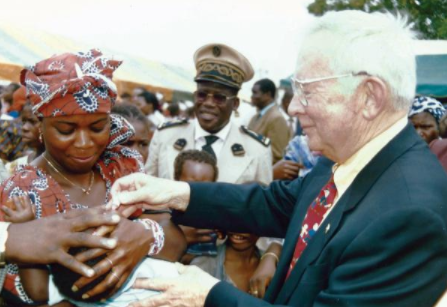
C. Grant Wilkins participates in a National Immunization Day in Côte d’Ivoire in 1998.
Photo courtesy of C. Grant Wilkins
C. Grant Wilkins, who sat at the table in the front row with his wife of over 50 years, Marlene, took the comments and the following ovation in stride. At 91, he walks with a slight stoop but still drives, travels, speaks, and maintains a busy schedule. He may not have universal recognition as a man who has helped save millions of lives, but he is. A member of the Rotary Club of Denver since 1969, he’s the first to say that it’s only through Rotary that anything like that could be done. “Rotary is the only way I’ve known of helping lots of people around the entire world,” he says. “We’ve saved millions of kids from polio. There’s no way I could even begin to do anything like that without being a member of this organization.” But Wilkins has been an important part of Rotary’s eradication efforts as well as many other Rotary initiatives. And his dedication begins with his own life story.
In 1951, Wilkins was living in Denver with his wife, Diane, working his first job out of college. One day he started to feel ill and couldn’t keep food down. He went to the hospital. “They thought I had the flu,” he recalls. “Then they did a spinal tap, found the polio virus in my spinal fluid, and put me in the polio ward.” The virus had attacked his throat, paralyzing his vocal cords and making it impossible to swallow. The doctors performed an emergency tracheotomy. As Wilkins writes in his memoir, Two Drops that Changed the World, “polio would be the center of my young family’s life and totally change my wife’s life for the next 13 years.”
Within two weeks, his fever broke, and Wilkins was moved from the isolation ward. Then, while Diane was visiting him at the hospital, she mentioned that she wasn’t feeling well. Doctors performed a spinal tap, and her diagnosis came back: polio. Within 24 hours she was almost totally paralyzed and placed in an iron lung, where she would stay for 2½ years until a portable respirator, a new invention at the time, allowed her to leave the hospital. Grant spent months learning to speak again.
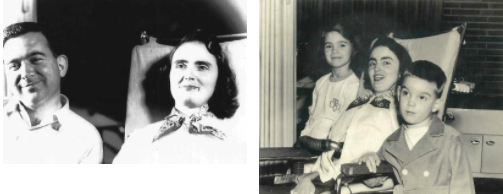
Grant and Diane at home; Shari and Mark with their mother.
In 1952, the year Jonas Salk began work on the first effective vaccine, some 58,000 people in the U.S. contracted polio, resulting in over 3,000 deaths and over 21,000 patients with some level of paralysis. In 1953, vaccination field trials began, and from 1955-57, incidence of the disease in the U.S. fell by 85 to 90 percent.
This was too late for the Wilkinses, but they carried on after Diane’s illness. For the next 13 years, they raised their three children, building their life around keeping Diane’s respirator going. She learned to paint holding the brush in her mouth, taught their kids to love music, and impressed everyone with her will to survive. In 1964, she passed away at age 36.
The family managed as well as they could. Soon, Wilkins grew close to an acquaintance, Marlene Siems, and in 1965 they married. A few years later, the kids were grown and gone, and Wilkins’ billboard business had been bought out under the federal Highway Beautification Act. So with an eye toward meeting people and helping others, in 1969 he joined the Rotary Club of Denver.
“I was born into Rotary,” Wilkins says. “My dad was a member of Fort Worth’s Rotary Club when I was born in 1926.” Everywhere they moved – in Nebraska, Oklahoma, Texas, and finally Colorado – his father joined Rotary.
At first, Wilkins focused on local projects, such as one that partnered Rotarians with underprivileged children in the Denver public schools. In 1978, he was elected president of the club, and in 1981 he helped start the Artists of America exhibition, with a portion of the proceeds going to the Denver Rotary Foundation. Over the next two decades, the show and sale would raise $1.9 million for the Denver Rotary Foundation and would also benefit the Colorado History Museum.
Then in 1985, RI President Carlos Canseco proposed that Rotary take on polio eradication. Given his history with the disease, Wilkins’ name was put forward to advise the program, which was called PolioPlus. “None of the senior leaders in Rotary had had polio themselves and/or had a wife that was totally paralyzed from it, so I was unique, ” he recalls. He became a key player in PolioPlus from its inception.
As a result of the efforts of Rotary and its four partner organizations, polio is on the verge of being eradicated, with just 22 cases reported last year as of 31 January 2018, down from 350,000 in 1988.
Wilkins celebrates his 90th birthday with his extended family.
But Wilkins has not limited himself to polio eradication. He helped establish the Russian Health Initiative, which hosts health fairs where people can be screened for a variety of medical conditions.
Wilkins was also a force behind Rotary’s focus on clean water. In 2003 he gave a talk at the American Water Works Association convention, where he learned that 6,000 children were dying each day from lack of clean water.
“I was chairman of the Health, Hunger, and Humanity task force for The Rotary Foundation worldwide that year,” he says. “So I went back and made water a task force of its own. We said that if every Rotary club would do one water project somewhere in the world, we could really change that. And already, we’ve got those deaths down to less than half. Instead of 6,000, it’s down below 3,000.”
After Riseley spoke at the January event, Grant and Marlene were called up onstage to be presented with a surprise check representing donations to a special C. Grant Wilkins PolioPlus Fund, which had been set up by members of the Rotary Club of Denver. In just a few months, the fund had easily collected over $100,000, which was matched 2-to-1 by the Bill & Melinda Gates Foundation. The check was signed “Friends of Grant.”
“Every Rotarian is a soldier in the polio war,” Wilkins says, looking back on all this. “We have over 35,000 places in the world where we have troops on the ground. That’s why we’ve been able to get this far. And that’s very, very satisfying.”
– Frank Bures

• Read more stories from The Rotarian

Rotary Club of Santa Rosa Sunrise - Founded June 30, 1986