banner
Bulletin Editor
Rob Sanville
Links
Club Info
Club Website
2026 Super Raffle Website
Sponsors
Interested in being a sponsor?
Download the website sponsorship guide
2026 SUPER Raffle Fundraiser
Meeting Responsibilities
This Week's Duty Roster
 
Presiding At Meeting
Rodrigues, Lori
 
Greeter
Lorenzen, Shauna
 
Pledge Leader
Tweeten, Eloise
 
Thought of the Day
Hayes, Merle
 
Microphone Usher
Lorenzen, Shauna
 
Sunshine Committee
Randolph, Rich
 
Web Site Editor
Lorenzen, Dave
 
Bulletin Editor
Sanville, Rob
 
Bulletin Notes
Randolph, Rich
 
Bulletin Notes
Shureen, Doug
 
Bulletin Notes
Tamanaha, Dicksie
 
Photographer
Smith, Warren
 
March Breakfast Team
 
Breakfast Captain
Drucker-Andress, Stacy
 
Breakfast Team
Eakin, Tom
 
Next Weeks Duty Roster
 
Greeter
Millar, Penny
 
Pledge Leader
Worthen, Steve
 
Thought of the Day
Herron, Steve
 
Microphone Usher
Millar, Penny
 
Speakers
Mar 05, 2026
Entrepreneurship/UME Voice
Mar 12, 2026
The Future of Work
Mar 19, 2026
Luther Burbank Center for the Performing Arts
Mar 26, 2026
Sonoma County Museum
Apr 02, 2026
Home Sharing
Apr 09, 2026
Change of Venue
View entire list
Upcoming Events
North Bay Science Discovery Day
Mar. 07, 2026
10:00 a.m. – 4:00 p.m.

The North Bay Science Discovery Day is a free community festival bringing together 100+ organizations, supported by 70 sponsors and 150 volunteers, to spark young people’s wonder and curiosity about science, technology, engineering, and mathematics (STEM); to strengthen the San Francisco North Bay’s STEM learning ecosystem; and to connect the STEM industry, education, and public sectors to deepen and sustain young people’s STEM learning. 

Here's the link to our volunteer descriptions and registration.

Sonoma County Fair Grounds

Hike - Sugarloaf State Park – Red/Bald Mt. Loop
Mar. 08, 2026
9:00 a.m. – 2:00 p.m.
Where
Sugarloaf Ridge State Park is a scenic state park in the Mayacamas Mountains northeast of Kenwood CA. The park protects about 4,000 acres of rolling hills, oak woodlands, mixed forests, canyons, meadows, and the headwaters of Sonoma Creek. It offers more than 25 miles of trails for hiking, biking, horseback riding, and trail running, with elevations ranging from 600 feet to nearly 2800 feet.
Rating
This is a DIFFICULT hike on an established trail. The total length of the loop is 6.2 miles, with nearly 1500 feet of elevation gain. Expect the hike to take 4-5 hours, including time for lunch along the way. Views of Mount Diablo and Mount Tamalpais can be seen from the top parts of the trail. We will also cross two creeks, which, depending on how much rain we've had recently, might require us to cross barefoot in a few inches of water. 
Dog Friendly
No.
Organizer
Dan Rosaschi: 707-899-6169 for more information
Date, Time & Directions:  Sunday, March 8th from 9:00-2:00
We will meet at Parking Lot A in Sugarloaf Ridge State Park. From Sonoma Hwy (Hwy 12) take Adobe Canyon Road east. Go past the park entrance a short distance. Parking Lot A is on the left side of the road.
Bring
Good walking shoes. Picnic lunch. Water. Binoculars. Invite family, friends and prospective members to this hike.
Sugarloaf State Park

Hike - Healdsburg Ridge Open Space Preserve
Mar. 21, 2026
10:00 a.m. – 12:00 p.m.

March 2026 – EASY HIKE -- Healdsburg Ridge Open Space Preserve

SAYTURDAY, MARCH 14  10A-NOON  Optional Healdsburg restaurant lunch afterward     

Organizer – Don Floriani.  Dog-friendly.

Healdsburg Ridge Open Space Preserve

Game Night
Mar. 28, 2026
6:00 p.m. – 9:00 p.m.
Saturday, March 28, 6-9pm
Paul and Penny's house - 249 Boas Dr, Santa Rosa, CA  95409
Bring some food and/or beverages to share
Optional - bring a game
Friends and family welcome
Please RSVP to pennymillarcpa@gmail.com
Santa Rosa
Penny and Paul's Home

Hike - Glen Oaks Ranch
Apr. 19, 2026
9:00 a.m. – 12:00 p.m.

April 2026 – MODERATE HIKE -- Glen Oaks Ranch – History, Wildflowers, Valley Views, Sonoma Land Trust Guide  

SUNDAY, APRIL 19  9A-NOON  MODERATE  Optional Kenwood restaurant lunch afterward 

Organizer – Marty Behr.  Dogs not permitted.

Glen Oaks Ranch

Senior Center Garden Party
Apr. 24, 2026
10:00 a.m. – 2:00 p.m.

We’ll have BBQ hotdogs and hamburgers.

Santa Rosa
Finley Community Park

View entire list
Birthdays & Anniversaries
Member Birthdays
Bonny Landers
March 11
 
Merle Hayes
March 21
 
Dan Davis
March 27
 
Spouse/Partner Birthdays
Jaqui Zwick
March 7
 
Susan Morgan
March 12
 
Chavette Chaney
March 19
 
Georgia Worthen
March 26
 
Molly Hoberg
March 26
 
Carol Carlenzoli
March 31
 
Anniversaries
George Pappas
Merle
March 13
 
Join Date
Steve Olsen
March 5, 1987
39 years
 
Paul O'Rear
March 17, 2016
10 years
 
Tom Eakin
March 21, 2002
24 years
 
Links
Links
Club Website Tutorials
Sunrise Foundation Service Fund
What Are My Make Up Options?
How to Contact the Sunshine Committee
SR Sunrise Facebook Page
ESRAG - Environmental Rotary Action Group
Youth Exchange - District 5130
SCARC Meeting Schedule
Rotary International Business Portal
Latest "Rotarian Magazine"
Executives & Directors
President
 
President Elect
 
President Nominee
 
Secretary
 
Treasurer
 
Past President
 
Rotary Foundation
 
Philanthropy Chair
 
Marketing
 
Service Projects
 
Membership
 
International Service Chair
 
Photo Albums
Meeting Sightings
25 - 26 Work Parties
2025 Christmas Party
2025 Veterans Lunch
2025 Oktoberfest
25-26 Hike / Walks
* 2025 Debunking of President Cindy
* 24-25 Hike / Walks
* 2025 Raffle Party
* 24-25 Service Projects
* 2024 Veterans Day Celebration
* 2024 Christmas Party
* 2024 SRKSEP
* 2024-25 Meeting Sightings
Subscribe to Bulletin
Subscribe to our eBulletin and stay up to date on the latest news and events.
Stories

The Program for March 5th

Meeting for February 5,2026

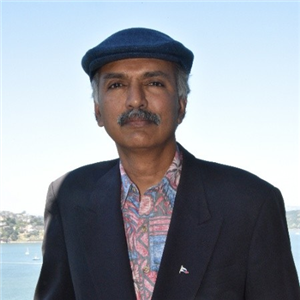
Adithya Padala
Entrepreneurship/UME Voice

Experienced Chief Executive Officer with a demonstrated history of working on innovative technologies in computer software, consumer electronics and communication. Currently focussed on products that deliver crystal clear communications in noisy environments. Skilled in E-commerce, Entrepreneurship, Department of Defense, and Strategic Partnerships. Strong business development professional with a MS focused in Computer Science from University of South Carolina, BE from Osmania University and high school at HPS.

Passionate about education and mentoring. Enjoys anything to do with sailing both competitively and otherwise. Interested in building businesses that can be carbon neutral or net producers of clean energy.

LINK TO VIRTUAL MEETING INFORMATION

The Program From February 26, 2026

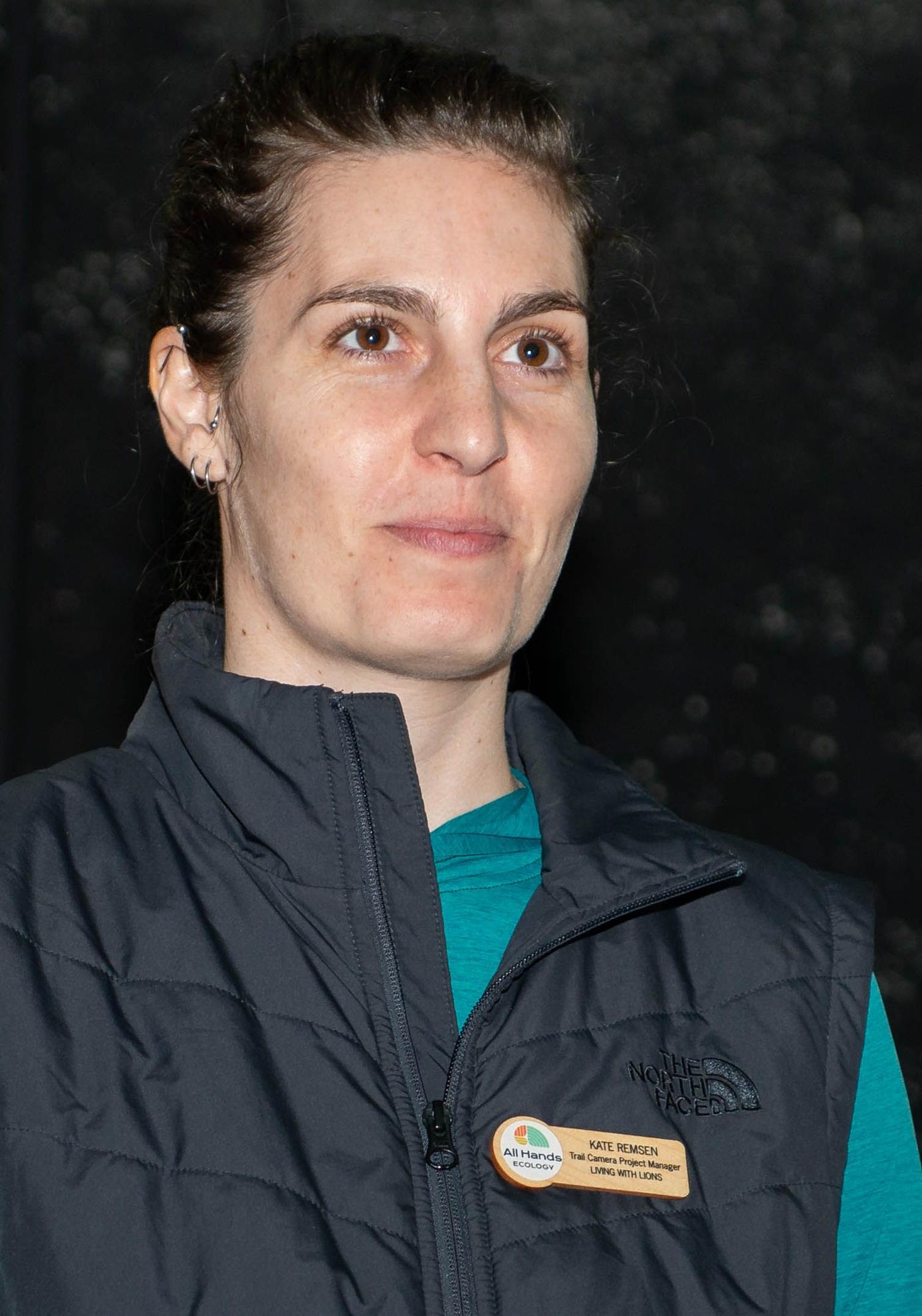
Kate Remsen of All Hands Ecology Presents "Living With Lions"

Our speaker for February 26, 2026, was Kate Remsen of All Hands Ecology. Kate is the Trail Project Manager for All Hands’ Mountain Lion Project. Kate works in community outreach, engagement, and mountain lion research. Her background includes film and television production and a 9-chapter docuseries on mountain lions with UC Davis’s Wildlife Health Center.

Kate’s job includes placing and managing trail cameras on private properties in the Sonoma and Napa Valleys (and expanding to Marin and Lake Counties) and analyzing the data provided by the project. All Hands locates, humanely captures, and equips lions with GPS collars. The data provided by location information from the collars, biological measurements and samples, and trail cameras is used for a variety of purposes, including the identification of lions’ priority habitats, wildlife corridors, the promotion of ecosystem conservation, and education. 10,000 years ago North America hosted a very large lion, known as the American Lion. This lion was significantly larger than even modern African lions. Mountain lions, also known as pumas, panthers, and cougars, were likely prey for these American Lions, which may explain mountain lions’ extreme illusiveness.

Mountain lions are now America’s apex predator. The largest mountain lion they’ve encountered weighed 130 lbs. Their favorite food is deer, and they also eat wild boar, domestic cats, livestock, and coyotes, among other things. They are amazing jumpers, so fences don’t stop them from attacking livestock unless the livestock is in lion-proof enclosures or behind shade cloth. Males can have a range of 200 miles and come in contact with lots of people. Mountain lions can live up to 16 years, although this is very rare. In general, mountain lions try to avoid people and are chill unless agitated; you are generally ok if you encounter one unless you notice agitation or aggression and in that case try not to exhibit fear and fight back.

Thank you, Kate, for this excellent presentation of your project and for giving us all the fun information about mountain lions!

Photo of the Week

Photo of the Week

On a regular basis, our resident photo pro Warren Smith, submits pictures of what is going on at the weekly meetings. You can always find the most recent pictures at the websites photo journal called "Meeting Sighting" Please note that all the meeting photos for the entire Rotary year are at this location with the most recent on the last page.

Thanks for all the great pictures Warren! Link to Meeting Sightings. The most recent are on the last page!

Additional photos may be found on the SR Sunrise Facebook Page.
Interact Service Event
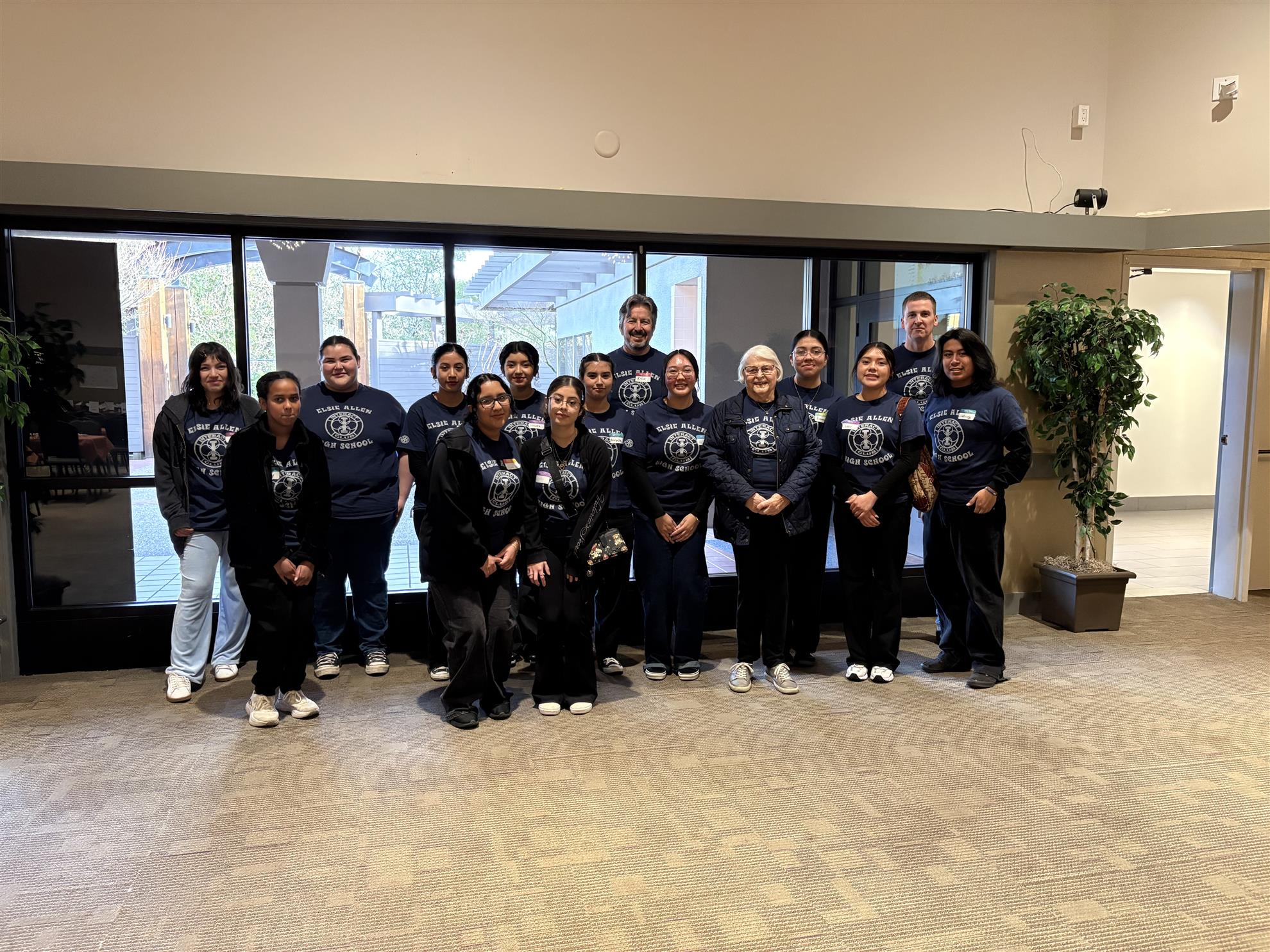
The Elsie Allen Interact Club provided support for the 20-30 club #1029 crab feed. 
 

 last week the Elsie Allen Interact Club volunteered at the Active 20-30 Redwood Empire #1029 annual Crab Feed for Kids.  12 of the Interact Club students participated with Merle, Rich Molloy(Elsie staff advisor), and myself supervising.  The students assisted with setup, serving, and cleanup during the event and were hard at it for 4.5 hours straight. 

RI President's Message

Francesco Arezzo

President 2025-26

March 2026

Water connects us all. From a river in a remote forest to a stream running past a city neighborhood, freshwater ecosystems sustain humanity. Yet these waters are increasingly under strain. Pollution, overuse, and climate pressures remind us that protecting freshwater is a global challenge.

Rotary has always believed change begins within communities. Now we are working to see how far the impact of community action can travel. When local service is connected, measured, and shared, it becomes a force that extends beyond geography and borders.

A water project led by the Rotary Club of Panamá Nordeste exemplifies this idea. The project served Indigenous communities in Panama’s Darién province, a region accessible only by canoe and small boat. With no roads, limited electricity, and reliance on untreated river water, families faced serious health risks.

To reach these communities, Rotarians had to rethink how supplies and services could be delivered. Working with a partner club in the United States and a specialized water organization, they introduced solar-powered water treatment systems for an area without access to an electrical grid. Local leaders were trained to operate and maintain the system, ensuring that clean water would continue flowing long after installation crews departed.

The results were immediate. Children who once missed school due to illness returned to classrooms. No longer needing to haul water from rivers, adults gained time and strength to work and support their families. What began as a water project became a foundation for healthier, more resilient communities.

This is how we extend our reach: combine local leadership with global partnerships, technical expertise, and long-term thinking.

That same spirit is at the heart of Rotary’s partnership with the United Nations Environment Programme through the Community Action for Fresh Water initiative. Around the world, Rotary and Rotaract clubs are restoring waterways, protecting wetlands, and safeguarding vital freshwater sources. By collecting data to map and measure this work, we can better understand its impact and show how local service contributes to worldwide solutions.

Data is not an end. It is a tool that helps us learn and improve so that Rotary’s service delivers real, measurable change. Each project entered and each waterway restored adds to a shared story of stewardship and responsibility. You can learn more and get involved at communityactionforfreshwater.org.

As we observe Water, Sanitation, and Hygiene Month, I encourage you to reflect on the freshwater systems that sustain your community and the role Rotary can play in protecting them.

When we connect local action to a global vision, we strengthen Rotary’s ability to make lasting change. Together, by extending our reach and working side by side, we truly Unite for Good.

You can find all prior "RI President's Messages" at this LINK

Message from the Foundation Trustee Chair

Message from the Foundation Trustee Chair

Holger Knaack

Trustee Chair 2025-26

March 2026

Since 2013, The Rotary Foundation has invested more than $230 million to support thousands of water, sanitation, and hygiene initiatives. Behind these numbers is Rotary’s unique approach. Rather than offering one-time fixes, we train communities to manage systems for generations, moving beyond charity to lasting change. Erica Gwynn, manager of Rotary’s water, sanitation, and hygiene area of focus, shares her perspective:

I have worked with hundreds of members, providing technical support to improve the sustainability and impact of their projects. During site visits, I am struck not only by their dedication but by how far-reaching their impact truly is — oftentimes in ways no one anticipated.

In northern Uganda for RI work, I met a Rotary member who had been a child soldier in the rebel Lord’s Resistance Army and escaped. During the conflict, he said, schools and health care facilities became places of refuge. Years later, after joining Rotary, he wanted to give back. He volunteered to improve water and sanitation in those same schools and facilities, which were once again centers of refuge — this time for the health, safety, and vitality of the entire community.

In Maharashtra, India, I witnessed how our Programs of Scale grant initiative, Partners for Water Access and Better Harvests in India, is bringing irrigation to a traditional farming region that gave women a voice. Though the women couldn’t own land, the water project enabled them to engage in silviculture, or care for forests, and other income-generating activities. They became knowledgeable about farming techniques, increasing their economic agency and dignity.

It’s no coincidence that water challenges are most acute in areas affected by conflict. In Haiti, I have seen how these projects are central to rebuilding resilience in communities recovering from instability and violence. I see the same theme playing out everywhere: These projects deliver so much more than clean water. They boost Rotary’s other areas of focus and are a source of safety, pride, and hope.

Indeed, water projects improve health, foster economic opportunity, and amplify education through increased school attendance, especially for girls who no longer spend hours fetching water. And they fight poverty.

By giving to our Foundation and volunteering in water projects, you are part of this success. Everything we do opens an opportunity for someone, somewhere.

You can find all prior "Messages from the Foundation Trustee Chair" at this LINK

News From "The Rotarian"
The Game Changer
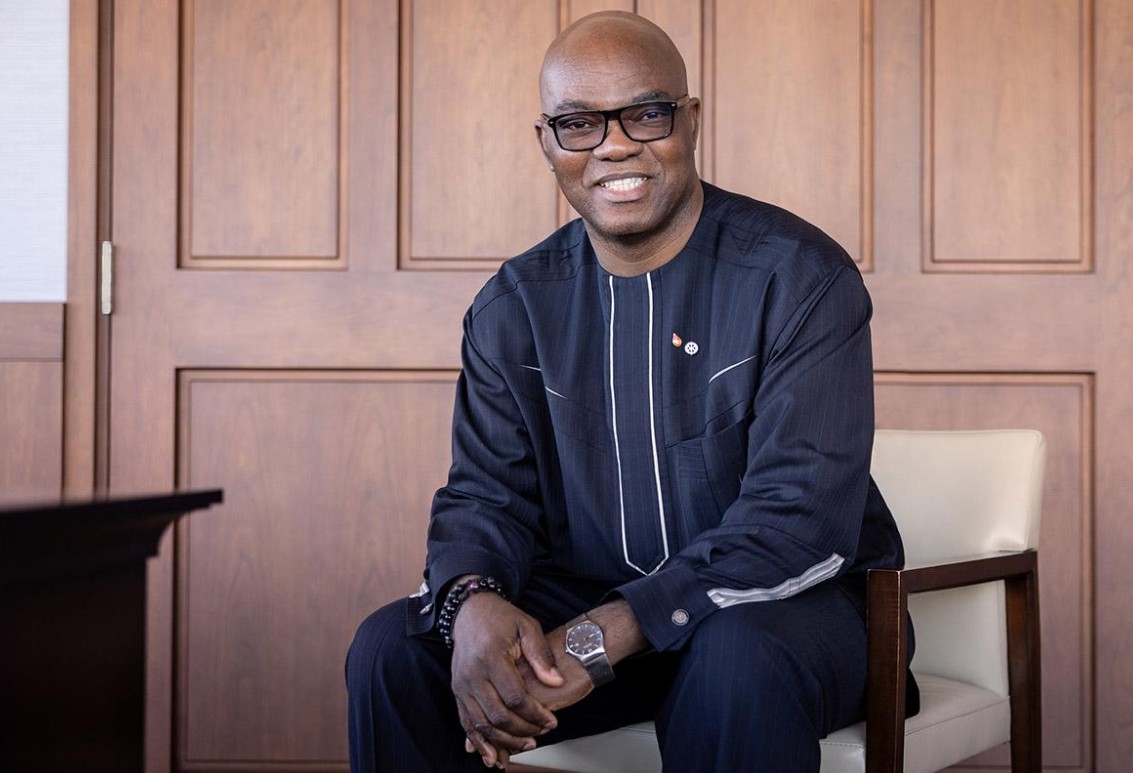
Meet your 2026-27 Rotary President, Olayinka Hakeem Babalola
Olayinka “Yinka” Hakeem Babalola is sitting on the wrong side of his desk, staring at the tiny squares on the laptop perched in front of him. He’s just finished speaking on a call with 300 Rotaractors from the African continent and other parts of the world, Rotary’s president-elect explains as he turns down the volume. “They held a celebration for me because I’m a past Rotaractor,” he says. By seeing Babalola, himself once in their shoes, embarking on the highest position in Rotary, who knows how many of the 300 he will inspire. It’s early October, less than two months since the Rotary International Board of Directors selected Babalola to lead Rotary, in a special session in late August after the resignation of RI President-elect SangKoo Yun, who died shortly after, following months of cancer treatment.
It’s only the second trip to Rotary headquarters for Babalola, of the Rotary Club of Trans Amadi in Nigeria, since his selection. His office is nearly empty, void so far of all the gifts Rotary leaders tend to accumulate during their travels as an incoming president.
Image credit: Monika Lozinska
While he’s new to the position, he has a long history with Rotary, starting as a Rotaractor in 1984 and then as a Rotarian in 1994. “One thing is for certain, preparing me for this role are my many years of engaging with Rotary” — over four decades, he says. “Not many people who get to this position have that privilege.”
In that time, he’s served not only as RI vice president and a member of the RI Board of Directors but also as an active leader and participant in RI committees such as the End Polio Now Countdown to History Campaign Committee and the Nigeria PolioPlus Committee. Babalola was a trustee of ShelterBox. His Rotary honors include the Regional Service Award for a Polio-Free World, the Service Above Self Award, and a Rotary Foundation Citation for Meritorious Service. He and his wife, Preba, a member of the Rotary Club of Port Harcourt Passport, are Arch Klumph Society members.
That’s all on top of his professional life. He worked for 25 years in the oil and gas industry, holding senior positions with Shell. He is the founder of two companies: Riviera Technical Services Ltd., an oil and gas infrastructure delivery company, and Lead and Change Consulting, an executive coaching and organizational performance advisory group.
Rotary magazine senior staff writer Diana Schoberg sat down with Babalola to find out more about the president-elect.
He was inspired to join Rotary because of something he saw on TV.
On summer break between his last year of high school and his first year of college, Babalola was hanging out at home watching TV when a well-dressed man on the screen caught his eye. The man was wearing all white, and “his English was something else,” Babalola recalls. Curious, he listened more closely. The man was talking about Rotary. “It was the first time I heard anything about Rotary,” Babalola says. “Like with most TV interviews, it probably lasted one or two minutes, but he made an impression on me.”
Fast forward to Babalola’s second year at the university, when the school’s public image director, a member of the Rotary Club of Bauchi, approached him with a proposal: Would Babalola like to help organize a Rotaract club at the school? “I still tell people I have no idea why he approached me,” Babalola says. He recalled the well-spoken man in white and asked if the director was somehow connected. It turns out the director knew the man on TV, who was the past district governor. Babalola was sold on the connection and went on to become the Rotaract club’s charter president.
He met his wife at a Rotaract meeting.
After finishing up his university education, Babalola moved to Port Harcourt and joined the community-based Rotaract Club of Trans Amadi. At one event, he recalls noticing a beautiful woman, the president of a university-based club. He pointed her out to a friend and said, “That’s the one.” He was right.
But Yinka and Preba aren’t the only members of their family who have been involved in Rotary. Their oldest daughter was the charter president of the Interact club at her secondary school. She moved to North America for college and today belongs to the Rotary Club of Winnipeg in Manitoba. Another daughter was the president of her university’s Rotaract club.
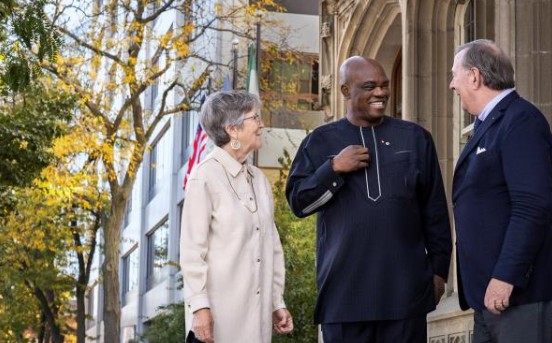
President-elect Olayinka Hakeem Babalola stands outside Rotary’s headquarters building with Rotary Foundation Trustee Martha Peak Helman and RI Vice President Alain Van de Poel.
Image credit: Monika Lozinska
His nickname is “the game changer.”
Babalola served as district governor in 2011-12 while employed by Shell, a multinational energy company. This was unlike his predecessors, who were either retired or running their own businesses while they held that role. He knew things had to change for him to be successful.
At his first meeting with the assistant governors and committee chairs, he asked them to include what would be the “game changer” in their proposals: how they used to do things, and how their approach would change going forward. “If they have no answer,” he says, “the proposal is thrown away. They need to present it again.
“It occurred to people that this guy actually wants something different,” he continues. “I’m called the game changer, but the ideas that changed the game were not mine.”
He raised $80,000 with a text message.
Part of Babalola’s effort to make changes as district governor involved his use of technology. On 1 November, the start of Rotary Foundation Month, he woke up around 3 a.m. and sent a request to a district group on a BlackBerry messaging app asking everyone on the platform to give something to the Foundation that day, no matter how small. Then he went back to sleep. When he woke up a few hours later, he made his own donation and posted the evidence. Within a few hours, the group had raised $80,000. “Usually, you would gather people together, you’d talk to them, and ask for it,” he says. “But with technology, you could ask virtually.”
That year, every club throughout the district gave something to the Foundation. The nearly $1 million raised was, he says, the highest amount ever from a district on the African continent for The Rotary Foundation.
He wishes he had more time to go scuba diving.
Babalola is certified to dive to 30 meters and has done some diving in the Mediterranean, the Red Sea, and the Atlantic. He’s looking forward to someday diving in Hurghada, a resort city on Egypt’s Red Sea coast that’s known for its marine life, iconic wrecks, and high visibility in the water. “The reefs are wonderful,” he says.
He also enjoys other outdoor pursuits including swimming, gardening, and bird-watching. One of the most interesting birds he’s seen is the Ibadan malimbe, a rare songbird with bright red feathers around its head and face that is found only near his hometown.
The 2026-27 presidential message is Create Lasting Impact.
If you need it, here’s a refresher on Rotary’s vision statement: “Together, we see a world where people unite and take action to create lasting change — across the globe, in our communities, and in ourselves.” This Rotary year, Babalola explains, RI has been focusing on that first word, “together,” through the message Unite for Good. In 2026-27, members will tackle the next part of the vision statement: creating change that lasts.
Lasting change across the globe is an easy idea for most Rotary members to understand, he says. “They can give you examples: our polio eradication work, our peace centers, global grants,” he says. “When you talk about lasting change in communities, they know because they do things in their own communities. But each time I’ve been in a gathering of Rotarians and asked them about lasting change in themselves, usually the room goes quiet.”
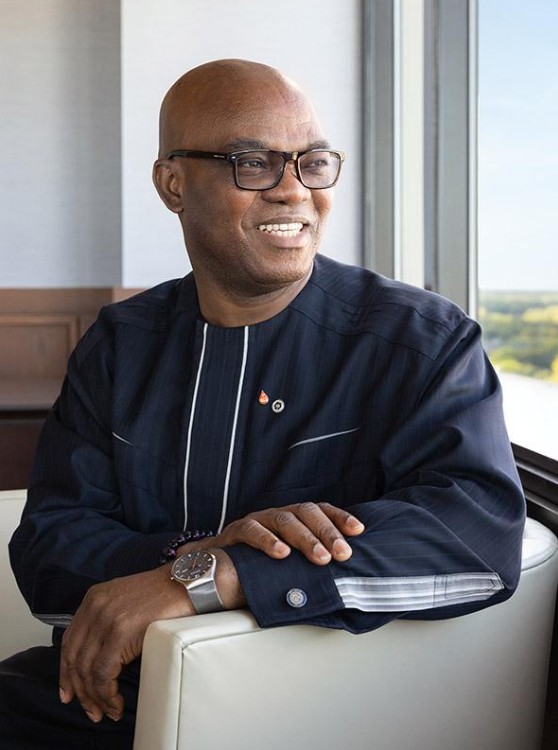
Image credit: Monika Lozinska
He thinks a key to growing Rotary is realizing the effect it has on you.
While members can and should measure the impact of a project, Babalola wants to see that idea flipped, too. “How has doing all of that impacted you?”
He can clearly see how Rotary has changed his own life. “I had a privileged upbringing — a good education in a place where many did not have that opportunity,” he says. “Rotary grounded me. It pulled me out of my privileged world and put me in touch with the realities of my community.”
Many Rotary members have their own stories about how their membership has changed their lives for the better, how it humbled them or brought them closer to their fellow human beings. Babalola encourages them to share those stories. “If we are going to grow this organization, we must let people understand how membership can make a lasting impact on their own lives,” he says. “That’s one of the things I’m hoping that I can help communicate.”
Rotary made him a diplomat.
As a Rotary director in 2018-20, Babalola represented more than 80 Rotary countries and geographical areas — over a third of the Rotary world — including countries in Africa (where at least 1,000 languages are spoken), the Middle East, and parts of Europe. The zones he represented included politically sensitive areas such as Israel, Lebanon, Ukraine, and Afghanistan. “There are certain skills you end up building,” he says.
For example, at a Rotary institute he convened in Egypt, he received a phone call from a senior government official about a map of Africa used at the event. The map, which he’d found on the internet, showed Western Sahara as a separate country, which Morocco does not recognize. Egypt supports the position of Morocco. “That kind of situation brings a certain awareness straight to you,” he says.
He’s the second president from Africa.
“It means a lot for the people of that continent,” he says. And, he adds, everyone seems ready to do the work to support him. “I’m used to delivering results. We need to deliver results,” he says. That’s what he’s been preaching at the Rotary institutes he’s attended. “I’ve told them, stop talking about things. Just do it. If it works somewhere, copy it shamelessly. Don’t be afraid to fail — be afraid not to try.”
This story is from the February 2026 issue of Rotary magazine.
The Rotary Foundation transforms your gifts into service projects that change lives.
Related stories
Rotary Club of Santa Rosa Sunrise - Founded June 30, 1986