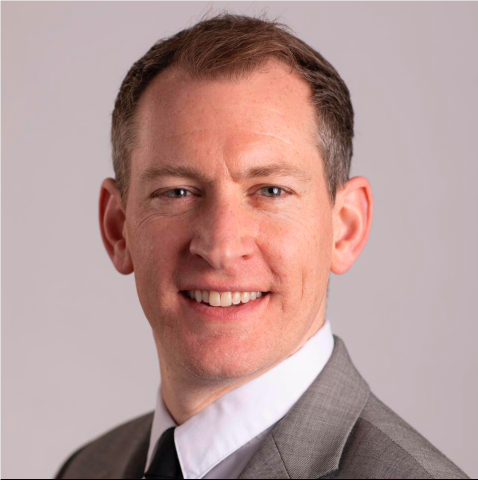
Geoff Cochran, Annual Giving Officer - "Understanding the Rotary Foundation"
Geoff is the Annual Giving Officer with the Rotary Foundation. He is part of a team within the Foundation's staff who applies giving trends, data analysis, and connections to empower Rotary leaders to acquire, retain, and upgrade donors, fund more grants, and create a strong pipeline of philanthropic support for The Rotary Foundation.
In his letter to President Debra about visiting our club while in the area for the District's Spring Training, he stated, "I am offering myself as a resource to you and the club to learn more about the Foundation and ways Rotarians can give through TRF. I know the club is active and has a vibrant giving culture and thought my time would be a great fit."
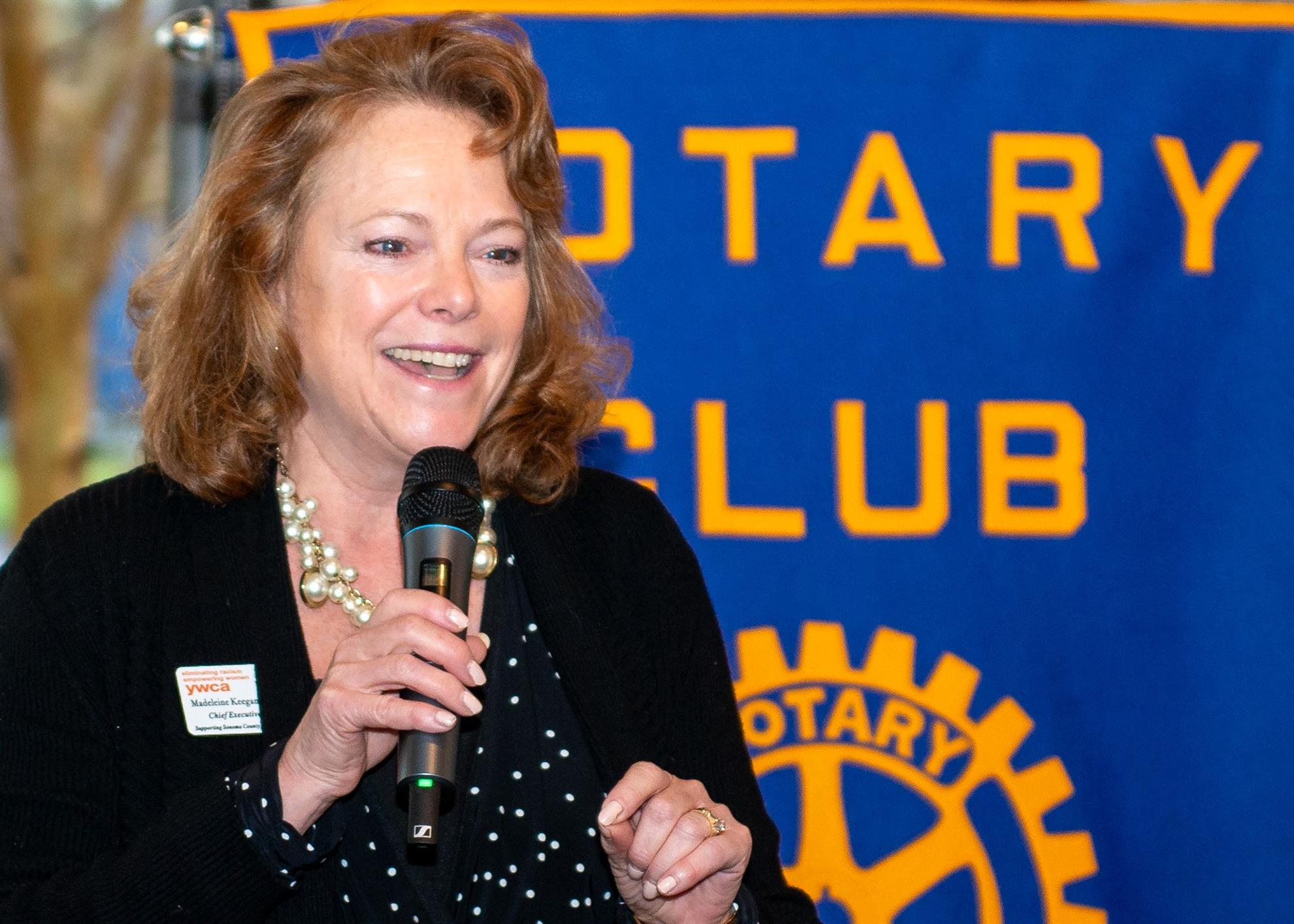
Madeleine Keegan O'Connell Presents the YWCA of Sonoma County
Our speaker for Thursday, March 28, 2024, was Madeleine Keegan O’Connell, Chief Executive Officer of YWCA Sonoma County. Madeleine has been the CEO of YWCA since 2012. Prior to her career at the YWCA, Madeleine was in the banking world with the Bank of the Redwoods in a variety of executive positions. She is a proud graduate of the University of San Francisco.
The YWCA was established in Sonoma County in 1975 when community leaders realized that Sonoma County families were becoming increasingly financially stressed, some even living in their cars. It is now the only domestic violence service provider in Sonoma County operating an emergency shelter. Madeleine supervises a staff of 50 and oversees a budget of $5 million. Domestic violence is a pervasive problem in Sonoma County; 1 in 4 families have experienced domestic violence. The YWCA provides three categories of services: domestic violence services, counseling support, and childcare.
The YWCA operates a 9-bedroom, 4,500 square foot home built in 1900 as a confidential safe house shelter for male and female victims of domestic violence. The YWCA has a 24/7 hotline staffed by trained domestic violence counselors. It also provides resources and support for divorce, custody, child support, housing, immigration, and finances. The YWCA also provides counseling services to survivors of domestic violence, including children, teenagers, adults, and families. In addition, the YWCA operates a network of six affordable childcare centers throughout the county, including a therapeutic pre-school called “A Special Place” in Santa Rosa.
The YWCA is a major participant at the Family Justice Center. The YWCA sees about 90% of the people who come through the Family Justice Center.
Thank you, Madeleine, for speaking to us about the YWCA and its many services, and for being such a powerful advocate for Sonoma County families.
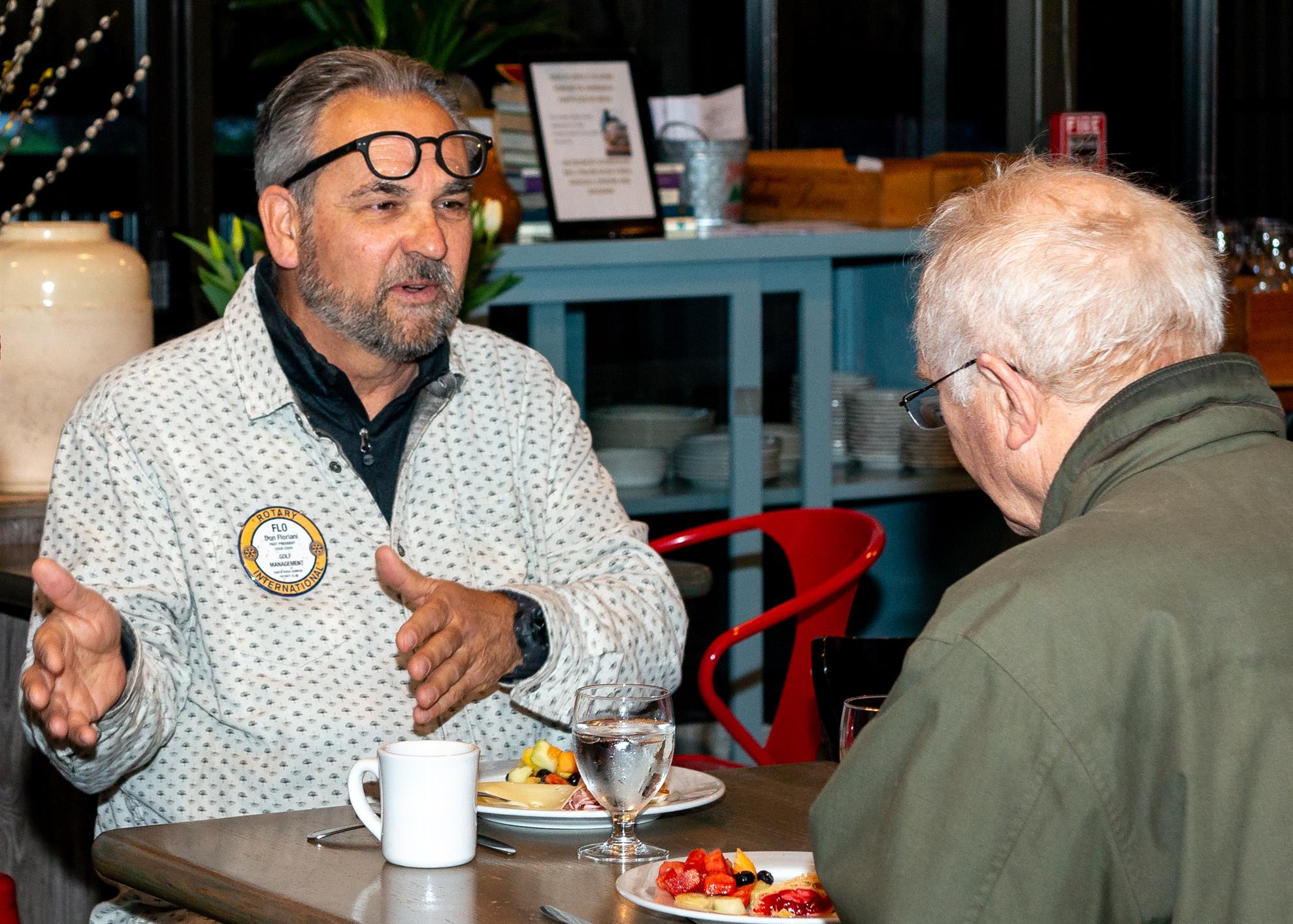
On a regular basis, our resident photo pro Warren Smith, submits pictures of what is going on at the weekly meetings. You can always find the most recent pictures at the websites photo journal called "Meeting Sighting" Please note that all the meeting photos for the entire Rotary year are at this location with the most recent on the last page.
Thanks for all the great pictures Warren!Link to Meeting Sightings. The most recent are on the last page!
A motorcycle cop was riding the streets of San Francisco when he noticed a car weaving with a bunch of heads in the back seat. When he pulled the driver over, he realized he had a car full of penguins. The officer said, "Sir - you should take all these penguins to the zoo!" The driver agreed. The next day, the same officer noticed the same car with a bunch of heads bopping around, so he pulled him over again. "Sir, I thought I told you to take these penguins to the zoo!" The driver replied, "You did, and they had a great time! Tonight, I am taking them to the movies."
These are times that cry out for peace. The Middle East is in its most volatile condition in years. The war in Ukraine is the largest in Europe since World War II, and there are armed conflicts in Sudan and parts of Central Africa. Nearly every continent is experiencing a major armed conflict.
Rotary has a vital role to play in advancing the cause of peace — I often say Rotary needs to work toward peace as aggressively as those who wish to wage war. It’s the spirit found in our vision statement: “Together, we see a world where people unite and take action to create lasting change — across the globe, in our communities, and in ourselves.” We must never lose track of that last call — that to bring about change in the world, we need to foster change within.
It is up to us to model peacebuilding behavior among each other. We can do better than questioning the motives of one another and jumping to the harshest possible explanation. After hearing words that might strain or offend us, we have an opportunity to ask, with compassion and curiosity, the intent of those offending words. And then we have another opportunity to repair the breach.
If we wish to be a beacon to the world, let us start by being so to one another. Let’s help each other find greater understanding and productive alternatives to words that cause hurt and distrust. And let’s stick to our principles, but never doubt the sincerity of each other to end conflicts, not inflame them.
I’m reminded of a speech that U.S. Senator Robert Kennedy made on 4 April 1968, that dreadful day when the Rev. Martin Luther King Jr. was assassinated. Kennedy was in Indianapolis speaking to an audience in a predominantly African American neighborhood where people had yet to learn that Dr. King had been killed.
He shared the terrible news. He honored Dr. King for all he had done for the cause of justice and peace. And then he connected with the fuming, grieving crowd by saying: “For those of you who are Black and are tempted to be filled with hatred and distrust at the injustice of such an act, against all white people, I can only say that I feel in my own heart the same kind of feeling. I had a member of my family killed.” It was the first time he had spoken publicly about President John F. Kennedy’s assassination. And while many American cities exploded in violence that night, Indianapolis did not.
It is in times of crisis and despair that we need empathy most of all. Empathy is the most powerful tool of peace, and it is vital if we are to take the first brave, humble steps to Create Hope in the World.
For many, the Bahamas is a place to escape colder climes, relax on white-sand beaches, and snorkel in clear, turquoise waters. For me, it’s home. I grew up sailing on these waters and to this day, anytime I can, I am out on the water with family and friends. It’s where my heart is.
The environmental threats my country is facing are real. Our coral reefs, vital for biodiversity, are in danger due to warming seas and pollution. Hurricanes and tropical storms seem to get more intense with each passing year. Rising sea levels pose an existential threat to the Bahamas, eroding our beautiful coastlines as saltwater intrudes on our precious and limited freshwater resources.
Late last year, I was fortunate to represent Rotary at COP28, the United Nations climate change convention in Dubai, United Arab Emirates. The consensus coming out of the meeting was that progress on addressing climate change has been too slow. Participants said the world needs to pick up the pace to reduce greenhouse gas emissions, help communities become more resilient to climate change, and better support countries that are most vulnerable to it.
Rotary can be part of the solution.
As you know, protecting the environment is one of Rotary’s areas of focus. Many clubs are active in their communities with projects such as beach and roadside cleanups. With The Rotary Foundation, you can increase your impact by pooling resources with clubs and districts around the world. Foundation grants let you put the generous contributions of your fellow Rotary members to work to make the world better.
Imagine the possibilities. Perhaps Rotary districts in Canada and Australia could protect wetlands in New South Wales in Australia. Rotary leaders from Brazil, India, and Taiwan could lead grant projects to train farmers in the Indian state of Andhra Pradesh in sustainable agriculture. Rotary and Rotaract clubs from the Bahamas, South Africa, and New York could work with their districts to help my country restore its natural resources, one reef or mangrove at a time.
The problems our environment faces seem overwhelming until you realize that many are fixable. There are so many ways to help through Rotary. Even if we don’t lead a grant or volunteer on the project, we can all help protect the environment through our giving to the Foundation.
Rotary can’t save the planet all by itself. But as our progress in ending polio proves, Rotary’s impact is great when we put our vision for a better world in motion, and just get started.
Rotary project supplying clean water to Zimbabwean villages brings wide-ranging benefits
By Etelka Lehoczky
Nobody takes water for granted in Zimbabwe, least of all the residents of Musekiwa and Mushaki. Located about 160 kilometers (99 miles) from the capital of Harare, the two villages have been drastically affected by the country’s water shortage. Until recently, many residents walked five kilometers (three miles) or more to find water every day.
“They were getting some water from open wells, some from rivers,” says Trymore Tafadzwa Kabanda, a councilor for Mushaki.
By the numbers: Rotary’s water, sanitation and hygiene projects
Global grants awarded since 2019 for these projects: 1,247 grants totaling more than US$93 million
Number of countries where clubs have used global grant funding for these projects: 95
Largest grant: US$800,000
Smallest grant: US$30,000
That changed when two Rotary clubs thousands of miles apart decided to collaborate on a grant-funded project. Members of the Rotary Club of Saint Helena, California, USA, learned about the villages’ situation in 2020 from a guest speaker whose wife had grown up in the area. They found out about the devastating effects climate change has had on rainfall in rural Zimbabwe, where more than 90% of households depend on agriculture for their main livelihood. Zimbabwe’s rainfall patterns have become highly variable in the last two decades. The rainy season used to last from October to March; now it sometimes starts as late as December.
“They had a horrendous water problem,” says John Muhlner, a past president of the Saint Helena club. “Women, for the most part, were walking miles every day to bring water back to their homes. Often they would go and wouldn’t find water, or maybe the water they found would be contaminated.”
The Saint Helena Rotarians contacted the Rotary Club of Harare CBD, Harare, Zimbabwe, which conducted a community assessment. After that, the clubs raised funds and applied for a Rotary Foundation global grant. The US$82,000 project plan was to dig two wells, install solar-powered pumps and a water piping system, train residents to maintain the equipment, and conduct an educational campaign about the importance of hygiene.
Although the project seemed straightforward, it took more than a year to complete. The first barrier was a predictable one: bureaucracy.
“It is quite important that you approach the various government offices to get the necessary approvals before you start a project,” says Antony Matsika, a past president of the Harare club. “We had to go through four levels of approvals: the provincial development coordinator, the district development coordinator, the rural district council, and – lastly, maybe, but still important – the chief of the area. If we didn’t go through those different stakeholders, we were not going to succeed in doing the project.”
Once work was underway, the clubs encountered a problem they didn’t anticipate: One of the wells they dug didn’t strike water.
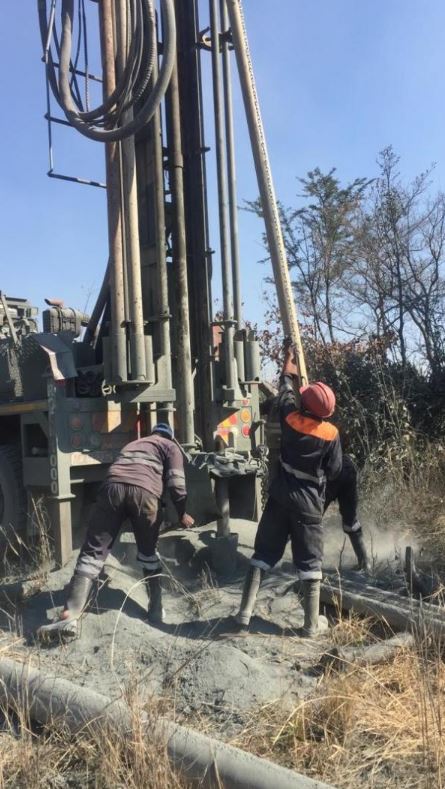
Workers dig a well in the village of Mushaki, Murehwa District, Zimbabwe
Courtesy of Constancia Bosha
“In Zimbabwe, you can contract for drilling one of two ways. One is to tell the contractor where to drill, and if nothing comes out of the hole, you’re responsible for the cost of drilling somewhere else,” says Dan Balfe, a member of the Rotary Club of Santa Rosa, California, USA, who also worked on the project. “We should have contracted for a wet hole, which is to say, they would guarantee to drill a hole that had water. We learned a lesson there. As a result, we had to do another phase of fundraising.”
Ultimately, the villages did get their water. Now the Saint Helena and Harare clubs are planning a second grant-funded project to help two more villages in the region. But there’s still a need for many more such initiatives. The World Health Organization estimates that 1.4 million people die each year because of inadequate water, sanitation, and hygiene facilities. Access to clean water affects everyone – often in surprising ways.
“Water touches on all of Rotary’s areas of focus,” says Mary Beth Growney Selene, chair of the Water, Sanitation, and Hygiene Rotary Action Group. “Children are not being pulled away from school to go fetch water in a local river. Parents don’t have to spend time fetching water, so they can be more productive economically. People aren’t as susceptible to waterborne diseases. ‘It all starts with water,’ is what we say.”
That was certainly the case in Mushaki and Musekiwa. “Now, most of the villagers don’t have to go more than a few meters to fetch water,” Kabanda says. “Also, diseases like cholera are prevented.”
Kabanda and the Rotary members believe the new wells shielded people in Mushaki and Musekiwa from a recent outbreak of cholera, which can be caused by a bacterium in brackish river water. A hospital in the area said there hadn’t been any cases of cholera from the two villages, Matsika says.
“Our conclusion is that it is probably because of our project – because of the supply of clean water.”

.png)





.png)