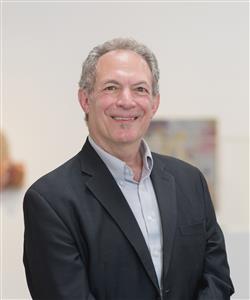
Jeff Nathanson has served as Executive Director and Art Curator for the Museum of Sonoma County since September 2017. A veteran arts administrator and curator, Jeff served as executive director of the Arts Council of Princeton (Princeton, NJ) from 2005 to 2016 where he oversaw a major expansion including the building of a new arts center designed by renowned architect Michael Graves.
Prior to that, he was a special projects curator for the Princeton University Art Museum where he oversaw major projects by artists Magdalena Abakanowicz and Sol LeWitt. He has been a consultant, guest lecturer and guest curator with a range of cultural and educational organizations including Brown University, California College of the Arts, the College of New Jersey, Crocker Art Museum, Cuesta College, Eastern Michigan University, the Bradford Graves Foundation, International School Services, Princeton Public Library, Rhode Island School of Design, Sanchez Art Center, San Francisco Art Institute, San Francisco State University, San Francisco Museum of Modern Art, Towson University, Westmont College and others.
Jeff studied fine arts and music at UCLA and UC Santa Cruz (where he earned a BA with college honors) and earned a Graduate Certificate in Nonprofit Fundraising from Indiana University School of Philanthropy.
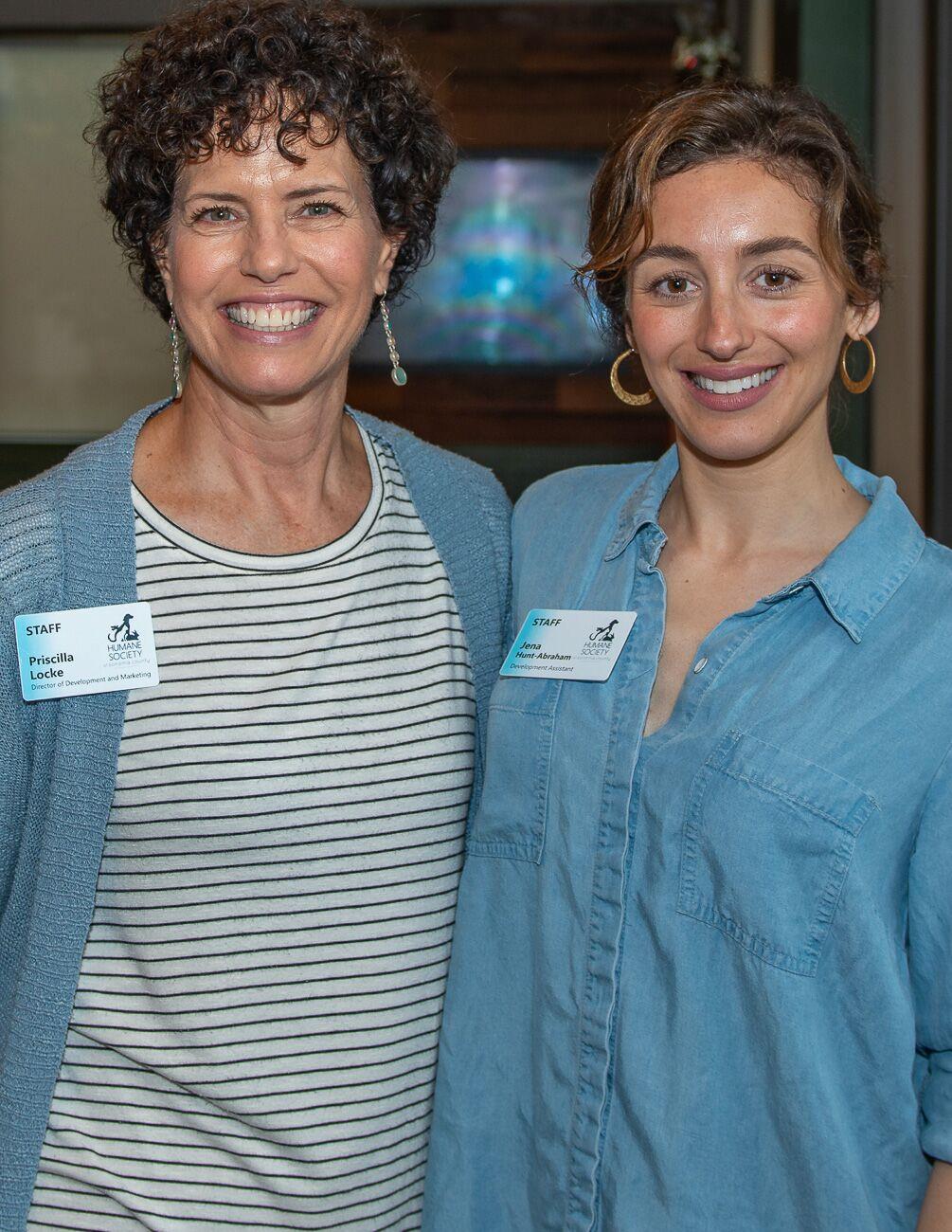
Our speakers for Thursday, May 9th were Priscilla Locke and Jenna Hunt Abraham from the Humane Society of Sonoma County. Priscilla is the Director of Development and Marketing and Jenna is the Development Assistant.
Did you know that the Humane Society of Sonoma County was founded in 1931 and is 100% donor funded? The Society is not affiliated with the national Humane Society organization or with a governmental agency; it is a Sonoma County stand-alone 501(c)(3). The Society has a 4-star rating from the Charity Navigator, a national organization that rates charitable foundations. The rating confirms that the Society has the highest financial and ethical standards. (Side note: The Rotary Foundation also has a 4-star, 100% rating from Charity Navigator!)
The Society provides medical care (including spay/neuter surgery and intensive care), training services, and adoption assistance to animals. It has facilities in Healdsburg and Sebastopol, including adoption clinics, acceptance of stray animals, dog licensing, animal training classes and veterinarian clinics. It also operates low-cost veterinary clinics on a sliding scale for qualified pet owners who might otherwise have to surrender their pets.
The Society has 70 employees and utilizes 700 volunteers! It accepts animals from all over the country and even recently had a rented jet deliver animals for their care from the Los Angeles area! The Society promises to love, support and work with each and every animal in their care. What a fantastic organization and a Sonoma County hidden jewel! Many thanks to Priscilla and Jenna for their informative presentation.
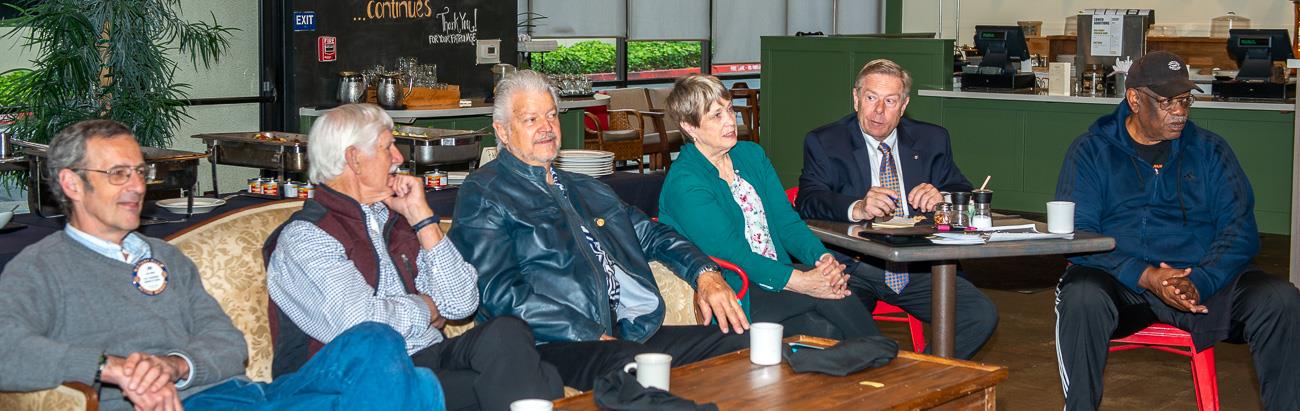
On a regular basis, our resident photo pro Warren Smith, as well as Club Public Relations-Image Director Jack Strange, submit pictures of what is going on at the weekly meetings. You can always find the most recent pictures at the websites photo journal called "Meeting Sighting" Please note that all the meeting photos for the entire Rotary year are at this location with the most recent on the last page.
Thanks for all the great pictures Warren!Link to Meeting Sightings. The most recent are on the last page!
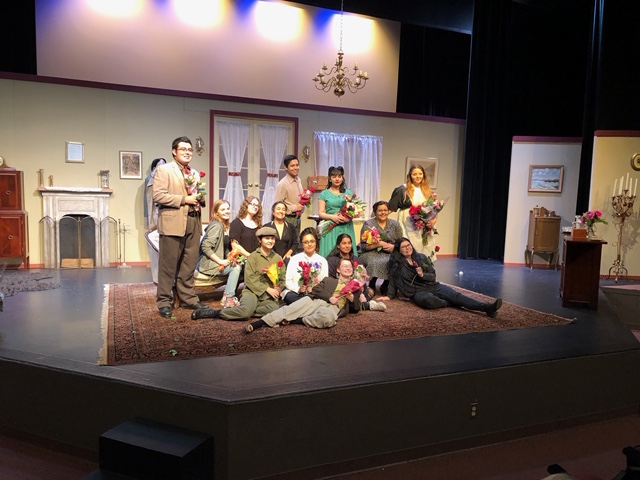
Yes, some very familiar names: John Leddy. Jaden Kegeny, Rob Giacomini, Trinity Laney, Logan Leddy: Elsie Allen Interactor's, Scholars and Food Bank Volunteers! And a Sunrise also known: Carolyn Anderson. Carolyn drafted and monitored our District Matching Grant for the Drama Department's Cyclo-Curtain backdrop. With inspiration and perspiration from fellow Sunriser and Grandmother Merle Hayes, these two dynamic duos brought a much needed asset to the Lobos Performing Arts Program!!
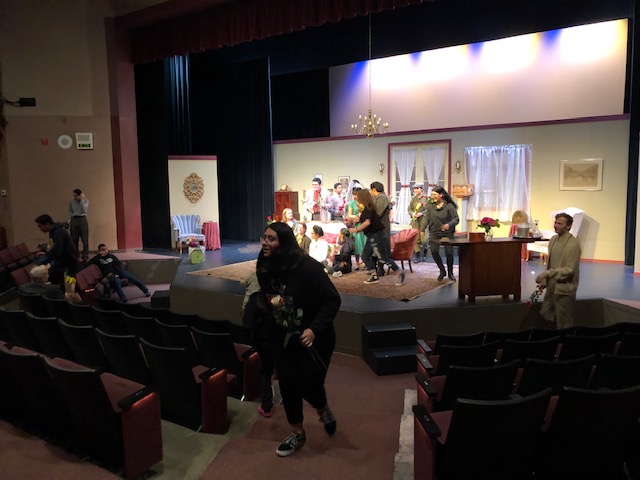
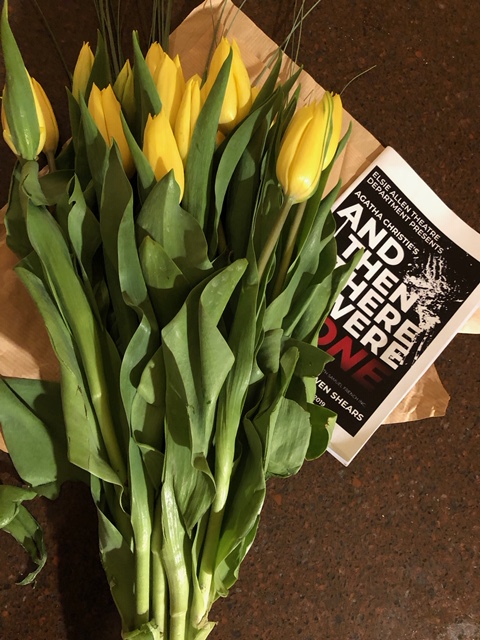
Enjoying front row seats, Carolyn and George, Rich and Betsy, Stacy and Merle had choice vanatage to the Agatha Christie classic which kept everyone guessing "who done it?"
Carolyn received applause and flowers for her role in advancing the curtain grant. Drama Department Chair Bronwyn Shears gave Carolyn and Merle and Sunrise due recognition for supporting Lobos students.
Proud Grandmother Merle and a relieved cast and crew!
The students are AMAZING!! Their dedication, talent, and performances reminded this reviewer that youthful creativity, blended with support and inspiration yields dividends for ALL!!
Keep the Lobos Performing Arts 2019-2020 Season on your horizon!
Diplomat traces start of career back to Rotary scholarship
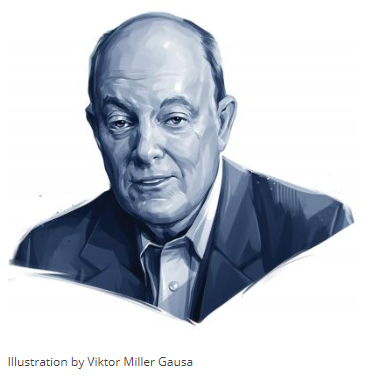
In four decades as a diplomat, John Caulfield represented U.S. interests in nine countries. He served at the U.S. Embassy in London; as one of three people at the small consulate in Cali, Colombia; in Venezuela after the U.S. ambassador to that country was expelled by President Hugo Chávez in 2008; and in Cuba at a time when the two countries had no diplomatic ties at all.
Caulfield traces his career in foreign service back to 1973, when he was a Rotary Foundation Ambassadorial Scholar in Salvador, Brazil. Now retired as a diplomat, he lectures on Latin America and consults with businesses that want to reach the Cuban market.
Q: What about your experience as an Ambassadorial Scholar led you to think about the foreign service as a career?
A: People were always asking me questions about the United States — about everything from Native American culture to the space program. And they would ask why we do things the way we do in the U.S. During this year of study when I was a kind of unofficial representative of the United States, and given all the questions people were asking, I thought, “You know, it might be interesting to do this as a career.”
Q: Your first posting was in Cali, Colombia. What was your role?
A: I was vice consul there. As part of my job, I was in charge of issuing visas to people in Cali who wanted to travel to the United States. At that time, Cali was known for problems with the drug trade. I had to really listen to people, because not everyone was going to tell me the truth, and it was important to distinguish fact from fiction. I learned what it meant to be an official representative of the U.S. abroad.
Q: Your last posting was in Cuba, when there was no U.S. embassy in that country. What were the challenges?
A: There’s a complicated history, and an emotional history. I used to call the U.S.-Cuba relationship “the bad divorce.” It’s so traumatic and difficult for everyone involved. Sometimes it’s hard to act in your own best interest, because you’re so concerned about the other people. I met incredible people in Cuba, very brave people, and I value that experience. I hope the Cuban people will have greater opportunities in the future than they’ve had.
Q: What skills are important in diplomacy?
A: You’re the person who explains to your own government what’s going on in the country where you’re posted. You have to listen and to understand what makes this country tick. What are the people here trying to accomplish? What are they interested in? And at the same time, I’m there to explain not only U.S. culture but also the interest of the U.S. government in a particular situation. Sometimes you have to figure out what that is in a new situation.
I go back to that early experience on my Rotary scholarship. The skills I started to develop as a young man continued to pay off throughout my career. The ability to observe, listen, and understand a foreign country and culture, and the deeper understanding of my own culture that I got from talking about the United States, served me well in my career as a diplomat.
.png)
.jpg)

.JPG)
.png)



.jpg)
.jpg)
.jpg)
.jpeg)
.jpg)