By Diana Schoberg Photos by Alyce Henson
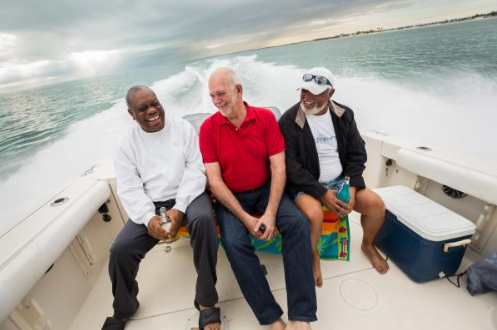
Several miles off the shoreline of Nassau, Barry Rassin, the 2018-19 president of Rotary International, balances in the bow of the bobbing Rat Bat. There are no colossal cruise ships out here, no noisy Jet Skis, only the occasional passing pleasure boat and the sound of water lapping against the hull. In the turquoise sea below, giant turtles glide across the ocean floor.
“To me,” Rassin says, “the sea is freedom, it’s peacefulness. When I’m out on the water, everything fades away. You feel like you’re at one with the world and nothing could go wrong.”
Barry Rassin enjoys some time on the water with his good friends Felix Stubbs, left, and Wade Christie.
A few minutes ago it was drizzling, but now the weak December sun struggles to peek through. The Rat Bat sways suddenly in the wake of a passing vessel. Unfazed, Rassin stands perfectly poised, staring toward a patch of blue sky floating on the horizon.
Late in the afternoon of 12 January 2010, Rassin and his wife, Esther, were at home in Nassau, the capital of the Bahamas, when a magnitude 7.0 earthquake rocked Haiti, 550 miles away. Shortly thereafter, Rassin got a call from Errol Alberga in Jamaica. At the time, Alberga was the governor of District 7020, which encompasses the Bahamas, Jamaica, and Haiti, as well as several other island nations in the West Indies.
Alberga told Rassin – a former governor of the district and president of the renowned Doctors Hospital in Nassau – about the earthquake and asked him to lead Rotary’s relief efforts. Rassin spent the rest of the evening pacing around his living room as he called other Rotary leaders in the region. In a corner of the room, a television broadcast images of Haiti in ruins – and then, scrolling across the bottom of the screen, came the emergency warning that caught Rassin’s eye: A tsunami might be headed for the Bahamas, a seismic sea wave so formidable it had the potential to wash over the entire country.
Rassin and his wife walked out onto their second-floor balcony and waited. “At night, if you look out toward the ocean, all you see is lights, stretching down to the edge of the water, and then everything turns black,” Rassin recalled in a powerful speech he delivered in January at the International Assembly in San Diego. “I looked at where the lights ended and the black began, and I waited for the blackness to come toward us and swallow the light.”
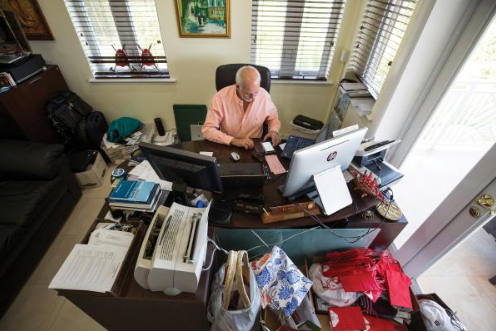
Barry Rassin at his home office in Nassau, Bahamas.
Fortunately, the tsunami failed to materialize, and Rassin got back to work. Over the next few days and weeks, as Richard McCombe, another past district governor, headed Rotary’s day-to-day response, Rassin coordinated long-term recovery efforts funded by donations from Rotarians around the world to The Rotary Foundation. He created a 132-page spreadsheet to track each detail: how much money was available, how much had been spent, which Rotary club was in charge of which initiative. “At the district conference the year after the earthquake, Barry went through the dollars for every single project,” says Lindsey Cancino, past president of the Rotary Club of East Nassau, Rassin’s club. “It matched to the penny what was in the [disaster recovery] account. I was mesmerized.”
In the immediate aftermath of the earthquake, Rassin worked with Claude Surena, a Haitian doctor and Rotarian who had turned his home outside Port-au-Prince into a makeshift shelter and hospital. There, Surena provided care for more than 100 displaced people. Elsewhere on the island, tens of thousands were dead and tens of thousands more injured. In nightly calls to Rassin and his team, Surena – who, at the behest of René Préval, then president of Haiti, would later oversee the recovery of the nation’s private and public health sectors – detailed the medicine and other supplies he urgently needed. And then, each morning, a private plane flew from Nassau packed with the necessary goods.
Rassin decided to tag along on one flight. On the four-hour journey, flying low over the ocean, he gazed out at the limitless blue of the sky and an azure sea dotted with green tropical islands. “It just looked like paradise,” Rassin said in his speech. “And then we came in over Haiti.”
On the ground below, he saw buckled roads, collapsed houses, and entire neighborhoods turned to rubble. Unable to land in Port-au-Prince, the plane touched down on a grassy strip outside the capital. After unloading its cargo, the plane headed for home. “In a couple of minutes, we were out over the water,” Rassin recalled in his speech, “looking down on that same gorgeous view. Haiti disappeared behind us, the Bahamas lay in front of us, and there we were, in between.
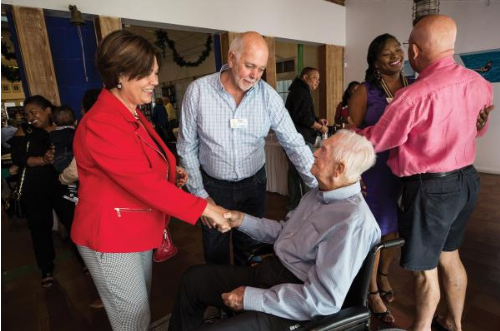
With his wife, Esther, Rassin mingles with fellow members of the Rotary Club of East Nassau.
"And looking down at that water, out at that horizon, I realized that there was no line, no boundary between there and here, between them and us, between the suffering we had escaped and someone else hadn’t. It could just as easily have been the Bahamas. It could just as easily have been us.”
Barry Rassin always felt he was supposed to go into medicine. It was his heritage. His father, Meyer, a notoriously brusque orthopedic surgeon, had arrived in the Bahamas from England during World War II to oversee the medical care of the Royal Air Force troops there. Except for some submarine activity, the Bahamas was outside the theater of war. Nassau’s Oakes and Windsor fields provided flight training for would-be RAF pilots destined to return to the fighting over Europe.
With little in the way of military medicine to occupy him, Dr. Rassin spent time ministering to local residents, including treating people with leprosy who had been exiled from society. This work endeared him to the populace. After the war, he returned to England, but in 1947, a few weeks after the birth of his son Barry, Rassin père returned with his family to Nassau to work in the government hospital. In 1955, he and his wife, Rosetta, a surgical nurse, opened Rassin Hospital to better serve their patients.
Barry was 10 when his father had him watch his first cesarean section. (“That kind of freaked me out,” he says today.) This was his introduction to the family profession. His older brother, David, would earn a PhD, specializing in pharmacology, and devote himself to researching the properties of breast milk.
As for Barry, he enrolled as a pre-med student at Long Island University outside New York City – and flunked out after two years. “I don’t know whether it was too hard for me or I just had no interest,” he explains. “I was never a good academic. Teachers always said I never applied myself.”
Rassin returned to Nassau and worked menial jobs at the British Colonial Hotel. He started at the front desk – “That was not me” – but was soon relegated to microfilming and delivering office supplies. After a year, Rassin realized he had to make a decision: He could either spend the rest of his life working at the hotel and living at home with his parents, or he could go back to school.
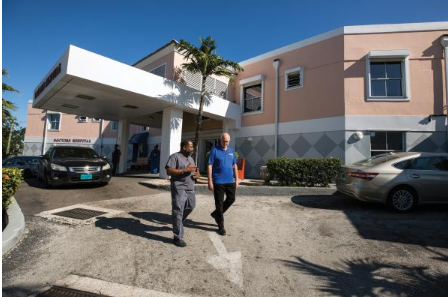
Barry Rassin converses with Charles Diggiss, who took over as hospital president when Rassin retired.
In 1967, he moved to Miami, enrolled in community college, and took whatever classes struck his fancy. He wanted to figure out what suited him best. “Two days in accounting and I said, ‘This is me,’” he recalls. “It was just so easy. It came to me.”
He transitioned into a business program, improved his grades, and transferred to the University of Miami, where he earned a degree in accounting – with honors. Later, he received his MBA in health and hospital administration from the University of Florida.
Back in the Bahamas, following several prosperous decades, Rassin Hospital had undergone a decline. After the Bahamas won its independence in 1973, a lot of British expats, including many of the hospital’s patients, left the country. That’s when Rassin, with several years of health administration under his belt (primarily at Miami’s Mount Sinai Medical Center), returned to Nassau once again, with his first wife and their kids, Pascale, Michele, and Anthony. His goal was to bring the best in modern medicine to the country – and he planned to do it at a transformed Rassin Hospital.
Charles Diggiss, today the president of Doctors Hospital (as the reinvented facility came to be known), covered emergency room shifts there in the late 1980s, when he was a surgical resident at the public hospital. “Barry was running a hospital that was one block away from the public hospital,” Diggiss says. “He had the courage to take that on. There was no promise of success, but every guarantee that this was going to be frustrating, every guarantee that the physicians were going to be skeptical.”
Looking back, Rassin recounts the challenges he confronted: “It was a battle with my parents. It was a battle with the doctors. It was a battle with my wife.” All that pressure caused the demise of his first marriage, he says. But the friends he made through Rotary steeled his resolve to persevere. “It gave me the support from a group of citizens of the Bahamas who said there was really a need to do this.”
Several years earlier, Rassin was working for American Medicorp in Hollywood, Florida, when a doctor asked him to join Rotary. Rassin declined. “In my mind, he was at least 70,” he explains. “I was 30. People say new members aren’t joining because we don’t ask. It’s not just the ask. I was asked. I didn’t want to join.”
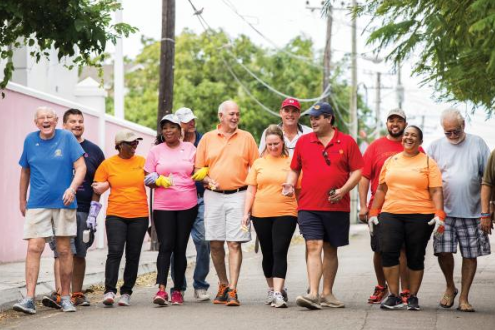
The East Nassau club recently helped clean up a community center for teenagers with HIV/AIDS.
He changed his mind about Rotary when he moved to Nassau and met John Robertson at a fundraiser for the East Nassau club. Robertson was helping out, and Rassin’s daughters, Pascale and Michele, were participating. The two men chatted, and at the end of the conversation, Rassin accepted Robertson’s invitation to lunch at Rotary. Seven years later, in 1987, he was the club’s president. Michele, the club’s first female member, would take the helm in 2009.
Rassin’s rise through the ranks of Rotary coincided with the culmination of his plan to transform Rassin Hospital. In 1986, he worked with a consortium of doctors to buy the hospital from Meyer Rassin and create the newly christened Doctors Hospital. In 1993, under Rassin’s direction, it completed an $8.5 million expansion, and today it’s considered one of the Caribbean’s leading hospitals.
As all this transpired, Rassin’s personal life changed as well when he met and, in 1990, married Esther Knowles. A successful banker, Esther dived into her husband’s life at Rotary. When he was district governor in 1991-92, she accompanied him on a six-month odyssey to every club in every country in the district. Their mutual respect and partnership are evident when you see them together. “Esther has always kept me grounded,” Rassin says. “As soon as she thinks that my ego is kicking in, she makes sure she kicks it back out. After any speech, if Esther was there, I always ask her how it was. She’s the only one who I know will tell me the truth.”
Rassin retired as the hospital’s president in 2016, though he continues to serve on its board of directors. In retrospect, the long struggle to make his dream a reality was worth it. “You’ve got to take risks in this life,” he insists. “That’s what we’re here to do: not to follow the same old path, but to take out your machete, cut away the bush, and create a new way. People here weren’t getting good health care. They needed it badly.”
“One of the most appreciable things about his journey is watching how he committed himself wholly and fully to Doctors Hospital while maintaining his involvement in Rotary,” says Charles Sealy, who met Rassin through Rotary and succeeded him as the hospital’s CEO. “To see how someone can balance the two – except I don’t think the word is ‘balance,’ because he was wholly committed to each of them.”
At the hospital, as in Rotary, people recognize Rassin as both a visionary and a detail-oriented administrator. They also salute him as a valuable mentor. “He’s good at identifying leadership talent,” says Felix Stubbs, a board member at Doctors who credits Rassin with creating the opportunities that led to Stubbs’ own stint as District 7020 governor. “When he sees someone with skills that he thinks could be advantageous to Rotary, he makes sure to pull that person along. That’s exactly what he did at Doctors Hospital. He identified good young leaders and pulled them up – and then he was able to retire and dedicate his time to Rotary.”
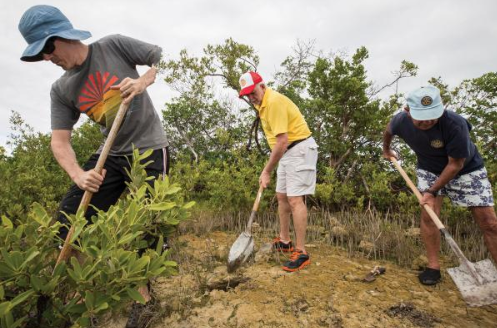
Barry Rassin helps Rotarians and Rotaractors plant mangrove trees at Bonefish Pond National Park on the southern coast of New Providence Island in the Bahamas. Learn more.
As befits an island organization, the Rotary Club of East Nassau meets inside a wood-paneled room at a yacht club. Pictures of sailboats bedeck the walls. Sir Durward Knowles, who, until his death in February, reigned as the world’s oldest living Olympian (bronze and gold medals in sailing in 1956 and 1964, respectively), was an active member.
In many ways, it’s the ideal 21st-century Rotary club: Sixty percent of its members are younger than 50, and one member is a dual Rotarian/Rotaractor. At a meeting in October, there were so many women in leadership positions that a man didn’t come to the lectern for the first half-hour. One order of business: handing out attendance awards. Rassin receives one for 30 years of perfect attendance. Since joining in 1980, he has missed only one meeting.
Though Rotary has been central to Rassin’s life for nearly 40 years, it was never his goal to become president of Rotary International. He was loath to even put his name up for consideration. But, he explains, “the Bahamas and the Caribbean have never had a president, and Rotarians there felt I should put my name in and represent them. I realized that they want to feel part of Rotary, and I was in a position where it was possible. So for them, I thought I should do it.”
Sam F. Owori, a member of the Rotary Club of Kampala, Uganda, was nominated in 2016 to serve as Rotary’s 2018-19 president. After he died unexpectedly of complications from surgery in July 2017, Rassin was selected to take his place.
Among the first people Rassin called was John Smarge, a past Rotary International director from Florida who had served as Owori’s aide. Rassin asked Smarge to serve as his aide too. “One of his first sentences was, ‘I want Sam’s memory to continue, and I want you to help me do that,’” Smarge recalls. “Barry was uniquely qualified to come in at this time. He will allow Sam’s memory to shine brightly.”
Smarge and Rassin have known each other for two decades. They’re from the same Rotary zone and served as district governors around the same time. They worked together closely after the earthquake in Haiti and served as account holders of the Haiti Earthquake Relief Fund, a donor advised fund established through the Foundation that supported projects totaling $6.5 million. “Barry Rassin is a rock star in Haiti – there’s no other way to say it,” Smarge says. “He’s a rock star because they know what he’s done for that country.”
Rassin may be a Rotary rock star and the pride of the Caribbean, but he shuns the limelight, says his friend Felix Stubbs, and considers himself a regular guy. Back when he ran Doctors Hospital, it was not uncommon to see him roaming the halls in shorts and flip-flops. When he visited recently, this time smartly dressed, everyone – from the staff at the front desk to the doctors and nurses – stopped to say hello. One woman rushed up and gave him a big hug. Another smiled and shouted, “Looking good, Barry!”
No disrespect there – just following company policy. In the early 1990s, Rassin (that is, Barry) asked everyone at the hospital to address their colleagues by their first names. He recalls that “one housekeeper walked up to me and asked, ‘Can I really call you Barry?’ I said she could. ‘Well,’ she replied, ‘I’ll just whisper it because I don’t feel comfortable.’
“We’re all on the same level,” Rassin continues. “We just wear different hats. I happen to wear the president’s hat this year, but Rotarians all wear the Rotarian hat, and I have that hat too. We’re all in this game together. We’ve all got to work together no matter what hat we wear.”
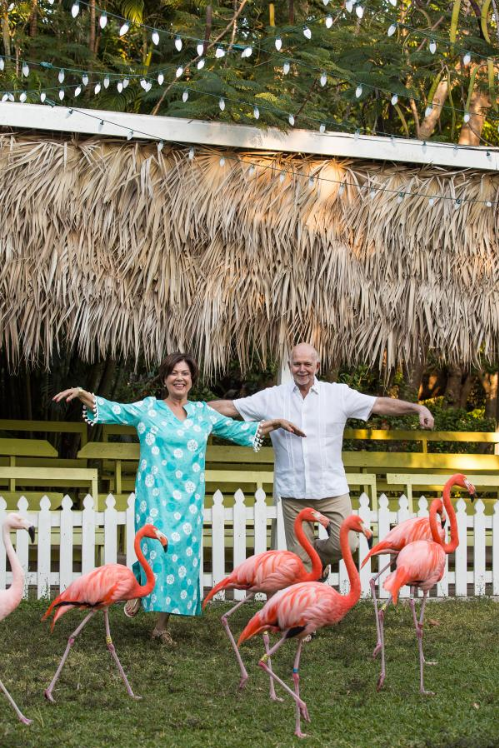
Esther and Barry Rassin with Caribbean flamingos at Ardastra Gardens.
The Bahamas is famous for its swimming pigs (Google it, it’s true), but Barry and Esther Rassin wish another creature would get more attention. The country is home to the world’s largest breeding population of Caribbean flamingos, a species hunted to near extinction in the mid-20th century. At Ardastra Gardens, a zoo and conservation center in Nassau, the birds parade around a ring several times a day, stopping for photo ops with delighted visitors who perch on one leg to mimic their new friends. Rassin came here as a child, and he has returned many times with his children and grandchildren.
It’s the last show of the day, and Barry and Esther stay afterward for a photo shoot alongside the flamingos. When that’s done, they are shaking hands with the birds’ “drill sergeant” – the gardens’ operations manager, who is also a Rotarian – when Esther remembers something: They didn’t get to stand on one leg like everybody else.
She and her husband, now Rotary’s distinguished president, dash back into the ring. The squawking, coral-colored birds gather round. Barry and Esther thrust out their arms and lift one leg off the ground. Their eyes lock, they can’t stop laughing, and it looks as if they could remain perched there, perfectly balanced, forever.


.png)
.jpg)

.jpg)
.png)



.jpeg)
.jpeg)
.jpeg)
.jpeg)
.JPG)