It’s a crisp, sunny day in late October, and school groups are touring the Jimmy Carter Presidential Library in Atlanta.
They see the Bible that the 39th U.S. president took his oath on, a campaign ledger, and a mockup of the Oval Office – as well as his diploma in square dancing, a “Peanuts to President” game board, and a Marvel comic with the Carter family joining Captain America in saving energy.
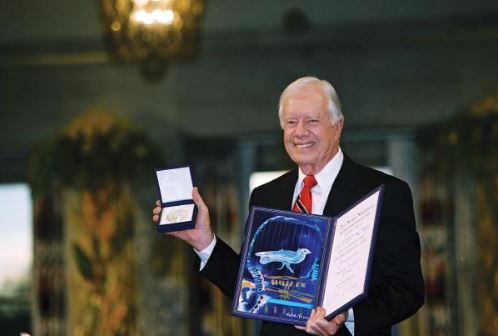
At the end of the exhibit is Carter’s Nobel Peace Prize, which he received in 2002 in recognition of his decades of work advancing peace and human rights.
“This is the biggest award in the world,” one of the field trip leaders explains to the elementary school students. Then she puts it into terms they will understand: “This is bigger than the Super Bowl MVP, believe it or not.”
Perhaps she should have mentioned his two Grammys.
Carter has spent his life fighting for peace: brokering the 1978 peace talks between Egypt and Israel that led to the Camp David Accords, paving the way for a nuclear pact between the United States and North Korea in 1994, and monitoring elections in Panama, Nicaragua, Venezuela, and other places where the ballot box became an alternative to civil war. During his time in office, from 1977 to 1981, the United States was not involved in any wars.
Jimmy Carter received the Nobel Peace Prize in 2002 for his decades of work resolving international conflicts and advancing human rights.
For the past 37 years, Carter has been redefining what it means to be a retired president – and the country’s longest-lived one at that, having surpassed Herbert Hoover (who lived 31 years after leaving the White House). During his presidency, Carter made a commitment to human rights the cornerstone of his foreign policy; he and his wife, Rosalynn, continued that emphasis when they founded the Carter Center in 1982. The center’s programs revolve around two main themes: peace and health.
“We feel that there’s a human right of people to live in peace,” he told The Rotarian. “We feel it’s a human right to have a modicum of health care, to have a decent place in which to live, to have a chance to have an education, to have freedom of speech and freedom of religion and the right to elect your own leaders.”
The center has observed 105 elections, including recent contests in Liberia, Kenya, the Philippines, Zambia, and Guyana, and it has worked with the United Nations and other groups to develop standards for democratic elections. When democratic avenues fail, the center mediates armed conflicts. It is currently involved in efforts to resolve the Israeli-Palestinian conflict, as well as conflicts in Sudan and South Sudan, Syria, and Liberia; it’s also working to combat the rise in violent religious extremism and Islamophobia in Europe, the Middle East, and the United States.
On other fronts, the Carter Center has formed a task force on disease eradication. The only one of its kind in the world, it analyzes data to ascertain which diseases could be eradicated from the entire world. The center is focusing on eradicating Guinea worm disease and regionally eliminating five other diseases: river blindness, trachoma, schistosomiasis, lymphatic filariasis, and malaria.
“I might say if Rotary wasn’t leading that fight to eradicate polio now, the Carter Center would – it’s the kind of thing that would be very exciting for us,” Carter says. “We’re very proud to see the progress that Rotary has had with that.”
Carter knows the power of service organizations well – he’s a member of the Lions club in his hometown of Plains, Georgia, and a past district governor. And for more than 30 years the Carters have dedicated a week each year to volunteering with Habitat for Humanity.
Carter spoke with senior staff writer Diana Schoberg by phone from his home in Plains on Halloween. Still very involved in the community where his family has lived since 1833, he planned to go downtown that night to join other local leaders in greeting trick-or-treaters.
The Carters have volunteered with Habitat for Humanity for more than 30 years.
Q: The Carter Center describes itself as waging peace. If peace isn’t merely the absence of war, describe the battle for peace.
A: We take peace not as a dormant situation, but as one to be fought for – like winning an armed conflict. We try to be aggressive in order to bring about that goal. We are not constrained at the Carter Center by policies of the United States government, although we have to comply with the law. We deal with people who are outcasts, or unsavory. I’ve been to North Korea three times, and I’ve probably spent more than 20 hours with their top leaders talking about the prospects of peace. We’ve also continued to deal with both Palestinians and Israelis. We have a relationship with the president of Sudan, Omar al-Bashir, who the United States refuses to deal with. We try to probe aggressively to find ways to bring about a peaceful understanding between adversaries, but I always make a point to get permission from the White House before I embark on such an adventure.
Q: How do you work with people who are arguing with each other?
A: I wrote a book, Talking Peace, about that. People who are at war, or a couple with a marital difference that leads to divorce, or parents who are alienated from children, or students divided on a campus – all have a difference of opinion that they can resolve.
When I founded the Carter Center, I wanted it to be a little Camp David, where I negotiated with people who were at war. But I soon found that sometimes when two sides were fighting in a civil war, they didn’t even want me to talk to the other side – they despised their adversaries that greatly. So instead of negotiating, we discovered that we could appeal to them by taking advantage of a basic premise of politics, and that is self-delusion. We would go to the generals of the two sides separately and say, why don’t you let us come in and help you hold an honest election – we’re sure that the people of your country will choose the right person to be the leader. And since both sides thought they would be victorious in a peaceful election if we were in charge of it, they would go along with it. So we’ve now done more than 105 elections in the world, each without trouble, and many of them brought about by adversaries who found an election to be a better alternative than continued combat.
A: Is there something that you’ve learned monitoring elections that would surprise our readers?
Q: We’ve found that the United States doesn’t meet the criteria for the Carter Center, because our elections are not conducted properly here. We don’t have one central election commission that makes the decisions for our country – we have counties that decide exactly how people vote and what time they vote. The Carter Center requires uniformity in the whole country.
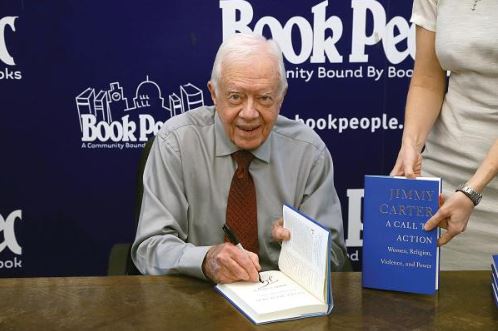
Jimmy Carter has written 30 books, including A Call to Action, released in December 2014.
In most countries where we work, we require that every candidate who is qualified have an equal chance to present their proposals to the public, with uniform access to the public news media and to the people’s minds. We try to minimize the impact of financial contributions within an election, not always successfully.
The United States has changed from a democracy to something of an oligarchy in the last few decades; the candidates who seek to be president have to raise a minimum nowadays of $200 million before they can hope to receive the Democratic or Republican nomination, and then a lot more later, when they run against the opposite party’s candidate.
Q: What would the United States have to do to fix its election system?
A: The main thing is to have public financing. When I ran for president in the general election against incumbent President Gerald Ford, he and I raised a total for the general election of zero. We didn’t go to anybody and ask for a campaign contribution. When I ran against Ronald Reagan in 1980, again we got zero money from any private contributor. We just used the box on the federal income tax form that each taxpayer could check to contribute. Nowadays every vote is not the same. The candidates rely on very wealthy people to help them become a nominee and be elected president, and then they’re obligated to those financial contributors when they get into office. The wealthy people get more wealthy and the powerful people get more powerful and the average person doesn’t have an equal influence on the American government anymore.
Q: Techniques to influence elections have evolved beyond stuffing ballot boxes. We are now seeing hacking and social media algorithms affecting outcomes. How is the Carter Center responding?
A: The Carter Center is studying the voting process. In many other countries, even in a nation like Venezuela, they have a voting system where you indicate your preference by a touch screen, and that’s transmitted to the central headquarters. Then you look at the screen and if it’s how you want it, you punch a button and it prints out a paper ballot. If a question is raised subsequently about the integrity of the election, you’ve got the electronic system that has given you an opportunity to have very early tabulation and then you’ve got the paper system to substantiate the accuracy of it. We don’t have that in our country, except in rare places. There’s no uniformity at all in America. I’m not criticizing my country, I’m just pointing out some possibilities for improvement.
Q: In its mission statement, the Carter Center recognizes that because it is tackling difficult problems, failure is an “acceptable risk.” Why?
A: When we began our work, we decided that we would be nonpartisan in nature, and we decided that we would not duplicate what other people were already doing well. If the United Nations or the United States government or Harvard University was taking care of a problem, we wouldn’t get involved in it. Instead, we’d fill vacuums in the world. Another thing that we decided, which is what you just mentioned, is that we would not be afraid of failure. If we think that something is worth doing, we make an all-out effort – even if we don’t have any assurance at the beginning that we’ll be successful. We’ve had some disappointments and we’ve had to change our priorities on some occasions, but that’s led us into some of the most fruitful things that we’ve done.
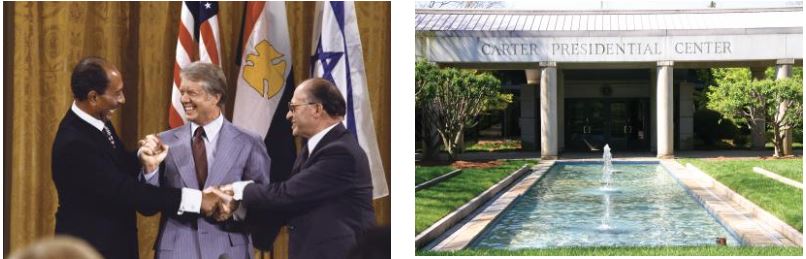
In 1978, as president, Carter orchestrated peace talks between Egyptian President Anwar Sadat, left, and Israeli Prime Minister Menachem Begin, right. The talks served as a model when the former president and his wife founded the Carter Center in 1982.
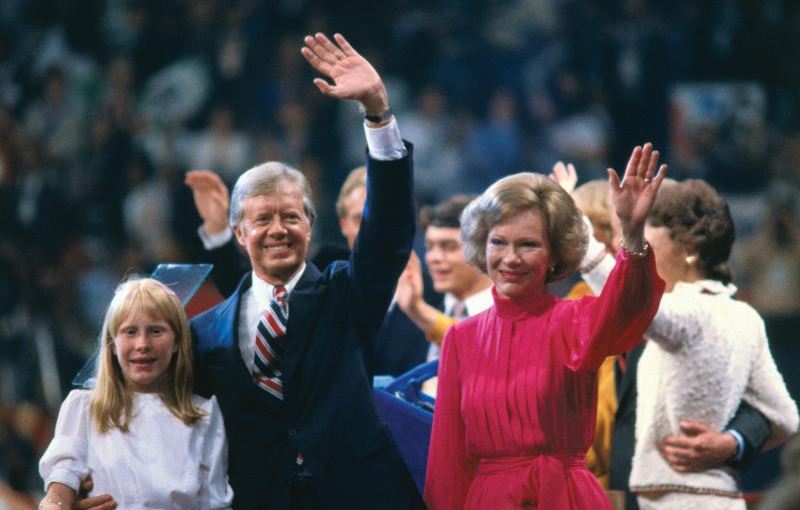
Jimmy Carter, with his wife, Rosalynn, and their daughter, Amy, at the 1980 Democratic National Convention.
Q: Can you give us an example?
A: Addressing Guinea worm, or dracunculiasis, was one of those that seemed hopeless. There was no known cure or successful treatment for it. It was found in 21 different countries. It was found in isolated villages that had no connection to one another. Often, ministers of health had never heard of the disease. It was one of those problems that nobody else wanted to address, so we had a chance to fill a vacuum. We had no assurance of success because until we began, there was no effective way to correct the problem. We’ve come a long way. We still face some unforeseen developments, but we are resolved to succeed. We’ve cut the number of cases of Guinea worm from 3.5 million the first year [1986] to 27 so far in 2017.
Q: You’ve been very close to eradicating Guinea worm for a while, just like Rotary has been very close to eradicating polio. What has made it so intractable?
A: We had a surprising development in the country of Chad a few years ago. We had zero cases of Guinea worm in Chad for nine years and all of a sudden we had another very small outbreak and we found that dogs were involved with transmission, and almost everybody who lives along a particular river in Chad has a dog. We’ve had to deal with this new outbreak just like you’ve had some setbacks with polio, but we’re not giving up.
Q: Being president of the United States would seem like the pinnacle of a person’s career, but after you left office, you went on to become one of the most respected humanitarians of our time. What did your work as president teach you? And was there anything that you only learned later?
A: When I was president, I learned about the interrelationships between countries and the differences between the people who live on the earth. I learned about problems like the threat of nuclear destruction, and we had a first glimpse of global warming at that time. I learned how important peace was: I was lucky enough to have kept our country completely at peace while in office – we never dropped any bombs or launched any missiles or fired any bullets.
Since I’ve been out of the White House, I’ve had much more intimate relationships with individual people than I ever did when I was president, particularly with people in foreign countries.
Q: When meeting regular citizens, what has made the biggest impression on you?
A: We tend to underestimate folks who have an average income of only one or two dollars a day, who don’t have good educations or decent homes. We think they’re inferior to us in some way because they haven’t provided for their families as we have. When we deal with them on a personal basis, we soon learn that they’re just as good as we are, they’re just as intelligent, just as ambitious, just as hard-working. Their family values are just as good as ours. We also learn that their perspective on life is different from ours, often because of the circumstances in which they’ve been born and raised. But we learn to respect them just as much as we respect ourselves.
Q: If you could do one thing to make the world a better place, what would that be?
A: The only time the human race has ever attempted to bring into reality the finest moral and ethical values of all the great religions was right after the Second World War, after 60 million people were killed. We organized the United Nations to guarantee that disputes would be resolved as they arose. That hasn’t happened. We still have multiple wars. Three years later, in 1948, the United Nations adopted the Universal Declaration of Human Rights, which guaranteed people equal rights. Those two things have been a dream or ideal or vision or aspiration or an inspiration, but they haven’t been realized. I would mandate that disputes be resolved peacefully and that the declaration be implemented. That’s what I pray for, and that’s what I hope will eventually happen.
• This story originally appeared in the February 2018 issue of Rotary magazine



.png)






.png)