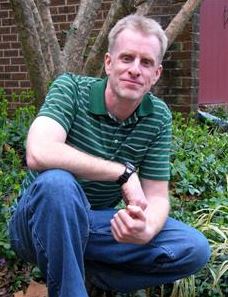
Executive Director, Laguna de Santa Rosa Foundation
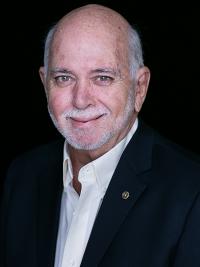
Kevin Munroe joined the Foundation staff in August of 2015. Kevin developed his passion as a naturalist in early childhood and subsequently transformed this interest into a rich career that includes conservation resource management, restoration, and environmental education. Among his recent accomplishments has been leading a 50-acre wetland restoration project within Huntley Meadows Park, a well-known park in Fairfax County's Potomac River Watershed, roughly 12 miles NE of Washington, D.C. In his diverse career, Kevin has excelled in building community partnerships, diversifying fundraising activities, and working with a variety of public and private agencies that include the Army Corps of Engineers, US Fish and Wildlife Services, the Audubon Society, and more.
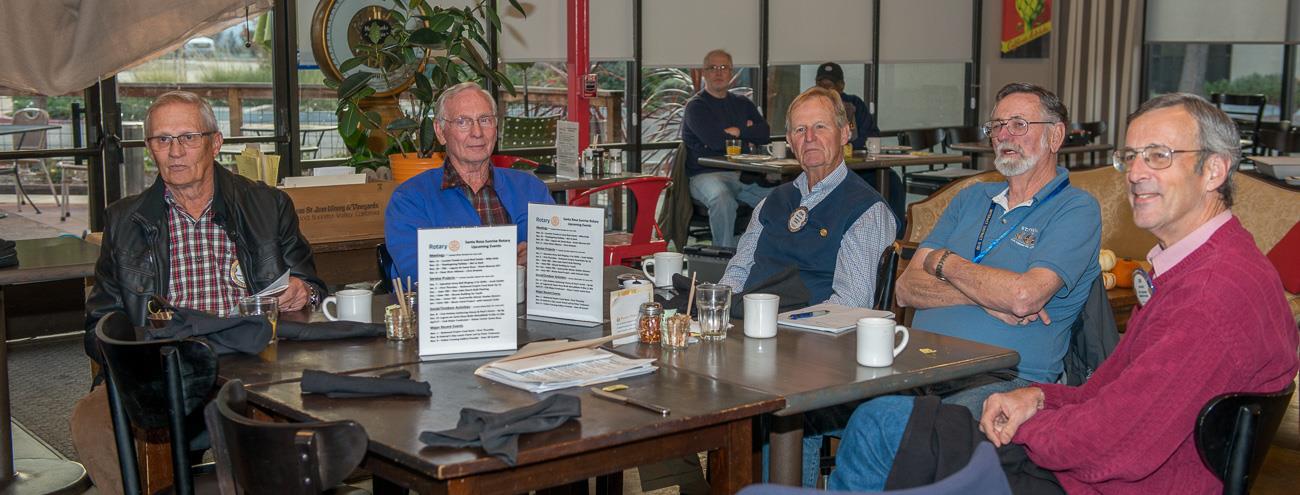
On a regular basis, our resident photo pro Warren Smith submit pictures of what is going on at the weekly meetings. You can always find the most recent pictures at the websites photo journal called "Meeting Sighting" Please note that all the meeting photos for the entire Rotary year are at this location with the most recent on the last page.
Thanks for all the great pictures Warren!Link to Meeting Sightings. The most recent are on the last page!
This culminating November issue marks the closing of Foundation Month. The Rotary Foundation, created in 1947 from donations honoring Rotary's founder Paul Harris. The first beneficiary of the funds became the still very dynamic Ambassadorial Scholarship program. Next were Group Study Exchanges and Technical Grants which have now morphed into the International transforming Global Grant network.
Rotary improves Lives!
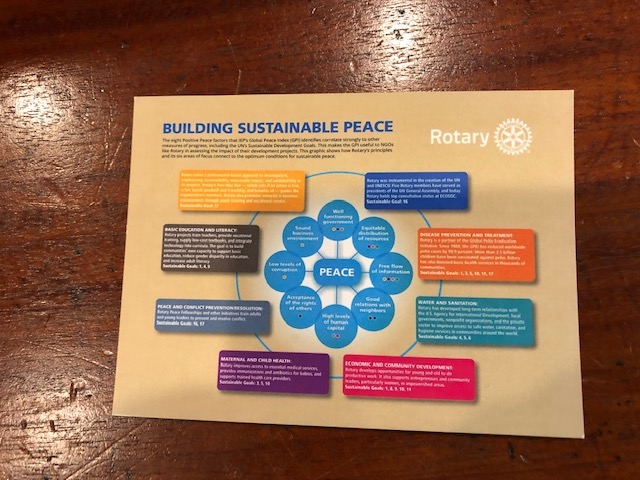
As the momentum of Service Above Self gains mass and speed, the vision of Paul Harris and Foundation architect Arch Klumpf is wider and brighter in scope. So too, do our opportunities to participate in local and worldwide initiatives for life improving, Positive Peace building, education and health standards of living.
No less have we seen from our own meeting space, the powerful, long reach of Rotarians responding to disasters across oceans, united in purpose to do what matters.
While the monthly theme will not repeat until next November, a closing punctuation I will add, reminding us how Rotary's philanthropic progression is an apt model for our heritage of hope and impactful living.
The 19th Century Biologist Haeckel espoused a theory dubbed Recapitulation. It draws I believe, a parallel to the development of our focus on a sustainable, mutually beneficial future.
Consider the Rotary Foundation's area's of focus in your legacy for tomorrow!!
It's traditional that the first Rotarian magazine of the Rotary year carries a profile of the incoming RI president and his or her family. I've always read those profiles with interest, never giving much thought to the possibility that one day, I might be the one bringing a writer from the magazine to my Rotary club meeting! I have never liked a lot of attention, and the idea of having my picture on the magazine cover made me a bit uncomfortable. But when I saw the photo the editors chose, I smiled. Because the star of that picture definitely isn't me, or even my wife, Esther. It's the flock of flamingos, none of which could care less about Rotary, all strutting past us in the same direction. All of them — except one.
I couldn't think of a more appropriate image to reflect the message I want to convey to Rotarians. That one flamingo, going the other way, represents so much of what we need to do in Rotary. That flamingo knows everyone's going one way. She sees it. But she also sees that maybe the path they're on isn't the best path. Maybe, just maybe, there's a better path over there, and she wants to get a good look before she goes marching on with her friends. And if, when she does stop and look, that new path does seem better, she'll call the rest of the crew to come over and check it out with her. And maybe, just maybe, they'll all choose that better path together.
Change is hard. And the longer we've been going one way, the more friends we have with us, the harder it is to be the one who turns around and does it differently. But change — not change for its own sake, but careful, considered, goal-directed change — is essential for any organization that wants to evolve, stay relevant, and move forward in the right direction.
So take a look at that picture, but don't look at me. I'm not the one that cover's about. That cover is about the flamingo. It's about having the curiosity, the courage, and the conviction to look at different paths that might be better — whether you're out for a stroll on a beautiful Bahamas morning, or helping chart the course for our organization.
For many of us, December is a time of reflection about the year that is about to end. We think about the things we resolved to do and compare that with what we actually got done. Many times we surprise ourselves when we realize we achieved even more than we had hoped. We also start thinking about the new year and, with the best of intentions, commit ourselves to even greater accomplishments.
It is a time when our thoughts turn to the things that are important to us — and nothing is as important as family. We are grateful for those we love and for those who love us. For Rotarians, that encompasses a large number of people around the world, because our concept of family includes not only our immediate relatives but also those many friends we have made over the years sharing Rotary. Each of us is much like a stone thrown into a pond, creating many ripples. When our ripples intersect with the ripples of our family and friends, we truly have an impact on our world.
We also think about the organizations that are important to us and that exist because of our generosity as well as the generosity of others. We voluntarily support these organizations and generously contribute our time, talent, and treasure to further their work and make our world a better place for all. And through this work, our family gets even larger.
Our family and our impact continue to grow each year through our commitment to and support of our Rotary Foundation. Working together creates a synergy that allows one person to truly make a difference. And when we all work together and commit ourselves to a cause, there is no limit to what we can accomplish. In that process we are bound together and become an even more close-knit family.
So at this special time of year, as you reflect on your family and the good things in your life, think about your Rotary legacy. Now is the time to make your lasting commitment so that the important work of our Foundation will continue in perpetuity.
Ralph Zuke - Rotary Club of Fairview Heights, Illinois
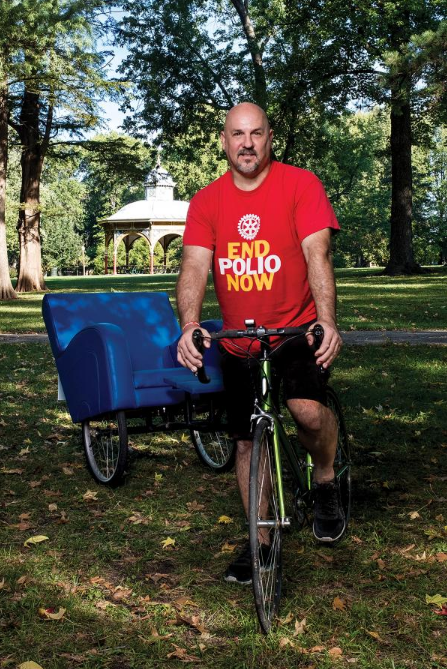
When Ralph Zuke learned how close the world was to eradicating polio, he decided to draw attention to the effort by riding a bike from St. Louis to Toronto for the 2018 Rotary International Convention.
When Brenda Wagner, his club’s president at the time, suggested that a regular bike wouldn’t attract much attention, Zuke decided to pull a rickshaw fashioned with a recliner. He already had the rickshaw, which he had built for a fundraising project several years ago.
Photo by Frank Ishman
But first, Zuke, now 52, checked in with his doctor, who told him he needed to get in shape. “Round wasn’t the right shape,” he jokes. During the 10 months leading up to the ride, he trained by riding about 2,500 miles.
On the 22-day trip, he aimed to raise $22,000 — symbolizing the 22 cases of polio reported in 2017. With pledges from Rotarians and people he met along the route, Zuke raised just under $24,000. The 2-to-1 match from the Bill & Melinda Gates Foundation brought the total to nearly $72,000.
Along his 703-mile trek, Zuke offered his Rotarian host families and other people short rides in the rickshaw, sometimes pulling 50 or 60 passengers in a day.
“It was one of the most incredible experiences I’ve ever had,” he says. “I met the most incredible people.”
Those included a farmer in Ontario whose Rotary club had disbanded five years earlier. Zuke gave him a ride, and the next morning the farmer greeted him with breakfast. “He truly had the heart of a Rotarian,” Zuke says.
Zuke’s ride took him through urban neighborhoods and along cornfield-lined country roads. A large sign with a QR code on the back of the recliner led people to a website that provided information about what he was doing, allowed them to follow his journey online, and suggested they donate to End Polio Now.
“Twenty-two cases is a really low number,” Zuke says. “But zero is the only acceptable number.”
If any cases of polio remain by the time the Rotary Convention in Houston rolls around in 2022, Zuke says he’ll do the ride again.
“I’m hoping we’re down to zero for so many reasons,” he says. “But one is, there are a lot of hills between here and Houston.”

.png)

.JPG)
.png)






.jpg)