Tom Laurenson on the History of Golf!

Our guest speaker for the Greatest Guest Day meeting on April 8, 2021, was Scottish Golf Historian, Tom Laurenson. Tom’s topic was “The History of Golf.” Tom is not just an avid golf historian, he is also a radio personality and President of the Branford, CT Rotary Club. Tom is also a genuine Scottish Highlander who learned to love and play golf in the Scottish Highlands as young boy. Tom also helped to build the Taynuilt Golf Course. He even had the first competitive hole-in-one on the course!
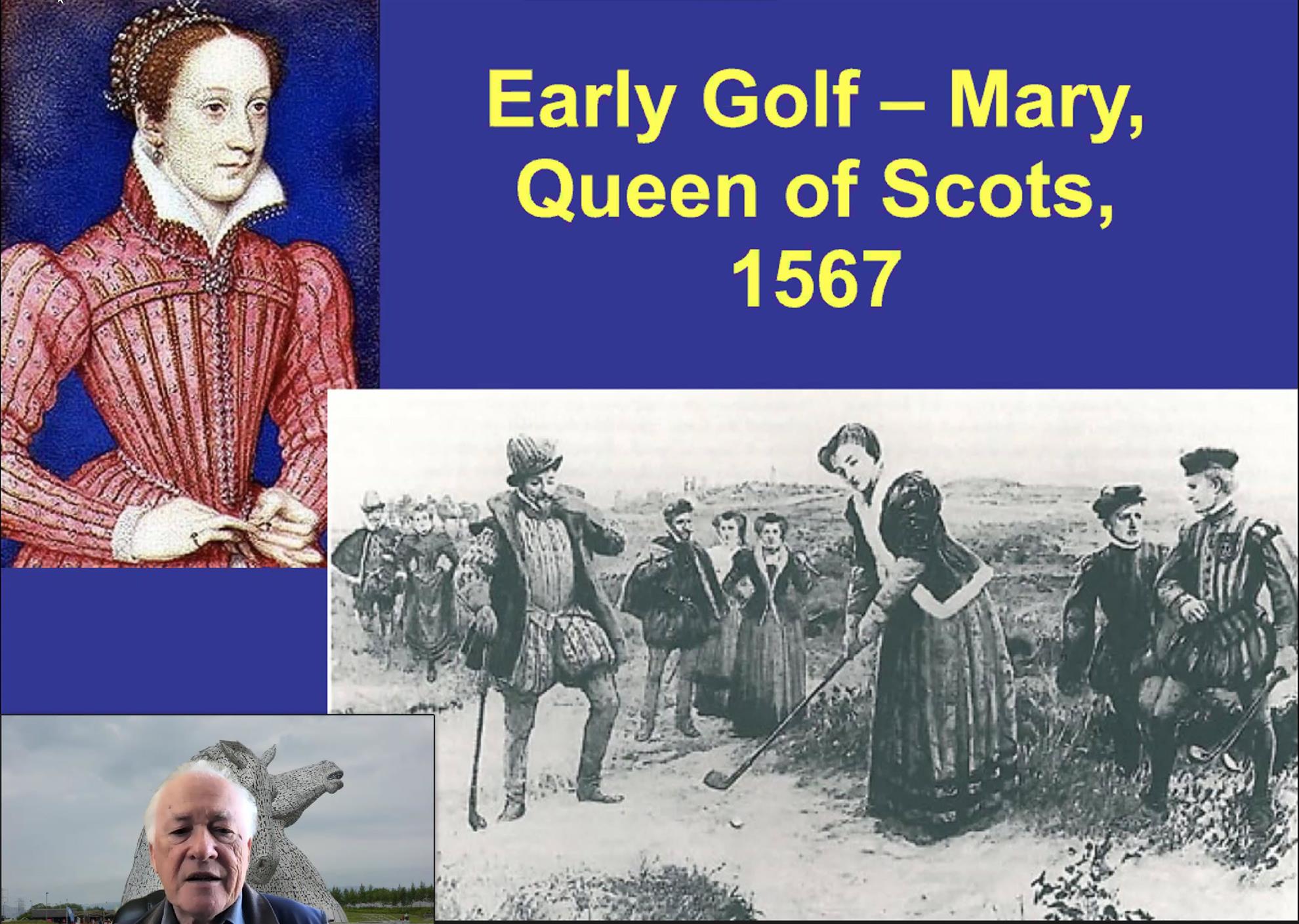
Tom talked about the history of golf starting back in 1421 when Sottish soldiers went to France to fight the Battle of Bauge during the Hundred Years War. Scots fighting the English brought the game home to Scotland, where it became deeply rooted. The King of England banned golf in 1457. The ban was lifted in 1502 when another king ordered a set of clubs! Mary, Queen of Scots was a golfer. Paintings in the Netherlands in 1620 showed golfers hitting balls in the midst of general daily life. A common factor in the early days of golf was that it was winter game played mainly on village or common land between growing seasons. It was also generally played by ordinary people. Throughout history, and even today, golf has these common factors: it is played with a round object, like a stone or ball; the ball is hit a specified distance to a hole; clubs are used; and the lowest score wins!
Modern day professional golf tournaments started in 1860 at Prestwick. The best golfers in the world were invited to play for a pot of money. Tom tells us - and here we have a dispute - that what we know as “the British Open” is actually called “the Open.” Every other tournament has to have a title in front of “Open!”
The most famous Scottish golf clubs/courses are probably St. Andrews, Carnoustie, and Royal Dournach. These are classic link-style courses built grassed-over dunes. Courses such as St. Andrews were built on property owned by the town, so anyone can walk around the courses whenever they want (except tournament days). The courses are very different from American courses. For example, the courses often have “gorse” (prickly yellow bushes) that are impossible to penetrate. If you hit your ball into the gorse you are not going to find it; just play another ball. The “traps” are actually traps; that's it, you never want to hit into the “bunkers” in Scotland. They are deep and steep. Tom told us a funny story about a professional golfer named Tommy Nakajima who hit his ball into the Road Hill Bunker while in contention for the lead at St. Andrews and took 5 shots to get out! Locals now call the bunker “the Sands of Nakajima.”

Ladies also historically played golf in the UK and elsewhere. The earliest known golf trophy for ladies was in 1811; the competition was between the “fishwives of Musselburgh.” Female golfers added important improvements to the game. For example, ladies led the development of the handicap system in the early 1900’s, originally facilitating competition among players from different clubs. Isette Pearson was the driving force behind the Ladies Golf Union (1893) and the handicap system.
Tom also lamented some of the modern developments in the game. In particular, he did not like the fact that golf clubs are now numbered. In the old days they had names like “Mashie,” “Niblick,” “Spoon,” and “Bulger.” The current use of numbers instead of strange names “took the magic out of the game.”
Well done, Tom. Thank you for the wonderful presentation. Your knowledge and obvious love of the game and its history is remarkable! And thank you for finally explaining those funny names like “Mashie” and “Niblick.”
View Tom's presentation HERE. It will be available for the next week only.