Dr. Peter Banks and the International Space Station
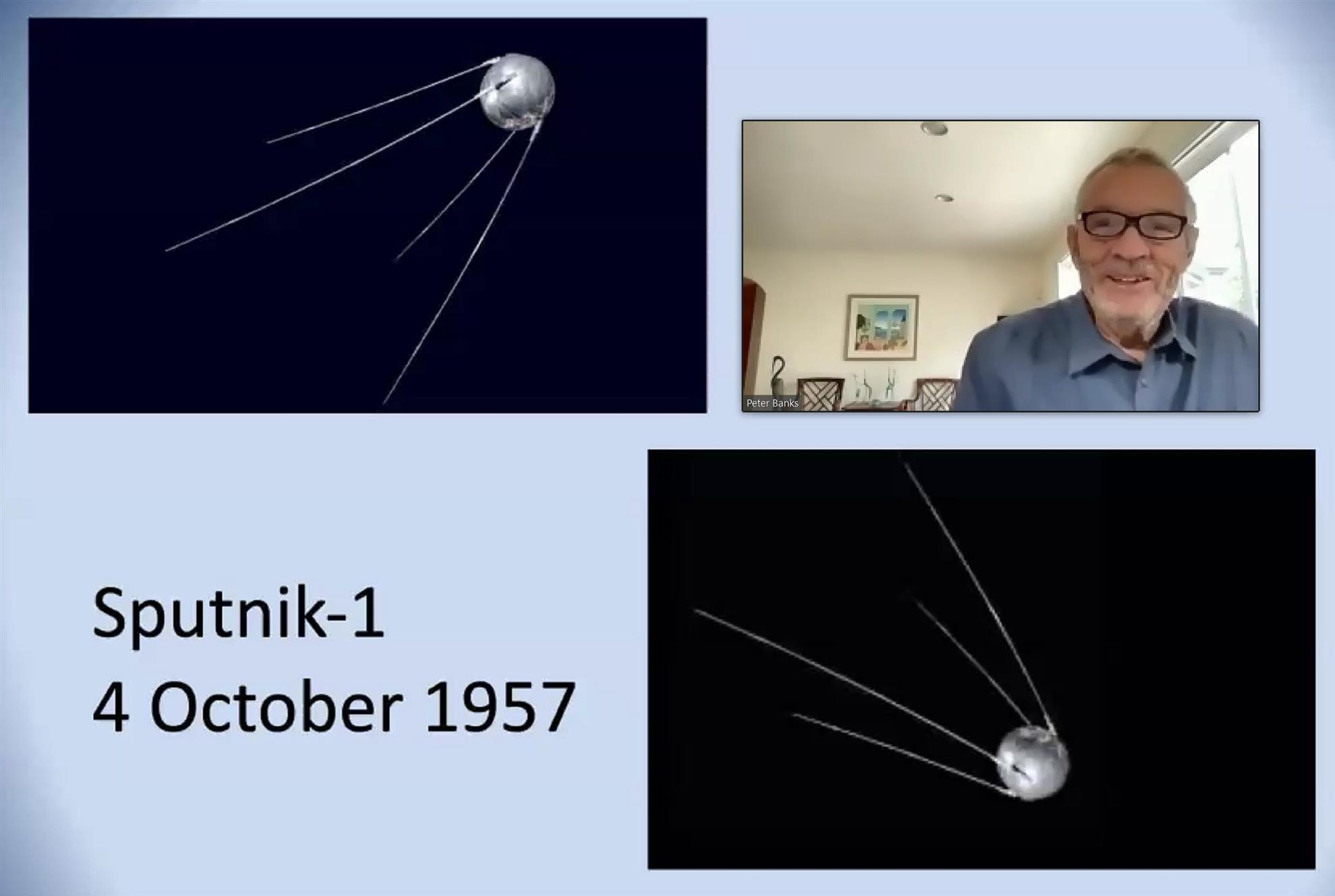
Our speaker for Thursday, September 2, 2021, was our own amazing Dr. Peter Banks! His topic was “The International Space Station.” Dr. Banks’ resume includes undergraduate and Master’s degrees from Stanford, a Ph. D in Physics of Earth’s Space Environment from Pennsylvania State University, and many years as a university professor at UCSD, Utah State, Stanford, and the University of Michigan. He moved to Santa Rosa in 1996 and is an advisor to NASA and a Senior Advisor to the National Academy of Engineering.
The International Space Station (“ISS”) is the product of the space race that some of us remember well, but which now seems slightly forgotten. At the end of WWII, German scientists developed 2 pilotless rockets, the V-1 and its successor, the V-2. The V-2 was a longer range, more deadly version of the V-2, and was fired at England, Holland, and France starting in September 1944. The town of Peenemunde in Germany was the home to the research and development of the V-1 and V-2 rockets, and many of Germany’s advanced scientists, including Werner von Braun, worked out of the region around the town. At the end of WWII, the Russians captured many of the V-2 rocket German scientists, but von Braun and other German scientists were captured by, or surrendered to, Allied and U.S. Army groups. Von Braun ended up with other German and American scientists developing the U.S. Saturn project and rocket engineering in general.
A “Space Race” between the U.S. and Soviet Union ensued. The Soviets developed the world’s first intercontinental ballistic missile, the R-7 Semyorka, in 1957, and used it for 35 years. The Semyorka powered the world’s first space launch, the Sputnick 1, in October 1957. At the time, Peter was an undergraduate at Stratford and remembers going out to the field sites next to the school and hearing a “beep, beep, beep” coming from space. The Soviet’s first manned launch was in 1961, propelling the cosmonaut Yuri Gagarin into space for a few days and a single orbit around the earth. The second man in space was Alan B. Shepard, a U.S. Navy aviator turned astronaut. Shepard’s trip into space was part of the U.S.’s Mercury program. Shepard’s flight did not orbit the earth.
The development of manned space stations started in 1986 when Russia developed the Mir Space Station. The U.S. was far behind, although it launched Skylab in 1974, which ultimately disintegrated in 1979. A more recent U.S. program is based on the development of the Space Shuttle. In 1995, the Space Shuttle dropped off American astronauts into the Mir station. They stayed on Mir for about 6 months.
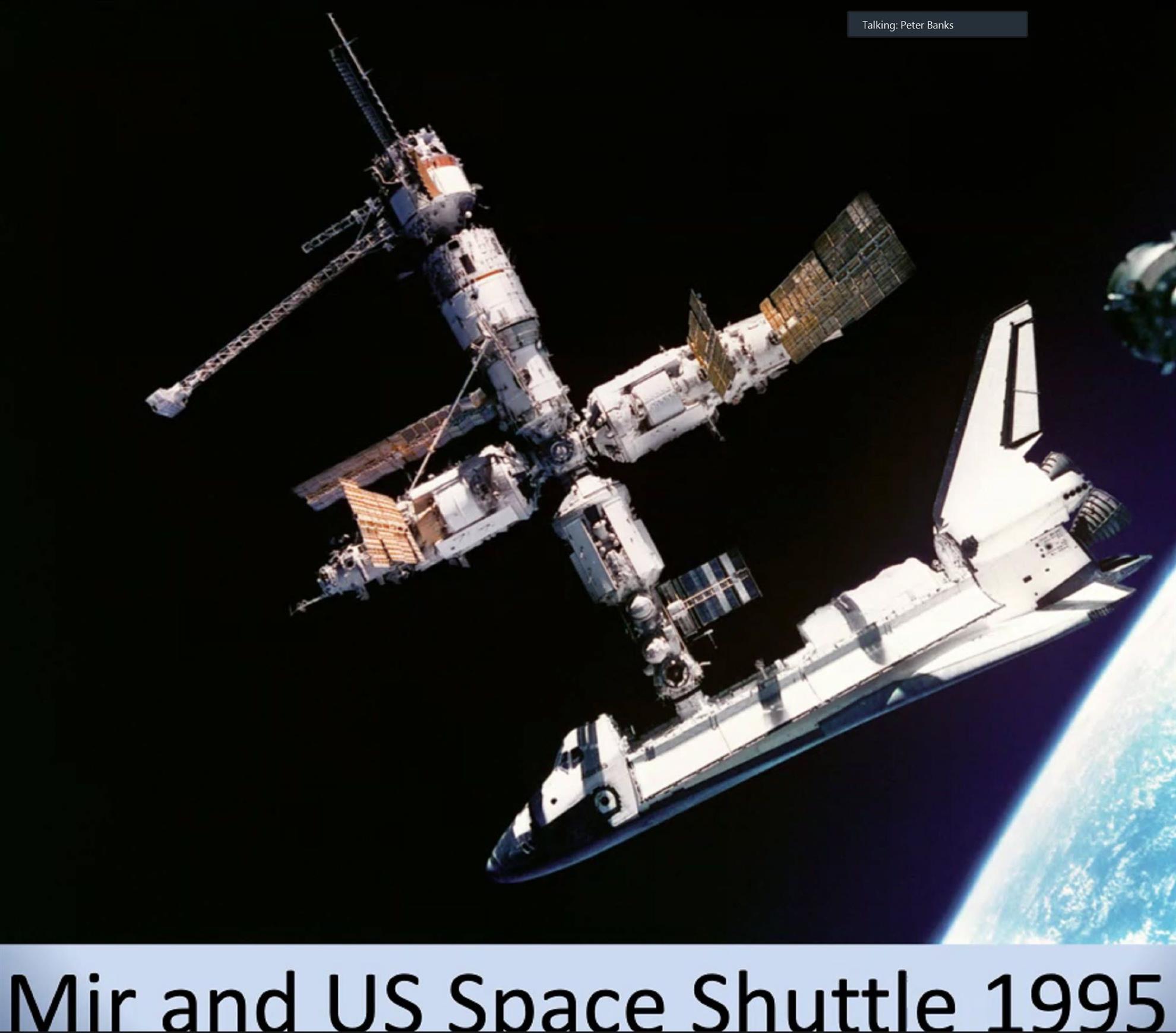
After the fall of the Soviet Union, the U.S., Russia, and other countries collaborated to construct and man the ISS. The ISS is the largest artificial object in space. It took 40 missions and 13 years to complete. It is size of a football field, costs $3 billion a year to maintain, and is the most complex engineering project ever developed!
Thank you, Dr. Banks! This was a fantastic and informative program. Thank you for bringing us into the information loop on the history and development of the ISS!
View Peter's presentation HERE. It will be only be viewable for the next week.