What's New in Solar by Dana Smith

Our speaker for March 14, 2024, was Dana Smith of Solarcraft, a leading solar contractor in the North Bay. Dana has been with Solarcraft since 2010, where he currently leads the commercial sales team. Prior to working in solar, Dana worked for a series of companies that offered Software as a Service (SAAS) and cloud hosted business services. He’s an avid North Bay hiker and mountain bike enthusiast.
Dana provided some tips on finding the right solar company. It’s important to have a good partner in solar. He noted that there are some very good companies here, but you should try to avoid companies that are too small or too large. A larger company can provide a range of specialists for different parts of your solar installation, getting you someone with specific knowledge and experience in each category of work. Larger, well-established companies also sometimes provide better warranties and a greater degree of continuity. On the other hand, a company that is too large will often have customer service problems. A good partner is a company that will be in business throughout the life you’re your system; someone to call upon to handle a variety of servicing issues in the future.
The cost of electricity in California has skyrocketed and we are seeing huge rate increases every year. The rate increase announced in January this year was 13%! Part of the reason for the increases is to allow PG&E to recover from the huge payments they are making to insulate the power grid from fire-related failures (and to pay for the big settlements and judgments caused by PG&E’s own failures to make power lines safer). Right now you can pay up to $.63 cents per kilowatt hour on a summer afternoon!
The big change in solar was effective for new installations starting in April last year. The PG&E solar-customer agreement went from Net Energy Metering (NEM) 2 to NEM 3. Under NEM 3, customers only receive wholesale credits for energy they export to the utility. This essentially means that when you sell energy to PG&E (because you don’t use all the energy you generate with your solar system), PG&E only credits you for the wholesale price of the energy. Under NEM 2 the customer received retail credit for the energy they exported. NEM 3 drastically undercut the financial benefit of solar. To combat this problem, almost every solar system installed these days has a battery backup, which allows for the use of energy stored in batteries during the time when the solar system is not generating energy. These battery systems, however, are extremely complicated. A recent big change in battery installations is the “Bill Saving Battery.” These batteries only offset PG&E bill costs (they don’t store energy for later use in a grid power failure), are cheaper and easier to install, and have a fast payback.
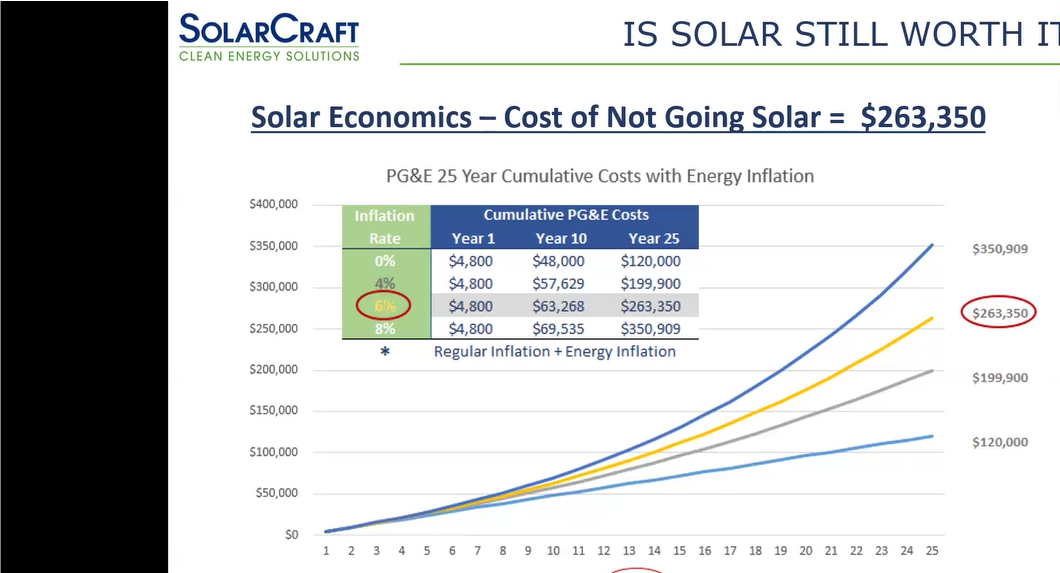
The chart below shows the cost of not going solar assuming typical inflation rates and an average monthly electricity bill of $400.
Another thing to consider in deciding whether to go solar is the current federal tax credit of 30%. A 6kW DC solar system with a 15kWh bill saving battery might cost you about $39,000, but with the federal tax credit the net cost is $27,000. There are also a number of financing options, including cash purchase, solar loan, and leasing/power purchase agreements. Sonoma County also has a unique energy efficiency program that provides loans at below market rates.
Many thanks to Dana for the super clear explanation of the cost of going solar (or of not going solar) and the effect of the new net energy metering system imposed by PG&E.