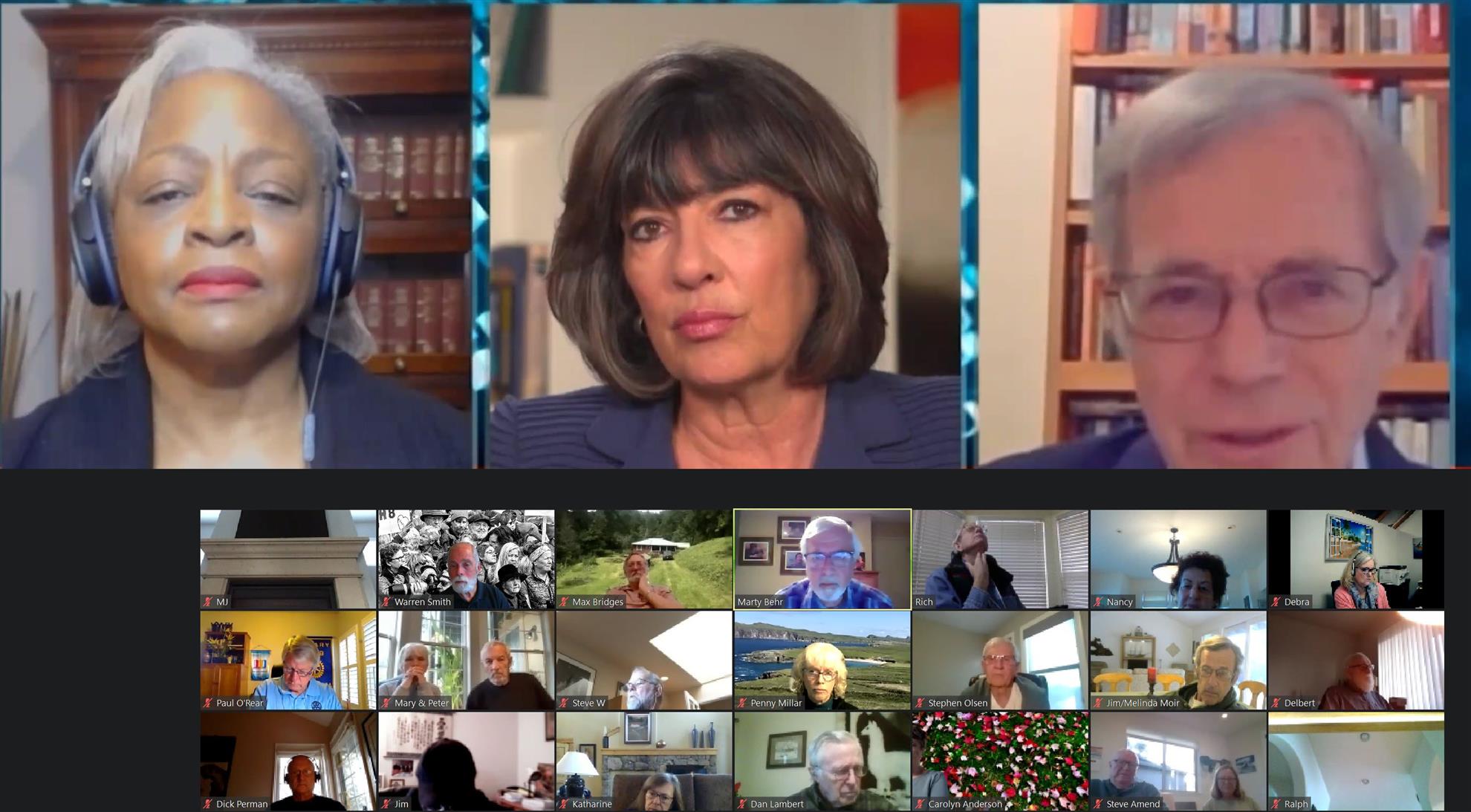
In our January 14, 2021 meeting, Past President Marty Behr led a special presentation on “Black Lives Matter,” featuring “guest” speakers Jim Gray and Arthur Chaney, along with a segment from a PBS Amanpour & Company program from June 19, 2020. Marty noted that he and other Club members have put together a working group to study and deal with the issues raised by this past summer’s Black Lives Matter movement. This work has included reading, educating each other, and discussing the issues, among other things. Marty reminded us that Rotary International has published an official statement on the subject of racism: “At Rotary, we have no tolerance for racism.”
In the Amanpour & Company program, Amanpour interviewed Professors, Carol Anderson of Emory University and Eric Foner of Columbia University. Dr. Anderson mentioned that the deaths of George Floyd, Ahmaud Arbery, and Breonna Taylor were not shocking to her because they are part of a pattern. Our history is a pattern of racial injustice, efforts to reform, and backlash against reforms. She and Dr. Foner were both excited by the Black Lives Matter movement but apprehensive about potential backlash. Significant examples of this progress/backlash cycle include giving/taking away property (40 acres and a mule) to ex-slaves after the Civil War; economic progress/massacre in Tulsa, Oklahoma in the early 1920’s; “emancipation”/evisceration of freedoms by the Dred Scott decision; school desegregation/white “flight” to private schools after Brown v. Board of Public Ed.; and Obama progress/Trump backlash. The program also explored some of the structural disadvantages faced by African Americans: Did you know that the net worth of white families averages ten times that of African American families? Or that African Americans are twice as likely to experience barriers to voting?
 Jim Gray was born in Texas and came to Santa Rosa as a child. He told us that preparing to speak on this topic brought memories that he would rather forget. His family experienced housing discrimination when they first tried to buy a home in Santa Rosa and ultimately ended up in South Park, in a predominantly black area. He recalls being turned away because of his race when he tried to get into Morton Hot Springs as a teenager. He talked about going with his family to a “sit-in” at a local store and having dog poop thrown at him and his family. He told us about holding a white woman’s hand as a student at Santa Rosa Junior College and having white men call the girl a “n-lover.” Jim ‘went academic’ on us. He thinks that culture makes people comfortable and they go ‘subconscious.’ When they see something different, it pulls them out of their subconscious state and causes a reaction. Jim told us that at that time he wanted to make those people aware of what was going on and that he could not tolerate it.
Arthur Chaney grew up in Oakland. When he was a kid, if he and his friends crossed the tracks into San Leandro they would be chased back to Oakland. He talked about discrimination in employment: While employed by an insurance company and under consideration for a promotion he was told by his boss that she had seen him with a mean look on his face. She questioned whether he was promotion material. Arthur tried to explain that he was only concentrating on a work-related question at the time, but he was never promoted. He also talked about discrimination while visiting relatives in Texas and Alabama. In Alabama they could not go into specific movie theaters and he recalls that in a restaurant in Texas a waitress would not wait on his table. Arthur offered us some additional reading material, including his statement on behalf of 100 Black Men of Sonoma County and his 6-page personal statement. Arthur summed up his comments with a four-letter word: VOTE. He said that the right to vote is so powerful that only by suppressing the right to vote can people be controlled.
Great presentation! Thank you all for the hard work and thoughtful commentary. And, weren’t the comments about backlash, made in June, prophetic?