Richard Lazovick - Hints for Preparing for a Power Outage
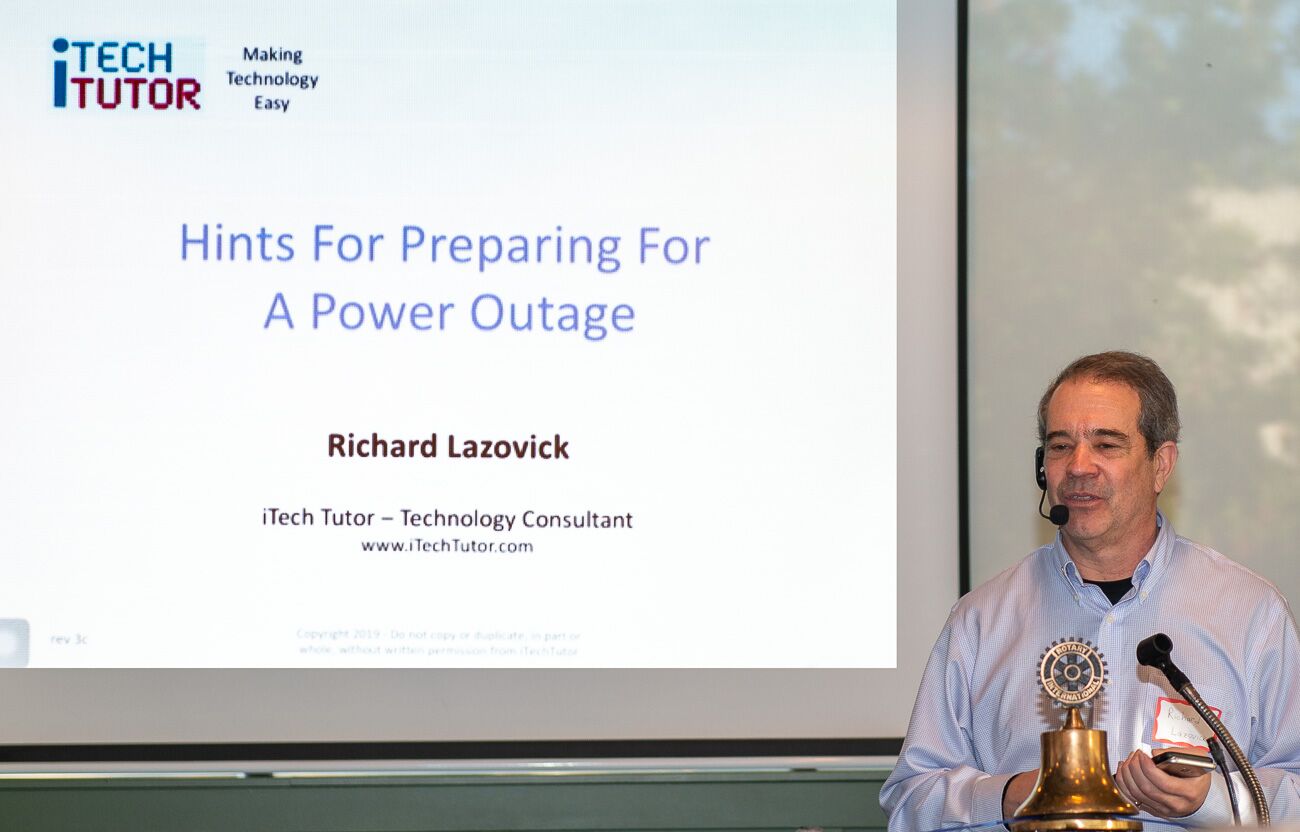
Our speaker for January 30 was Richard Lazovick of iTech Tutor, a Sonoma County technology consulting company. Richard is a member of the Santa Rosa Downtown Rotary Club, a graduate of Cornell University, and received an MBA from UC Berkeley. His talk was entitled “Hints for Preparing for a Power Outage.” He also provided us with a great handout containing the key information he presented.
Richard discussed the various alternative to PG&E when the power goes out and focused on solar v. generator, using a CPAP without a generator, and mobile phone service/internet access issues. The basic problems when PG&E goes down include the refrigerator/freezer, medical devices, charging devices, lighting, and usually home heating. A solar power system is great, but it doesn’t help much when PG&E goes down since most solar power systems are connected to PG&E through net metering (and also don’t produce power when the sun goes down). A great alternative is a battery back-up, but this is a very expensive addition to a solar system. And, battery back-ups have problems too because, as Randy Seeley pointed out, a home heating system will discharge the batteries quickly and, anyway, no one wants to stay in a freezing home. Also, if you are not able to get to your house and the heating system kicks in, the battery back-up turns on and will likely discharge the batteries quickly. Owning a generator might be a much better option if you choose the generator wisely. The most common sizes are 2k to 6k watts. Home heating is a problem with generators too, since they take a lot of energy. Or, you can be like Leroy Golden Hammer and have a built in, automatically connected, super powerful battery powered by your huge propane tank. I’m going to his house the next time PG&E fails!
The medical device problem is even tougher. This is often a life-or-death situation, so a generator is often the only solution, but you need to make sure the generator is running day and night and has plenty of fuel to do so. Power failures also create huge problems with communications, and you should try to find the best provider for your cell phone. Some providers are better than others when it comes to staying on-line when the power dies. And, figure out how to use your phone as a hot-spot for other devices!
Many thanks to Richard for rounding out our three programs on disaster preparedness. The program was well-organized and helpful in pointing out the various ways we can try to live without PG&E on a short-term basis.