OPENING RITUALS
Pledge: PP DENNIS YOUNG
Zoomers: PP CYNTHIA LUEDTKE, MANDY BACH, PAUL SCHUTZ, ABBY AHRENS, BRUCE FITZGERALD, PP DONNA VERNA, SANDY MINGIA, STEVE POMEROY
President FRANK’s Ops Team:
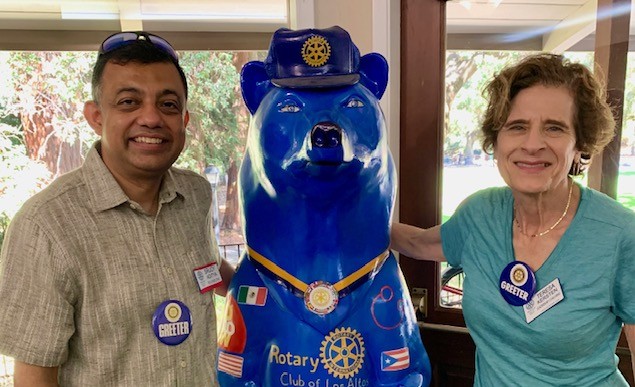
Greeters: TERESA KERSTEN, SRIJOY ADITYA. Thought of the Day: PP MARY PROCHNOW.
Cookie Monsters: TIGER ROHRS. Recognition: PP BONNIE BURDETT WALKER.
Rotator Writer: JEANINE VALADEZ. Photographer: STEVE SHEPHERD.
Publisher: SUSIE MIELKE. Editor: PP CYNTHIA LUEDTKE. Tech Team: LEE CODDING, MIKE KERR.
Website and Zoom: STEVE POMEROY, DAVID GREEN.
Thought of the Day: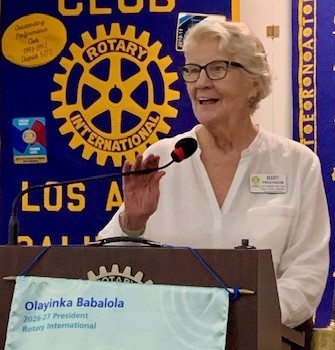
PP MARY PROCHNOW enabled us to enjoy John Lennon’s Imagine for spell and enjoined us to “Imagine a World of Peace,” noting that “we have power in this room to change the world…”
INTRODUCTIONS
President FRANK called PP CRYSTA KRAMES to do Introductions today.
Visiting Rotarians
Jarret Partlow MV Rotarian, lives in the neighborhood and was PP CRYSTA’s guest today
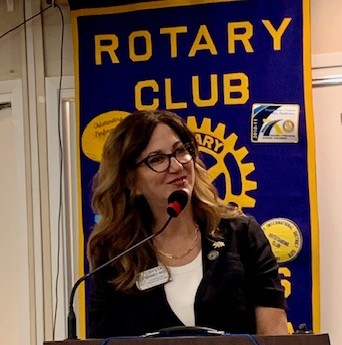 Rotarians with Guests:
LYNN WILSON ROBERTS brought her neighborhood today, including guest speaker, Dr. Rick Lanman, his wife Allana, Lynn’s best friend Marva, Sally Bowers, and her daughter and business partner Annie Roberts.
PP SAM HARDING introduced his guest, returning for their 3rd meeting, the new ED of El Camino YMCA, Shanon Pestrong.
BENNY LOEBNER’s guest was Laurie Tanen, a retired “high tech problem solver.”
PP CHUCK LINDAUER brought his lovely wife Ilona.
LIZ NYBERG introduced local benefactor and pillar of the community, Nan Geschke.
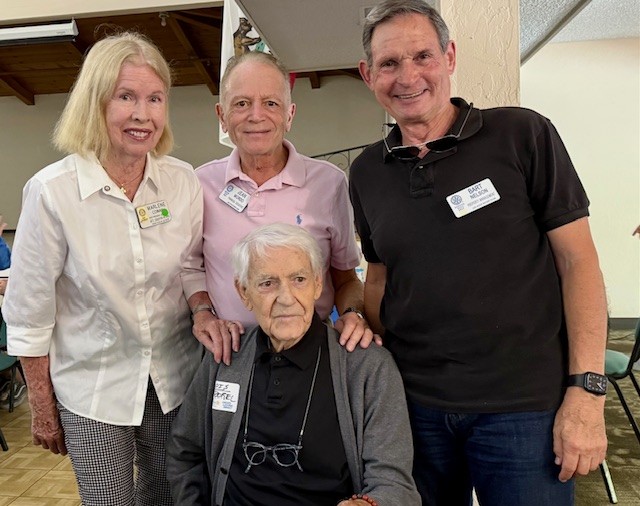 JEAN MORDO and BART NELSON welcomed back long time Rotarian and friend of all, Louis Borel, back from France and in a retirement residence in Sunnyvale.
STEVE SHEPHERD introduced Alan Truman, flyfishing “pro” in the same vein as STEVE is a golf touring pro.
HON MEMBER DENNIS MILLIGAN introduced his son Ryan today, who often helps in CINDY BOGARD O’GORMAN’s real estate endeavors.
PE JOE EYRE introduced Debrorah Baker of the Festival of Lights.
TERESA KERSTEN welcomed Veronika Smilak, who learned of us at FAITP and is now scoping us for interested family members.
BRANDON SMITH introduced JP Renaud from Canopy, here today for a grant update.
NEXT WEEK’S SPEAKER
John Poch, friend of LINA BROYDO’s and a SJ Rotarian, will talk about “San Jose 26,” which was conceived to create a lasting impact for our community by unifying Sports, Technology, and Culture. Led by the San Jose Sports Authority in partnership with the City of San José and a coalition of corporate, civic, sports and community partners, the initiative will maximize opportunities surrounding Super Bowl LX, NCAA March Madness and the FIFA World Cup.
GRANTEE UPDATE – FESTIVAL OF LIGHTS PARADE
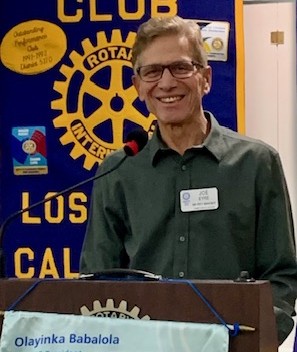 PR JOE EYRE introduced Deb Baker, Festival of Lights volunteer since 2008. The Parade is celebrating its 50th anniversary! Deb has a long history of hands-on impact on the Parade doing everything from electrical, building, costuming, managing various aspects of the event, and many other devoted tasks. In 2022, Deb received a LA/LAH Joint Volunteer Service Award.
Festival of Lights is governed by 25 active board members, all work year round. There’s Costume Maintenance and Repairs 15 people, the Float repair and maintenance team, Makeup and costume making and refurbishment. Many other hands work to make this show a pillar event for our community. The parade started in 1977 by three local business owners - Hope Higbee, Jack Huston, and Marion Jackston – who wanted to have a holiday event. The Foundation was founded a year later.
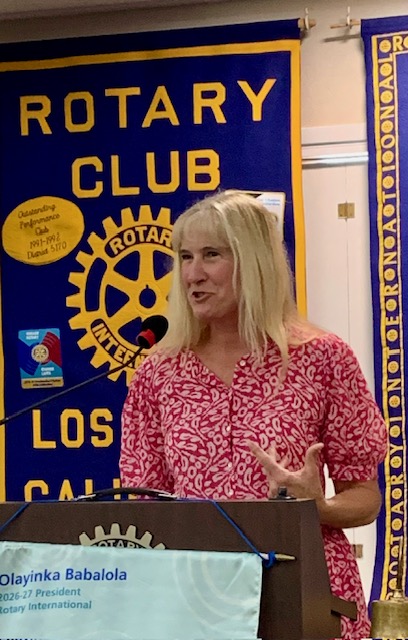 Deb described how five years ago they created a formal intern program where LAHS and MVHS students apply and they work year around on Sundays to handle all refurbishment, robotics, music, and all tech in general. Adults are teamed with them.
On event day there are 1200 volunteers in the parade, plus teams of scouts and escorts, 25 people in costuming and makeup, 40-65 hands and Certs that help run the parade, 20 to close the event. They stay very late, long after fans are gone! They are always looking for volunteers, especially engineering and custom building/making work; just show up on Sundays and get connected.
KMVT broadcasts the event and will be doing a documentary on the parade. They are raising money to fund the film.
BLUE BADGE INDUCTION: TONY BLAGROVE
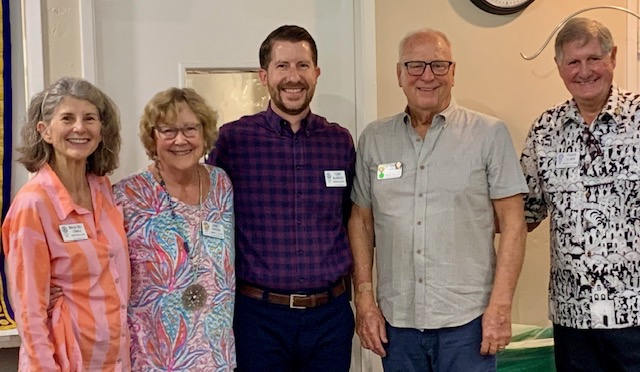
President FRANK called up Sponsors JANET and PP SAM HARDING, Membership Chair MJ LOMAX, and Red Badge Chair CLAUDIA COLEMAN. Blue Badge Inductee TONY BLAGROVE has been a Red Badger since Aug 2025. Evidently loving that status, the club nevertheless welcomed him to Blue-Badge-hood for the betterment of all.
GRANTEE UPDATE – CANOPY
Before introducing our guest, BRANDON reminded us that Oct. 1 is the Fall Grant Application deadline.
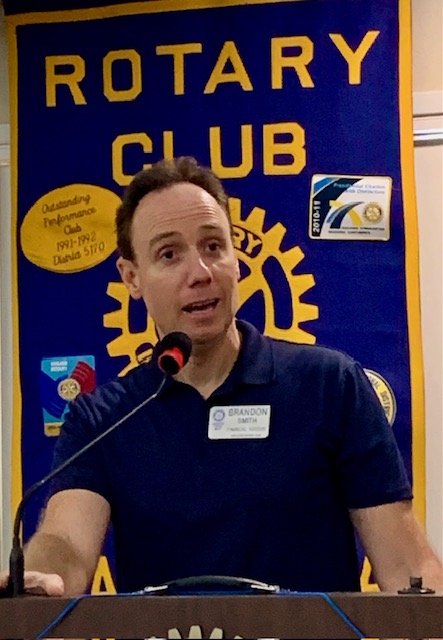 BRANDON Introduced Jean-Paul (JP) Renaud, Director of Canopy. From his bio, “JP has over 15 years of experience in communications and executive leadership. Prior to his last job at TreePeople, JP served in the United States Peace Corps as an Organizational Capacity Building Specialist in Ukraine, where he created lasting impact in HIV/AIDS education, testing and treatment, and LGBTQ advocacy.” JP believes in “Healthy Trees, Healthy Communities.”
Canopy is a community tree planting nonprofit with the goal to create urban forests and teach residents about the vital benefits of urban forestry. Trees react, grow, and age differently in urban versus forest ecosystems. In the past 30-40 yrs, science has changed dramatically; this interconnectedness between humans, urban ecosystems and the trees that exist there are vital to human and environmental health.
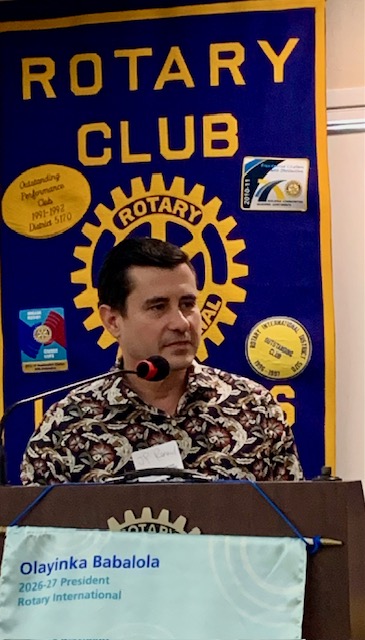 Private landowners, residents, and developers can do great work in this area; it’s not just a municipal or legislative responsibility. There are dramatic inequities across the socioeconomic strata of our society as to who gets to benefit from trees and their shade, which neighbors benefit from carbon sequestration, pollutant absorption, storm water management, and the production of healing oxygen.
It’s not enough to just plant pretty trees in the middle of cities. One needs to understand what kind of tree can thrive in the congested, chaotic, and, to be honest, dirty environs of urban and suburban cities. Species selection, planting location, and what materials and human interaction surround the tree, are all areas where knowledge MUST improve.
Mr. Renaud said they are investing in the future – we may not be here when these young trees mature and live out their lives – but their existence will be our legacy.
CALL TO ACTION: BooksPlus Cubby Build Day
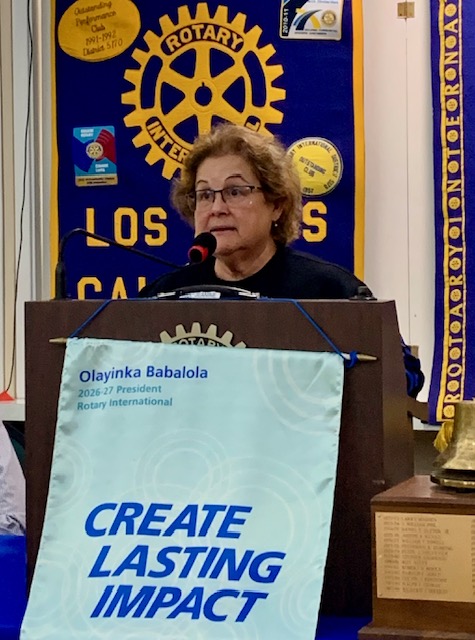 Your Rotator Writer, JEANINE VALADEZ, switched hats and took the podium to issue a call to action on behalf of the BooksPlus Committee.
It’s time to schedule the Cubby Build Day! Rotarians are asked to go to the Doodle Poll at https://doodle.com/meeting/organize/id/eZGq2r2a before 9/30 and please assert your availability to help at BooksPlus’ next Cubby Build Day. We are deciding between Sat Oct 3 or Oct10, 9-3pm at Sally Chaves’ house. Sticker sorting will be a key activity -- we need lots of sorters. As ever, BooksPlus envisions Every Child Prepared to Learn by the time they reach Kindergarten.
OUR GUEST SPEAKER:
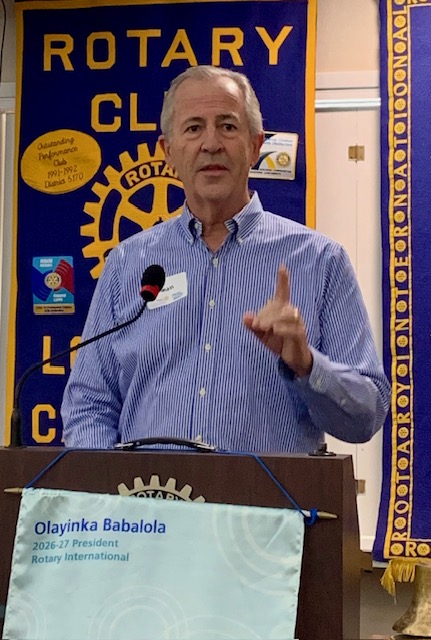
PE JOE EYRE introduced our speaker, Dr. Rick Lanman, who is quite the polymath and has skills, expertise, and interests across a broad spectrum of knowledge. A Stanford chem alum and Northwestern MD, he is also a prolific writer and a naturalist. His presentation aimed to explain how Adobe Creek was once a perennial steelhead stream.
 A Technical Note provided by Dr. Lanman: Steelhead and rainbow trout are the same species. Steelhead migrate between the ocean and freshwater, while rainbow trout remain landlocked in freshwater. Since Dr. Rick’s premise was that these fish once migrated to and from the Bay, your writer will use “steelhead” to refer to them.
What Brought Our Speaker to this Research?
Dr. Rick has done a lot of work in medicine and in ecology (both flora and fauna), but he’s very interested in our local ecosystem, and he has taken a particular interest in 14.2-mile-long Adobe Creek. Much of his presentation was drawn from a paper he wrote for the Los Altos History Museum newsletter in 2021.
Dr. Rick, who lives on Van Buren, right near the creek, grew up hearing longtime residents, including his former neighbor Herb Bickel (of Bickel Lumber which became Bruce Bauer Lumber), describe fishing for steelhead in Adobe Creek.
For years, government agencies disputed this because official records were scarce. Dr. Rick eventually found multiple independent sources confirming steelhead in Adobe Creek. Sources included: 19th-century maps showing the creek connected to the Bay, an 1877 fishing guide describing Adobe Creek as a fishing stream, a Stanford professor's 1898 record of steelhead in the creek (which was then called San Antonio Creek), a 1909 promotional brochure describing Los Altos as having a "never-failing mountain trout stream," and oral histories from longtime residents who remembered fishing for steelhead into the 1950s. (Note: Adobe Creek was also called Arroyo San Antonio and also Yuegas Creek.)
Dr. Rick also noted that he became aware of three preserved steelhead specimens collected from San Antonio Creek in 1893, discovered in the California Academy of Sciences collection (that originally came from the Museum of Natural History at Stanford).
So Why Did the Fish Disappear?
Dr. Rick blamed the 1950s flood-control projects. A tidal gate near the Bay prevents migrating fish from entering the creek, while a long concrete channel between El Camino Real and Highway 101 creates another major barrier. Numerous smaller concrete drops and culverts also prevent fish passage. These structures also created super-fast flows of water, which further disable fish from coming back upstream.
Why Did the Creek Stop Flowing?
While Adobe Creek remains perennially flowing down until Manresa Way; it fails to flow all year below that. Our modernization, namely, roads, pavement, storm drains, and water diversions prevented rainwater from soaking into the ground. As a result, groundwater levels have fallen and the creek now dries up downstream of the perennial headwaters during warm weather.
More Recent Findings:
Dr. Rick provided evidence from modern samplings in 2011, where he and a fish biologist, Dr. Lydie, “electrofished” different sections of Adobe Creek for analytical purposes. Fish populations declined as they moved upstream, eventually reaching zero fish at Hidden Villa, despite the water there being clear, cold, and apparently suitable for steelhead.
Possible Solutions:
Dr. Rick stated the need for rewilding this ecosystem. It starts right in our neighborhoods. This is not a far-away problem. In terms of mitigating the harm to fish, he proposes removing or modifying barriers, improving fish passage, reducing water diversions, installing bioswales and other systems that allow rainwater to infiltrate the ground, and potentially using natural features such as beaver ponds to restore summer streamflow.
How Looking Back Can Help Us Look Forward:
Dr. Rick amplified this thinking about the importance of history in learning how to keep our future safe. He noted Daniel Pauly’s 1946 "shifting baseline syndrome,” where people often assume today's ecosystem represents what has always existed. Historical ecology can reveal that ecosystems were once substantially richer than people remember. It’s a sad yet common tale that in urbanizing our wild lands and creeks, coexistence with them was rarely considered as post-war suburbs sprawled. At the core of these issues is the bane that is urban sprawl. Build up, don’t build out, and rewilding is the way.
Dr. Rick’s wants us to "keep asking the question and keep pushing for evidence." Knowing our history can help us marvel at past realities and also reimagine solutions that will prevent future disasters.
Q&A:
PE JOE EYRE: Santa Clara Valley’s Water District’s position? Answer: The fish biologists they employ acknowledge it. It's undergoing a generational change. Some of the board members do. Rebecca Eisenberg (Our District 7 Water Board Rep) totally gets it.
SHERRY AUERBACH: What's happening on the ocean side, especially given that fewer fish are spawning? Answer: This is true, but look at the miracles that have happened after the Klamath river multiple dam removals. In 2 years, salmon made their way 800mi to the topmost lake. Dr. Rick noted how undereducated most people are about the positive impact of carbon sequestration, especially by tree species that sequester at accelerates levels, redwoods being a case in point…as long as they are high enough to get watered by fog.
TAMI MULCAHY: rewilding is new to people: has Dr. Rick mapped out key strategic areas? Answer: He has, but it is for naught unless one can gather an intersectional group of stakeholders to get things off the ground. It’s not enough to expect the City Council to do this. Sadly, the key goal continues to be flood control and not rewilding. Alameda Creek took 30 years to get various agencies to remove barriers and fish are spawning again; Chinook maybe in a few years. It can be done.
GREG DABB: has noticed pumps at Hidden Villa and at Manresa Way. Water runs there year around. What is going on? Answer: It’s all about water reservoirs and percolation ponds and trying to raise the water table. The historical subsidence of San Jose raised alarm bells. Dr. Rick prefers bioswales everywhere.
JEANINE VALADEZ: Do you have examples of local rewilding initiatives, even if just a couple, and who drove them to fruition? Answer: He just joined the Board of Turtle Island Restoration Network; their focus is protecting San Geronimo Creek in Marin County. This is the southernmost locality for Coho Salmon and they are succeeding. He also acknowledged the smaller improvements made by Valley Water in San Jose bringing back Chinook Salmon into the creeks and rivers.
As a follow on, Dr. Rick brought up Land Trusts. (Ed Note: These instruments have done amazing things in our urban areas to return lands and domiciles to underserved communities and to mitigate displacement.) He spoke of LTs with more than a little skepticism when it comes to rewilding efforts. He said that LTs are great for building paths and protecting lands from development. But they do little to nothing about true rewilding. He seemed to imply with frustration that they were about “gentrifying” green space. They do protect species, but Dr. Rick says the work is not always thought out. He gave the example of an LT protecting a Thule Elk Herd near here, yet the Herd cannot migrate as it needs to; it cannot cross 101. A travesty. Their grazing could “manage” fire risk for thousands of acres and yet we do not build them passways.
ADJOURNMENT
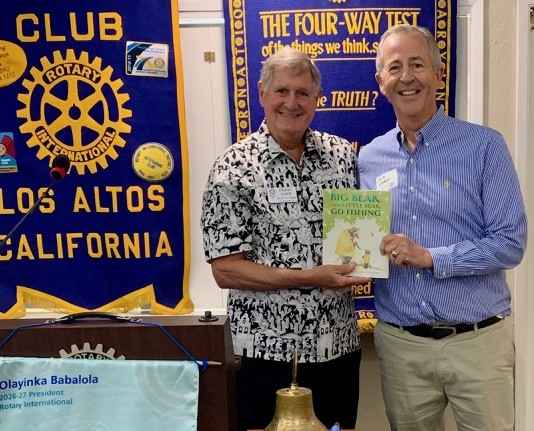
This week, the BooksPlus/Linden Tree partnership curated the book titled, Big Bear and Little Bear Go Fishing, in honor of our Guest Speaker. Linden Tree donated the book and members of our BooksPlus committee delivered the book to a local school library. LARC’s BookPlus is all about early childhood literacy, 0-5yrs: Every Child Prepared to Learn.