
The End of Polio

The last cases of naturally occurring paralytic polio in the United States were in 1979, when an outbreak occurred among the Amish in several Midwestern states. From 1980 through 1999, there were 162 confirmed cases of paralytic polio cases reported. Of the 162 cases, eight cases were acquired outside the United States and imported. The last imported case caused by wild poliovirus into the United States was reported in 1993. The eradication of polio in the United States is based in part of the early efforts by President Franklin D. Roosevelt whom himself was afflicted with this crippling disease. The National Foundation for Infantile Paralysis, later renamed the March of Dimes, was established in 1938 and grew out of the great success of the Birthday Balls for President Franklin Roosevelt. The balls and the foundation, both Roosevelt’s ideas, were directed by his friend and former law partner, Basil O’Connor. Rotary’s leadership, beginning in 1985, inspired the World Health Assembly to pass a resolution to eradicate polio, which paved the way for the formation of the Global Polio Eradication Initiative in 1988.
The last indigenous case of polio in the Americas was occurred in September of 1991. In 1994 the western hemisphere was declared polio free. As the polio eradication effort closes in on the disease, the work becomes more difficult. Polio’s strongholds remain in the world’s poorest countries, many of which require greater levels of support to reach the goal. Assistance from global, national, and local leaders is critical in this respect. A small but dedicated group of Rotarians is working with national governments and multinational organizations to encourage them to commit the political and financial support required to eradicate polio. If polio isn’t eradicated, the world will continue to live under the threat of the disease. More than 10 million children will be paralyzed in the next 40 years if the world fails to capitalize on its US$5 billion global investment in eradication.
Our presenter, Judith Rowland, is a current Rotary Ambassadorial Scholar finishing her Master’s degree International Development at the London School of Economics and Political Science in. Currently Ms. Rowland, who is from Springfield, MO, is a US Campaigns Associate at The Global Poverty Project where she runs The End of Polio Campaign in the United States.
For more information on Rotary International’s efforts to eradicate polio in our lifetime, please take the following link: http://www.rotary.org/en/ServiceAndFellowship/Polio/FactsAboutPolio/Pages/ridefault.aspx
A Polio Fact Sheet can also be found on our website homepage in the “downloads” area.
The Global Poverty Project campaign, The End of Polio can be found at this link: http://www.globalpovertyproject.com/campaigns/endofpolio
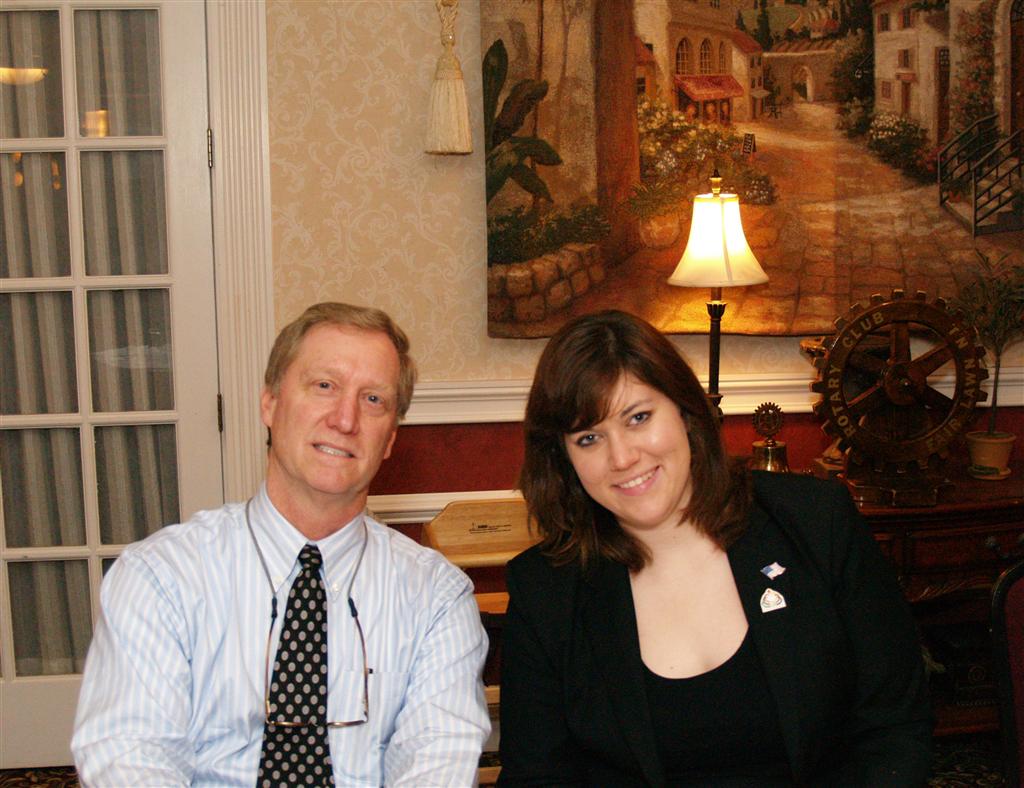
Photo: (l-r): Tom McGinnis, Fair Lawn Rotarian & Judith Rowland Ambassadorial Scholar