Last week, our International Director John Wotherspoon was given the wonderful news that our Global Grant for the Timor Leste water project to supply potable water to two villages has been granted. Our Club is currently setting up a special bank account to pay for the work to be done in Timor Leste. Congratulations to John, Paul Jupp and Bruce for their input into this process, and for the Rotary Clubs in our District 9510 and D9560 Clubs for partnering with us to make this international project a reality.
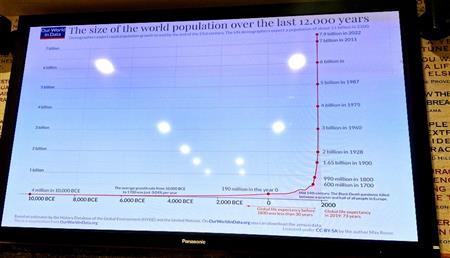
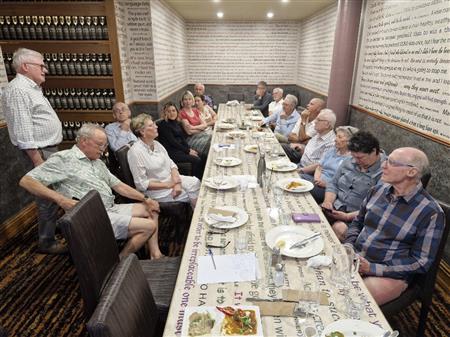
Last Thursday night’s guest speaker Dr Stephen Morris on “Limits to Growth – Population and the Economy”, detailed the relationship between population and economic growth and environmental degradation. Interestingly, it took 250,000 years to reach 1 billion people on Earth, and only another 210 years to reach 7 billion more and it continues to grow at approximately 80 million per year!
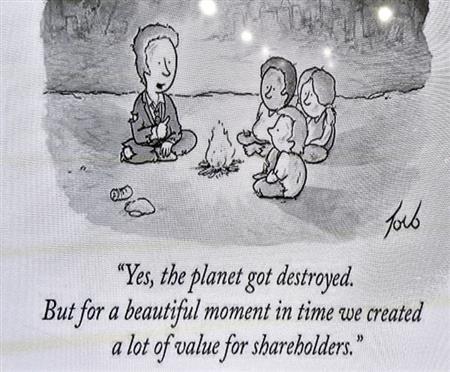
Greenhouse house emissions per person have risen over 7 times since 1924. Total emissions are up 70 times since 1750. UN demographers expect a population of about 11 billion in 2100. With such rises, the natural environment continues to deteriorate; with human behaviours and population combining to create the problem through the use of huge stocks of coal, petroleum and natural gas that had taken tens of millions of years to accumulate.
Our Earth’s ecosystems – which provide clean air, fresh water, food, resources and medicine – are faltering. We have suffered a loss of biodiversity 10,000 times faster than 100 years ago. This age (Anthropocene) is the sixth mass extinction. According to the WWF’s latest Living Planet Report, we have lost 68% of all vertebrate wildlife populations since 1970. At least 6-10% of extinctions post-1500 have been in Australia. 96% of the biomass of mammals on Earth are now humans plus our livestock (with just 4% being wild animals that still exist). 2024 Overshoot Day showed that on 1 August 2004, humanity used nature 1.72 times faster than our planet’s ecosystems could regenerate. In Australia (on 4 April 2024), Australia used nature 3.93 times faster that it could regenerate.
Stephen talked briefly about ethically responsible strategies that lower population growth ie improving education for women and children, access to quality and voluntary family planning, improved access to healthcare and welfare, female empowerment and gender equality. Thanks, Stephen, for succinctly detailing the problems that we humans need to address to take the enormous pressure off our Earth’s fragile environment.
Rob with Dr Stephen Morris
Population growth
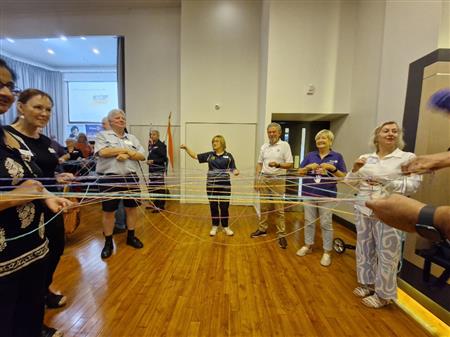
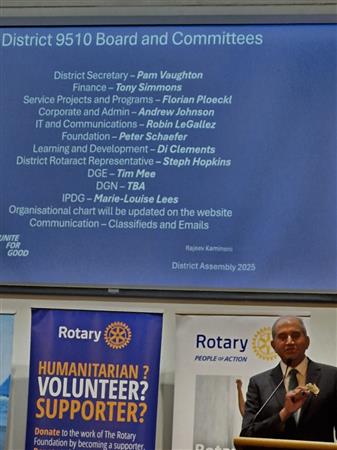
On 29 and 30 March, I attended the President’s Elect Learning & Development Seminar and was delighted to be joined by Jody, Alison, Paul J and Di at the District Assembly. Incoming District Governor Rajeev and his team did a great job of informing Rotarians of the Zone 8 Pilot project to date, the roles and responsibilities of various Club positions, and ensured we had a relaxed and enjoyable weekend at the same time (not quite the Big Bang's String Theory but a lesson in connection among groups!).
DGE Rajeev
On Friday 11 and Saturday 12 April from 10am-4.00pm at the North Adelaide Village shopping centre (near Bakers Live shop 7, ground floor), Adelaide Club and Adelaide Light Club will come together under a project called “Shop and Share” to collect non-perishable goods to support families experiencing hardship in their local communities. Any goods collected will support women and children who are in Domestic Violence Shelters. If you’d like to volunteer for any of the six 2-hour shifts over 11/12 April, please let me know via the email I will send out.