
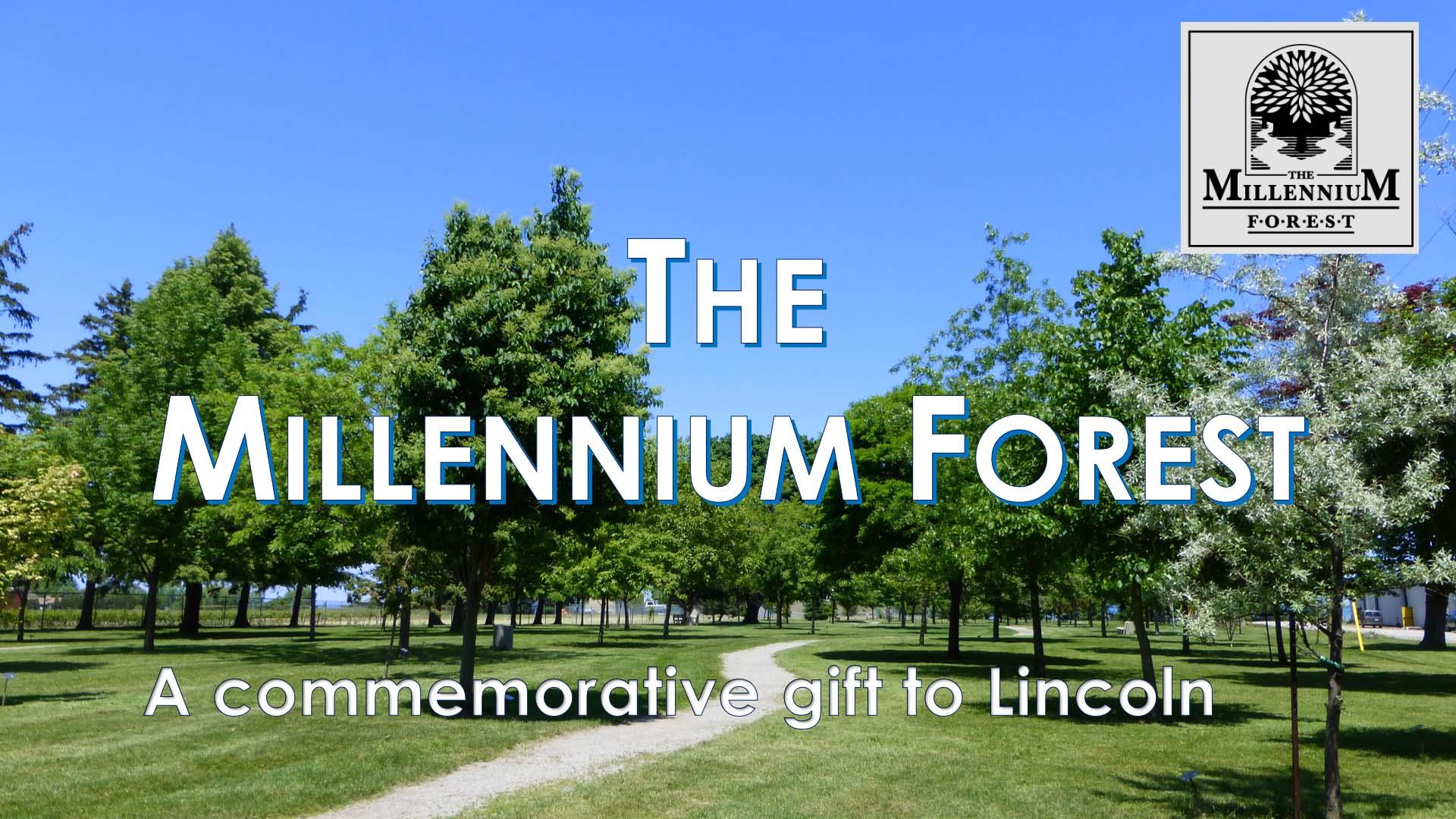
The Millennium Forest (a commemorative gift to Lincoln)
In 1999 the Lincoln Garden Club, the Rotary Club of Lincoln and the Town of Lincoln were investigating an appropriate Millennium Project. Dr. Emil Andersen proposed the idea of a Millennium Forest. The University of Guelph’s, Dr. C. J. Swanton, Chair of the Plant Agriculture Department, felt that it was an excellent project. Not only did the University suggest founding the forest on their grounds, they further made a commitment to look after the forest and maintain it as a courtesy.
The Objective of the Millennium Forest: “To provide a permanent living Millennium project that would provide beauty and enjoyment for the community, enhancement of the environment, useful information for those interested in trees and commemorates persons in the community.”
The University of Guelph offered a 3-acre plot which seemed ideal. The land was the Northeast corner of the Home Farm property on Victoria Ave. The south half had previously been homes and gardens of 3 research scientists working at the station (Dr. Emil Anderson was one of these). The North half of the property was the Horticultural Research Institute of Ontario dump and Lake Ontario. This is part of the land donated to the Government of Ontario in 1906 by Moses F. Rittenhouse for horticultural research. It is easily accessible from the QEW (exit 57).
By Spring 2000 the project was ready to start. The two Clubs, along with several helpers from the Town and University and many non-club members worked for many weeks to clear the unwanted trees and brush.
Together, Dr. Anderson, a Rotary Club member and Lincoln Garden Club representatives began selecting and sourcing the trees as well as publicizing the project. Alongside 8 previously established mature trees remaining in the Forest, 135 different deciduous and evergreen trees were selected on the basis of their ability to grow, survive, beautify, have historical value or features of particular interest in this Carolinian ecological zone. Some trees will live 200+ years. Some trees flower in Spring. Some have tremendous Fall colour. All trees will serve as a commemorative to the beloved family member, friend and prominent person for which they were purchased.
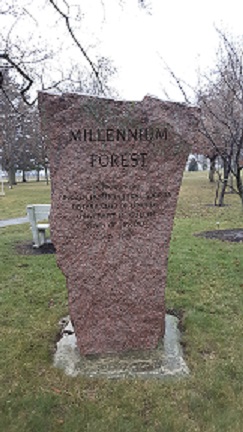
The Millennium Forest Stone
A striking 6.5-foot natural granite stone was placed at the southeast corner of the Forest. It is engraved as follows:
Millennium Forest
A project of
Lincoln Horticultural Society
Rotary Club of Lincoln
University of Guelph
Town of Lincoln
A.D. 2000
The Town of Lincoln covered most of the cost of the Stone with the Rotary Club and The Lincoln Garden Club covering the balance.
Funding for the Forest
The sale of memorial trees at $200 per tree which included a plaque bearing the name of the tree and a 3-line inscription provided most of the funds. The trees went on sale in the Fall 2000 and sold extremely well. Publicity by word of mouth, a flyer created for the Forest and local newspaper stories proved very effective.
A cheque for $17,500 from the Ontario Trillium Foundation was generously received and put to immediate use. Fencing, a beautiful wheelchair accessible pathway winding through the Forest, four benches, and some of the bulldozing work were benefited from these funds.
Planting the memorial trees commenced in late Spring 2001.
Dr. Emil Andersen Memorial Sign
The Dr. Emil Andersen Memorial Sign was added in 2011. Dr. Anderson was the driving force behind the Millennium Forest. He passed away in 2010 at the age of 94. On October 26, 2011 a dedication ceremony was held in the Forest honoring Dr Andersen’s many contributions to horticulture, the scientific community and the Town of Lincoln. The Andersen Family provided the funds ($1,700.00 memorial fund set up in his name at the time of his death). His daughter and grandson were at the ceremony. This sign shows the name and location of every tree in the Forest and is at the southwest entrance to the Forest, off the parking lot.
The Millennium Forest and its 135 different trees has flourished and provides a beautiful and noble commemorative living canopy for future generations as well as everyday, present day enjoyment for the current generation. Beyond that, it also serves as an educational resource for botanists, students and all other visitors.
But, through the years, a number of trees have been replaced due to dry summers, wind damage, weed whacking, disease and insects. Last year 3 trees, were replaced. Cooperative work between Vineland Research employees and volunteers saw these trees cut down and replanted. A stable source of financing is needed to augment the dedicated work of both past and present volunteers who keep the Forest flourishing.
More Info Lincoln Garden Club & Horticultural Society