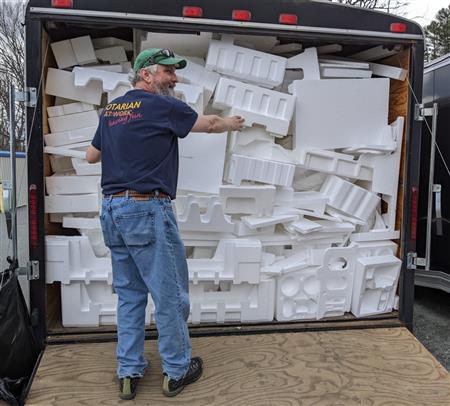
On April 24th, Mike Carrier from the Rotary Club of Plymouth addressed the Rotary Club of Nashua regarding the #6 Styrofoam recycling program their Club initiated in 2022, in collaboration with other northern New England Rotary Clubs. Styrofoam is 98% air, but takes up a lot of space (35% volume in landfills). If we can recycle it (which very few places offer, hence it ends up in the waste stream and ultimately our landfills), we can significantly reduce the space it takes up in our landfills. The answer is densification.
Guilford now accepts Styrofoam for densification from communities where they have an agreement, and Lebanon and Plymouth are now part of that. The Clubs collect the Styrofoam in a variety of ways, including local and regional community collection events. They are working on Collection Bins (which use huge reusable and thus sharable bags), as well as traveling collection vans.
Mike shared examples of what can and cannot be recycled through this program. Construction foam is mostly unacceptable, tape needs to be removed, food service containers are recyclable, ‘packing’ Styrofoam is accepted (both things that are used to ship to individual consumers and to places like hospitals and veterinary offices. They cannot accept the little peanuts, food service containers that are embedded with food and/or grease, and blue and black foam. He then described the process of densification, and how they then sell it for reprocessing, providing an income stream for the transfer stations.
Mike stressed the importance of a good relationship with your local transfer station, as that partnership is key to success. Mike took a number of questions from the audience, and concluded with his thanks to the Club for allowing him to speak.
Mike shared examples of what can and cannot be recycled through this program. Construction foam is mostly unacceptable, tape needs to be removed, food service containers are recyclable, ‘packing’ Styrofoam is accepted (both things that are used to ship to individual consumers and to places like hospitals and veterinary offices. They cannot accept the little peanuts, food service containers that are embedded with food and/or grease, and blue and black foam. He then described the process of densification, and how they then sell it for reprocessing, providing an income stream for the transfer stations.
Mike stressed the importance of a good relationship with your local transfer station, as that partnership is key to success. Mike took a number of questions from the audience, and concluded with his thanks to the Club for allowing him to speak.