
E Russell Smith, Luz Maria Ortiz Smith, Janet Napier, Connard Hogan, Erik Davis, and Angelique Springer Davis in Taipei, Taiwan.
Six members of the Rotary Club of Santa Barbara Sunrise traveled to Taipei, Taiwan, to attend the 2026 Rotary International Convention, joining thousands of Rotarians from around the world for a week of fellowship, inspiration, and cultural exchange. In addition to participating in the convention, they explored Taipei and joined a post-convention tour of Taiwan, experiencing the country's rich history, traditions, and remarkable hospitality.
Club members Luz Maria Ortiz Smith and Janet Napier share their personal reflections from this memorable journey.
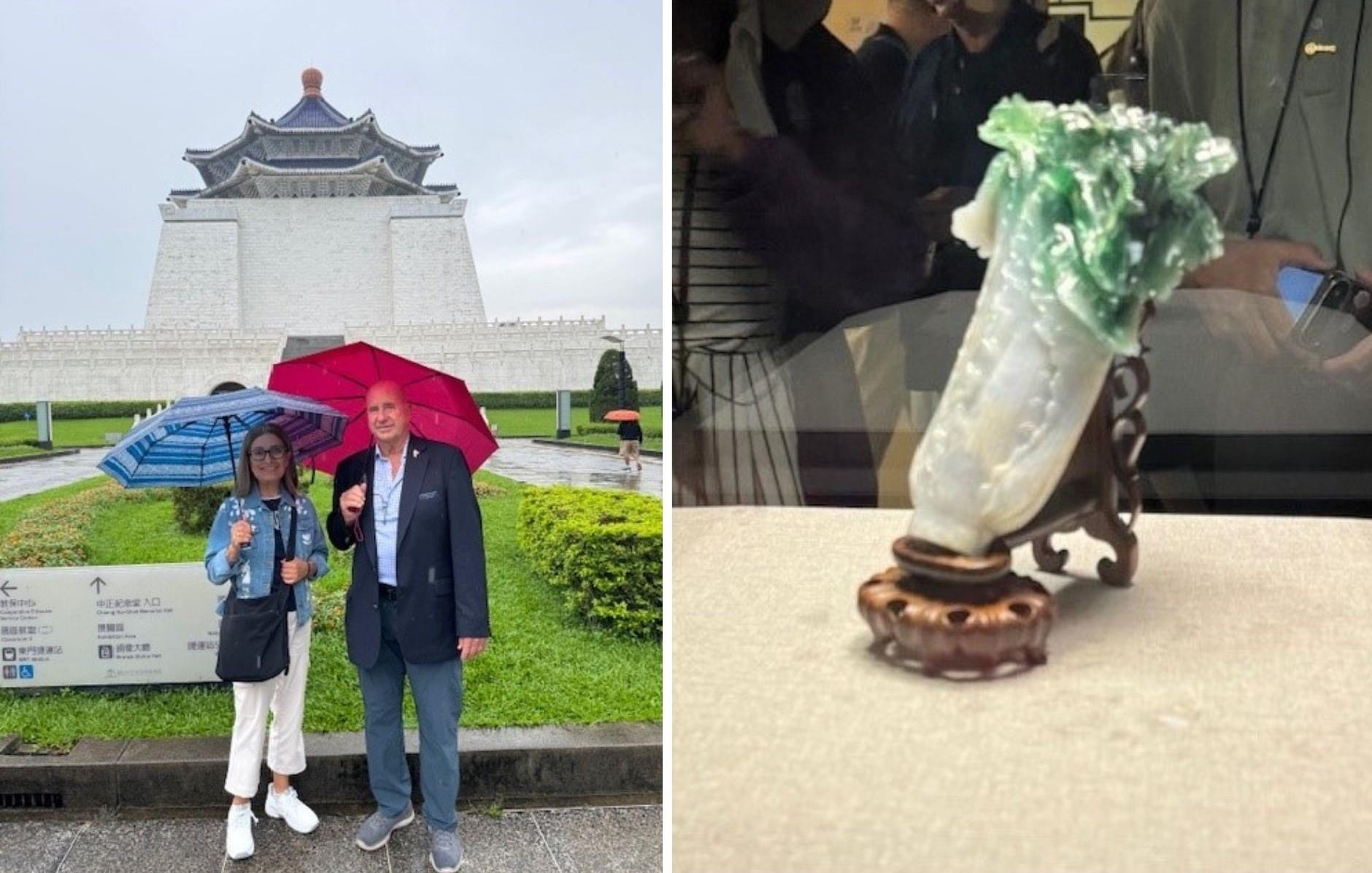
Left: Luz Maria and E Russell at Chiang Kai-Shek Memorial Hall; Right: Jadeite Cabbage
We had many wonderful experiences in Taiwan, not only during the Rotary International Convention but also throughout our five-day tour. Among the many highlights, one that stood out most was the hundreds of Rotarian volunteers who warmly welcomed us and were always available to assist us wherever we went. Having attended many Rotary conventions over the years, I can say that this is the only convention where I have seen such a remarkable number of dedicated Rotarian volunteers. Their enthusiasm, professionalism, and genuine willingness to help visitors made a lasting impression and contributed greatly to the exceptional experience we enjoyed in Taiwan.
We also had the privilege of hearing outstanding speakers during the general sessions. The speaker who inspired me the most was Nobel Prize laureate Malala Yousafzai. Her powerful message of courage, resilience, and the transformative power of education was both moving and inspiring, leaving a lasting impression on everyone in attendance.
Learning about Taiwan’s culture, history, and cuisine was another memorable part of our journey. While I must admit that I did not enjoy every dish we sampled, I appreciated the opportunity to experience authentic Taiwanese food and traditions.
One of the highlights of our tour was visiting the National Palace Museum. Seeing the famous Jadeite Cabbage, regarded as one of the museum’s most significant antiquities, was truly fascinating.
-Luz Maria Ortiz Smith
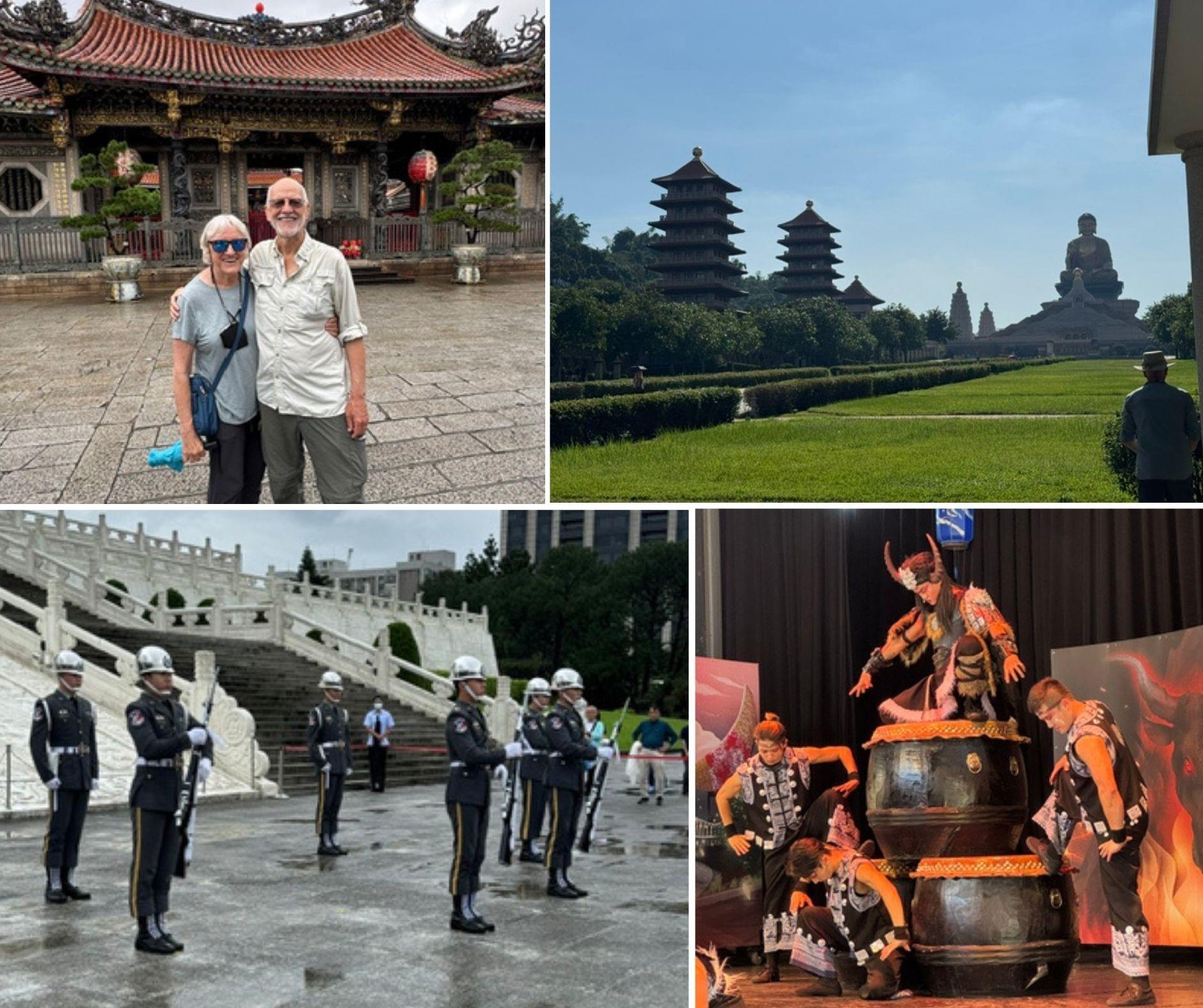
Clockwise from top left: Janet and Connard at Longshan Temple, Taipei; Fo Guang Shan Buddha with Pagodas;
erformance at Yilan National Center for Traditional Arts; and Soldiers at Chiang Kai-Shek Memorial Hall.
Besides the information and inspiration we glean from attending a Rotary International Convention (this was our 11th), Connard and I enjoy experiencing the culture and learning about and seeing the host country’s historic sites. So, having a free day prior to the Convention opening ceremony, we booked a tour of the main places of interest in Taipei. We saw the guard ceremony at the Chiang Kai-shek Memorial before viewing the statue of the military commander, revolutionary and statesman, himself, who oversaw the relocation of the Republic of China government to the island of Taiwan (formerly Formosa) in 1949. He is very important to the Taiwanese. Then, on to the National Palace Museum which houses 700,000 priceless, ancient artifacts spanning 8,000 years of Chinese history, many of which were saved from mainland China during the Chinese Civil War. Our guide took us to see some of the most impressive pieces of art, but we wished we had had more time to explore there.
Our next stop was the Longshan Temple, one of Taiwan’s most significant and stunning places of worship. Originally built in 1738, it is an active, multi-faith sanctuary dedicated primarily to the Goddess of Mercy. After sauntering down Dihua Street to see the local teas and spices for sale and the Ximending shopping district for a quick lunch stop of beef noodle soup and mango shaved ice dessert, we ended our tour at Taipei 101, a 101-story, 1,667 ft skyscraper resembling a bamboo stalk and featuring an 89 th floor indoor observatory. It was the world’s tallest building from its opening in 2004 until it was surpassed in 2009 by the Burj Khalifa in Dubai.
Night markets are not to be missed in Taiwan so, during our six days in Taipei, we visited three of them: Raohe, Shilin and Ningxia. Our interest there was not to shop but to eat! While hesitant to risk the squid, chicken feet, sausage, stinky tofu, and deep-fried somethings, we sampled the black pepper pork buns, sweet potato balls, quail eggs, and crab legs, as well as bubble tea – a tea-based drink with milk and chewy tapioca pearls (boba) at the bottom, served cold with a wide straw. Delicious!
The day after the closing ceremony of the Convention, Connard and I, Luz Maria Ortiz and E. Russell Smith, joined a 5-day tour of the island of Taiwan along with approximately fifty other Rotarians from around the world. We were divided into two large, air-conditioned buses with English-speaking guides. It turns out the island of Taiwan is very large, so our lengthy drives took us to Sun Moon Lake where we sampled tea and a tea-soaked egg at a tea factory and took a boat ride on the beautiful lake, then the next day on to Tainan to see the Anping Fort, a fortress built by the Dutch East India Company between 1624 and 1634. Next, we were received by a monk at the Fo Guang Shan Buddha Museum, a most impressive site, world-renowned for its colossal bronze seated Buddha statue (354 feet high), with eight identical pagodas lining the main avenue up to it. The main hall houses a relic purported to be from the historical Gautama Buddha.
The next day took us to Fangliao, Pingtung, where we boarded the Breezy Blue Train, a restored 1950s heritage train pulled by a diesel engine and without air-conditioning, requiring passengers to open the windows to cool down. The three-and-a-half-hour journey glides along the Pacific coast with views of the Taiwan Strait, and crosses 100 bridges and runs through 30 tunnels, ending in Taitung City. From there we visited the Bunun Leisure Farm for a tribal tour where we attended a tribal performance: singing, dancing and storytelling, and made leather bracelets for ourselves. We learned that Taiwan recognizes 16 indigenous tribes who account for 2.5% of the island’s population and are primarily of Austronesian descent.
Each day, our buses stopped for lunch and dinner at local restaurants serving regional foods. Sitting at large, round tables with lazy Susans in the middle, the wait staff brought dish after dish to the tables – at least 8 to 10 per meal – and we, using chop sticks or spoons, helped ourselves (or not) to sometimes delectable, sometimes unpalatable (to our Western taste) foods, such as pork belly, chicken, cabbage, fish, abalone, soups, sea weed, and totally unknowns. The meals usually ended with watermelon as dessert but, on one occasion, we were served a plate of cherry tomatoes because tomatoes, in Taiwan, are consumed as fruit (which, of course, botanically they are).
On our last day, we traveled to Taroko Gorge and viewed the entrance to the Taroko National Park, then on to the Yilan National Center for Traditional Arts, a cultural park dedicated to preserving, promoting and showcasing Taiwanese folklore, traditional crafts, performing arts and music. There, we followed a parade down the main “street,” attended a traditional play/operetta and learned to make chopsticks. Sadly, our tour came to an end at the Taipei main station for a taxi ride out to the airport and the next day home.
-Janet Napier
More of Janet's and Connard's photos can be viewed here.
The Rotary International Convention is more than a gathering of members from around the world, it is an opportunity to build friendships, broaden perspectives, and experience the cultures that make our global Rotary family so unique. Thank you, Luz Maria and Janet for sharing your memories.