
June is Fellowship Month

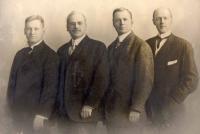
The first four Rotarians: (from left) Gustavus Loehr, Silvester Schiele, Hiram Shorey, and Paul P. Harris Courtesy of Rotary Images
The final month of every Rotary year is Fellowship Month. This is a fitting designation since fellowship is particularly to the forefront with changeovers being very much the priority in June.
Fellowship is of course one of the five core values of Rotary, the others being service, diversity, integrity and leadership. Yet in so many clubs there is a real objection to the use of the word fellowship and I know of some clubs where the use of the word will require the person concerned to make a donation to the fines box.
It seems those who find the word objectionable see it as one of those legacy words that define old Rotary and inconsistent with new Rotary. That said no one seems to have been able to identify or even invent a word that comes close to all that is implied in the word fellowship. Certainly the term goes back a long way – apparently to the twelfth century from the Middle English word felaweshipe or feolahschipe, meaning companion!
Depending on which dictionary you prefer, the definitions of fellowship generally comprise common sentiments. Broadly fellowship can be related to three areas of significance – company, association and membership (or partnership). So it can refer to a community of interest or activity but also a company of equals or friends. A somewhat obsolete interpretation is as the quality or state of being comradely! A thesaurus will tell us it is an association of people who share common beliefs or activities, as we do in Rotary.
Synonyms are listed as communion, rapport and rapprochement. Related words include accord, agreement, concord, harmony, oneness, solidarity, togetherness, unity, affinity, empathy, sympathy, understanding, amity, companionship, friendliness, reciprocity and symbiosis. No wonder it is hard to find a word that might come close to capturing the shades of meaning suggested by fellowship.
Then there is the other meaning that is widely used in academia but also in Rotary. So in a University there an accepted status of a Fellow and in Rotary we of course have Rotary Peace Fellows. Generally it accepted that a fellowship provides for a financed study post providing study facilities, and tuition and living costs (sometimes in return for teaching service). There is also a Christian or ecclesiastical interpretation.
Rotary also has Fellowships in many areas, which are based on a friendly association of people who share a common interest, or more broadly as a group of people meeting to pursue a shared interest or aim. Editor Clarice and I clearly were on the same wavelength this week as inside Networker you will read an article about International Fellowships.
Rotary Fellowships are designated as autonomous, international groups of Rotarians, Rotarian spouses, and Rotaractors who join together to:
- Share a common interest in worthwhile recreational activities (sports, hobbies, etc.)
- Further their vocational development through acquaintance with others of the same profession
- Make new friends around the world
- Explore new opportunities for service
- Have fun and enhance their Rotary experience
There are nearly 70 formal Rotary Fellowships catering for interests from Chess to Cricket and Stamps to Skiing. I note there is even a Fellowship for Past District Governors (and friends)! Alphabetically it sits next to the Fellowship for Old and Rare Books and maybe that is not a random or unintended connection. [View full list here]
Getting back to the concept of fellowship, part of the problem seems to be that we have taken a noun and made it into a virtual verb. So we have commonly identified fellowship to mean a period of social time but also an activity. How often do we see at Rotary functions that fellowship is listed in the program as a period of time before or after a meeting? Those periods are a time when we are socialising (as we might refer to it) whereas in fact the whole event, including the meeting represents real fellowship and I think therein rests the source of the discomfort with the concept of fellowship. As for the expression “let’s have some fellowship,” I think we are way off the mark. Simply I think we are misusing the word and maybe if we avoided using it in the context of pre-dinner drinks or social time we would restore it to its proper place as a real core value of Rotary.
Paul Harris was looking for friendship when he conceived the idea of Rotary. He wanted to develop friendships that went beyond the cordial relationships of business connections. It was of course a very different society in those days and people typically socialised by joining special interest clubs or sporting associations. The idea that Paul Harris had was a club based on “a very simple plan of mutual cooperation and informal friendship such as all of us had once known in our villages.” It was also based on the expectation of reciprocal trade between the best single representatives of each business. As Rotary grew so did the sense of special relationships. Again, it is hard for people in 2013 to imagine life in 1913 but a Rotary meeting and Rotary service was pervading. The Rotary lunch, and the closeness of Rotarians and their families meant a special kind of fellowship, in which all those definitions of fellowship applied.
Networking has been suggested as a better representation of what is intended by the word fellowship. If I have been able to adequately able to define fellowship it will quickly be seen that networking is in fact only a part of what fellowship is about. In fact it is a more self-serving aspect of fellowship. An accepted definition seems to be the exchange of information or services among individuals, groups, or institutions; specifically: the cultivation of productive relationships for employment or business.
Whatever word individual Rotarians may feel most comfortable with, fellowship is alive and well in Rotary and will be celebrated most demonstrably over the next month and into July as club officers change over and all Rotarians recommit to Service Above Self.
Over the past few weeks Lynda and I have enjoyed fellowship at its best. Inside Networker this week you can read about the induction of what was going to be three new members into the Rotary Club of Yarraville, but became an induction of four new members. Fellowship in all of its meanings was very evident that Saturday afternoon as we cruised along the Maribyrnong River.
In Networker last week you read about three events where Rotary fellowship was again amply demonstrated. The charter of the Rotary e-Club of Melbourne, Rotary Engaged - the 2013 Assembly and the Charter of the EarlyAct club at Balwyn North Primary all engendered real pride in what we do and can achieve in and through Rotary. Just as impressive as fellowship events were the outstanding Pride of Workmanship Awards at the Rotary Club of Keilor East and the 78th Charter Dinner of the Rotary Club of Essendon, where they celebrate their charter every year – not just every decade or every quarter century. This way the sense of what their fellowship is about is reinforced annually and I’m sure this goes a long way to explaining why the Rotary Club of Essendon remains a strong and effective club after 78 years.
Over the next month or so Lynda and I will look forward to a lot more Rotary fellowship at changeovers, the imminent charter of the Rotary Club of Bendigo Next Generation, the 50th Anniversary Rotary Club of Echuca-Moama Steam Rally, the welcome back to our Hiroshima Peace Forum attendees, the wind up of the Police mentoring program for this year, Rotary Art Shows [Camberwell and Bacchus Marsh] and many more events that demonstrate, all in their own way what we experience everyday in Rotary. Rotary – it’s amazing.
Dennis Shore,
District Governor.
- See more at: http://www.rotarydistrict9800.org.au/news/3618/june-the-month-of-rotary-fellowship/?type_fr=4#sthash.RdfHR97S.dpuf
#fellowship