
India Reflections by Larry Emrich
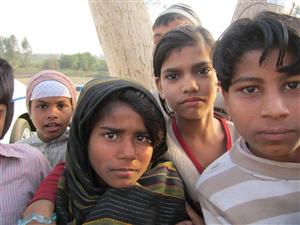
From his journal he writes, I have a hard time with India. The cities large and small are enormously impacted with people, motorcycles, rickshaws, cars, trucks, buses, vehicles of all kinds, propelled by internal combustion engines, water pumps, and camels, and yet there is a peace there, a pervasive serenity. You can find it; you can feel it in the commotion, the traffic, the ubiquitous horns, the bumpy roads and, in February, the dust. You can see it in the movements of the people, in the eyes of the old men, in the pace of life. At least, I feel it, but never at first. It seeps into one’s soul after days of restless sleep, after driving hours to get a few hundred kilometers, after walking countless blocks and inhaling pounds of dust, after seeing the kids, after following the health care workers in the villages as they perform their duties, door to door, talking with parents and vaccinating all the children against polio. India is an enigma: serene and chaotic.
Sunday, February 19, 2012: National Immunization Day in India. Over 172 million children under the age of five would be vaccinated. For the next few days, health care workers would go door to door, in the villages, and vaccinate any child under five years of age, who did not go to the local booths, clinics or hospitals. No child is missed; that is the goal. We spent several hours at
a local elementary school vaccinating children, masses of children, non-stop, one after the other, presented to us by an older sibling, brought to the station to receive the drops, mark the pinky, and do the next child. Our tally sheet showed over 300 children in a couple hours, and still there were more. We kept at it until no more children came to receive the drops.
The best part of the trip for me would be the next phase: visiting the villages. I was really looking forward to this. We were on the road at 7:00 the next morning to go to a remote village near a town called Basuli. We arrived around 9:30, met the supervisors and the health care workers who were already hard at it. We followed them around the village, door to door, watching them interact with the women at each home, vaccinate children in the house if they had not yet received the drops, mark the door to show that the house had been visited, and then move on to the next house. In a typical remote village like the one we visited, there are about 500 homes, each with about five family members, for a total of 2500 villagers. In the village next to the one we visited, we were told there were also 6,000 monkeys. Our village had a handful that supervised our work from rooftops and trees.