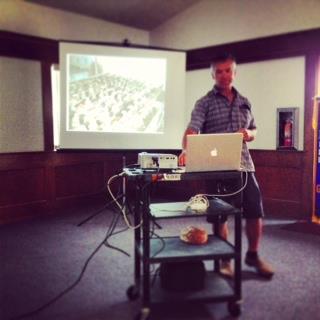
Ray Fields-Abalone Farm
A very interesting program on abalone farming from Ray Fields, President of Abalone Farms in Cayucos, the oldest and largest abalone farm in the US. He started there in the 80s with 7-8 employees and now he manages 35 employees.
Abalone is considered in the snail family. They grow slowly and have a average 20 year lifespan. In the late 60's abalone were plentiful and taken off the shores/reefs so much that there was a decline in growth, thus this Abalone farm was built. It was decided that the average age of abalone to sell was 4 years. The formula for success is sea water and electricity to keep that sea water flowing. The average time an abalone can survive without fresh flowing sea water is about 45 minutes until the oxygen is absorbed, so PG&E is pretty much on call to the farm, especially since they spend an average of $37K a month for electricity.
At three years of age the abalone is sexually matured. twice annually the abalone gives up eggs. Ten million eggs are released in sterile water. About 50K survive and evolve into brown diatoms. They are fed algae and are kept indoors for two months with lights, etc. After two months, about five thousand survive. They are kept in indoor tanks from 5months to about a year. Once about a year old, (now about 3K survive), they are put out in the concrete tanks with PVC pipe so they can 'latch on'. Once out in the concrete tanks they are fed kelp from the ocean in which the farm employees go out and 'trim'. Kelp can grow 1-2 feet daily. They have to pay the state of California a percentage for the kelp access. Kelp is harvested three times weekly, about 60 tons used weekly. ($120/ton is the cost)
In 1997, the state of California closed all harvesting south of San Francisco. Now Abalone can only be purchased by farms. At the present, about one million abalone are sold per year. There are local restaurants that purchase abalone from this farm; Sea Venture, Lido, Cracked Crab.