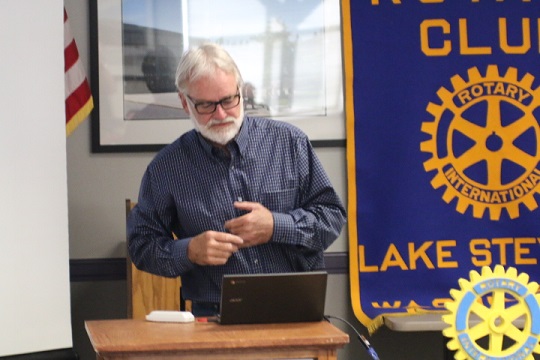
 Mark Schrader, our speaker last week, was born and raised on a farm in Nebraska. When he was 16, his family moved to Santa Barbara, California. It was his first view of the Pacific Ocean. After graduating from University of California-Berkeley, he and his wife moved to the Stanwood area where they lived on a small farm for over 40 years.
In 1983, Mark became the first American to sail alone, around the world via the Southern most route. Four years later, he did it as a competitor in an around the world sailing race. In 2009/10 Mark assembled a crew of scientists, teachers, writers and photographers to circumnavigate North and South America on the sailing vessel Ocean Watch. His book, One Island, One Ocean is the story of that historic voyage. Project Ocean Watch is planning on repeating that voyage scheduled to depart from Seattle in late 2018.
This talk was full of Mark telling stories about navigating the ocean, doing research on small & giant squid and the beginning of Project Ocean Watch. Mark commented, that if you take a map and draw a circle around the Americas, it becomes clear that what you are looking at is not two continents and two oceans but one island surrounded by one ocean, all interconnected. On May 31, 2009, a small group of sailors set out to circumnavigate that island---the first time that it had ever been done. After one year, 25,000 nautical miles, 50 ports of call in 13 countries, they returned with remarkable stories. The paragraph comes from the book authored by Mark and some of his sailor mates.
"Project Ocean Watch was launched the day the financial markets failed in 2008. They were in the process of asking for money and earlier had commented that they wouldn't sail until the 64 ft. Ocean Watch was fully funded. Because of the market failure, they set sail, raising funds along the way. In their venture through the virtually ice-locked Northwest Passage and around the turbulent tip of Cape Horn, the crew was eye witnesses to a number of villages, cities, traditional cultures and coastal habitats touched by climate change. Among Mark's research was the study of squid both small and large. Another research project was the Barrow Bowhead Whale project. Disasters have ruined the Bowhead Whales. Craig George was in charge of the Whaling Commission responsible for counting the number of Bowhead Whales in Barrow, Alaska. And, there was Harry Brower Jr. who killed whales. Over time, they have formed an alliance working for the North Slope Department of Wildlife. To understand the relationship without printing another chapter, you have to read the account of their relationship in One Island--One Ocean."
.jpg) Here, Mark is pointing to the amount of water on Earth compared to the size of Earth. This includes all fresh and salt water, frozen and liquid.
Here, Mark is pointing to the amount of water on Earth compared to the size of Earth. This includes all fresh and salt water, frozen and liquid.Researching the vast ocean was Lessons Learned Along the Way. Another part of the book. The Around the Americas was conceived as a voyage of discovery, and from the Northwest Passage to the tip of South America, the crew continuously learned new lessons about the environment, ocean conservation, oceanography as well as other scientific disciplines. But a big part of the mission---in lectures, presentations, boat tours, and school visits---was to pass on what we'd discovered to students, sailors, scientists and scores of everyday folks they met along the way. Almost always, the most instructional encounters were the unexpected ones. Thanks Mark, for such a story-telling adventure that opens our minds to the impact we all have on the environment around us.