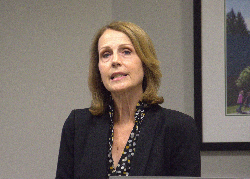
Returning to our Club to update us on the Bridge Receiving Center was Tracy Rubstello, Friday, August 1st.
Overview
This document outlines the current state of the Bridge Receiving Center, a non-profit supporting children in Washington’s foster care system. It details the center’s operational status, including its recent expansion to provide emergency placement services and plans for future growth. The summary also highlights significant challenges, primarily stemming from the unintended negative consequences of the state’s “Keeping Families Together Act,” which has made it harder to remove children from unsafe environments. Consequently, the children entering care are more traumatized, requiring more intensive and costly therapeutic interventions, which are also described. Bridge Receiving Center Operations and Services.
Tracy recently moved to Seattle to be near family, expressed gratitude for the support from the community of Lake Stevens, where the Bridge Receiving Center is located. The center is celebrating its fifth birthday on August 17th and has served 308 children to date. Historically, the center focused on “first-into-care” children, defined as those pickedup by police or Child Protective Services who had not been in the care system before. This definition changed in December. The organization is planning a fundraising event called “Let’s Dream Big” at the Bellevue Club to support its mission and future expansion.
At the state’s request, Bridge has expanded its services to become a designated Emergency Placement Center, in addition to serving first-into-care children. Washington State has only 15 total emergency placement beds for children in crisis; Bridge Receiving Center provides five of these.
The children now entering care are significantly more traumatized, confused, and neglected than in the past due to recent legislative action and new requirements. The center now serves children through age 18, many of whom have been in the system for a long time, have restraining orders against their parents, and have been out of school for years, with many being illiterate or lacking basic math skills.
Most emergency placement children have been with Bridge for a full month, which is unusual as emergency placement typically involves frequent movement, a practice. Bridge actively works to counteract due to its traumatizing effect. Bridge provides intensive, creative, and individualized trauma care, which the state now recognizes as essential. Therapies include equine therapy, art therapy, and play therapy (e.g., blowing bubbles, jumping on a trampoline) to help regulate the nervous system.
The staff includes a licensed clinical therapist, an educational specialist, and a mental health case manager.
Bridge emphasizes that trauma is not just what happens to a child, but also being alone in that experience. The center works to unpack trauma from children’s central nervous systems by validating their experiences and affirming their worth, preventing tragic outcomes like addiction and homelessness. Recognizing that many children struggle to dream for themselves due to their experiences, Bridge tells them to dream.
The Lake Stevens School District partners with Bridge to help place children in school when they lack a connection to their school of origin. The center works against severe challenges, such as a child whose mother sexually trafficked her to pay rent, striving to instill a sense of value and worth in these children.
Children are provided with the center’s phone number on wristbands and other items, allowing them to reach out for support even after leaving care, leading to many returning to Bridge’s care.
Many of these children have never seen a therapist before entering Bridge’s care, highlighting the critical need for the mental health services provided. The organization is starting a mentor program to provide children with lasting relationships after they leave the center’s care, as these relationships are protected by the state. Children entering the system are more traumatized than ever, requiring more intensive and expensive care, with Bridge bringing in more specialists to address these complex needs.
Many children are returned to unsafe homes, and Bridge is seeing an increase in children returning to their care multiple times.