Survival Tips

by Lorine Parks
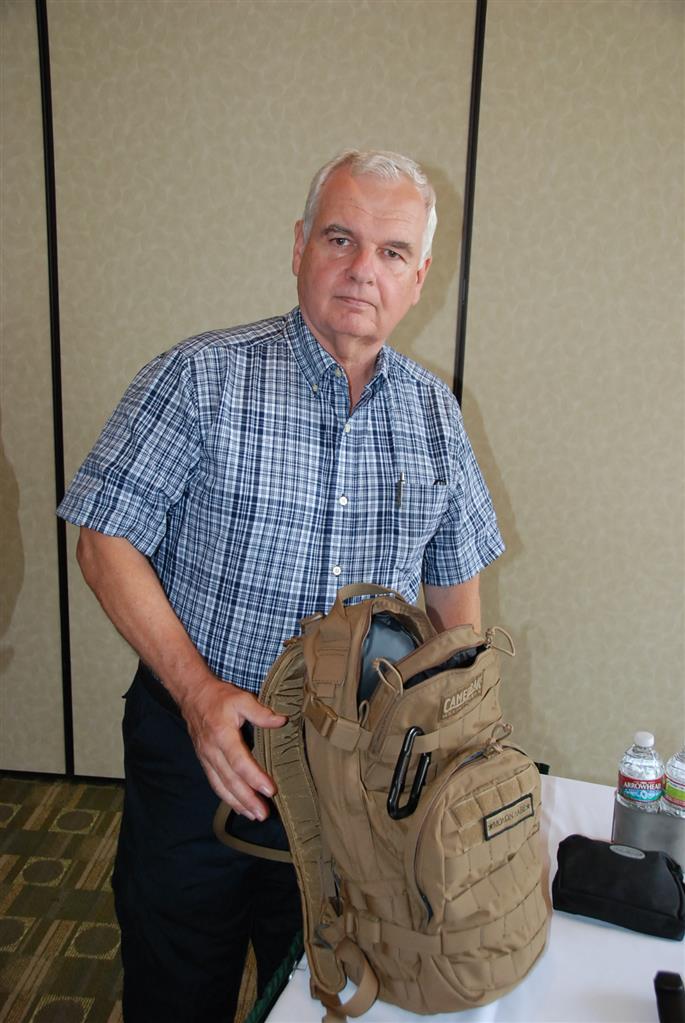
“Don’t wind up on the six o’clock news.” That was our guest speaker Gerry Beck warning to us, as he began a fascinating program about basic survival techniques.
Those of us who take for granted our soft life in our nice secure civilization, need to remember these simple survival rules when we venture into nature’s domain. First, tell someone where you are going, Second, don’t go alone. And, Third, in case you forget rules number one and two, take a survival kit. Always have one packed and stored in the car, wherever you go.
Just remember, Gerry emphasized, if you are lost in the wilderness you have exactly the same chance of survival that the pioneers or the ’49’ers had, or the Donner party. When we go back to the sod, we are returning to the food chain. And, unarmed, we are not even the top predator. A little paranoia helps to get the right perspective here.
What do we want to put in our BOB (Bail Out Bag)? The basic needs for survival are food and water, shelter and first aid kit, and then rescue items such as flares and mirrors.
Where can you get such supplies? Well, it would be wonderful if Hometown Hardware (I know you’re listening, Ray) had a specific shelf where these items were already collected. What a public service, and sure-fire perennial best sellers.
Where to get the pack? Any sporting supply house. And non-profit organizations, such as AARP and the Sierra Club, give out lightweight canvas or plastic bags as a membership bonus. No excuse for not finding one for yourself. Each traveler should have his/her own.
And what to put in it? Remember, you may have to put this pack on your back and walk some distance, so keep it light. Water, first. Water weighs eight pounds to the gallon. Two gallons would be a good two-day supply. But two bottles would be a start. And, there are ultra-light small water filters that should be in that kit, to extend your drinkable supplies.
You can store more in the vehicle, and you should test or renew supplies every year.
Then food, dried food. Dried meals, trail mix. Here’s a Rule of Threes to tell you how much you might want: you cannot live 3 minutes without air; 3 hours without shelter in an inhospitable environment; 3 days without water; 3 weeks without food.
So a large quantity of food has a lower priority than shelter. Pack a thermal or heat-retaining blanket, a rain poncho, matches to start a fire, or a cigarette lighter.
Next, and still vital, prepare for an accident. Have a first aid kit: gauze bandages, adhesive tape, band-aids, scissors, tweezers, mini-flashlight, disinfectant, aspirin, Neosporin disinfectant and itch-relief, and Tums. Target has an in-store promotion right now, if you buy three of the Johnson and Johnson “participating items,” you get the bag free. See Target’s health care area. And a Swiss army knife – some of those gadgets could be life-saving.
Now, to get rescued. The BOB should have something to signal with, to get you noticed, especially if you have become immobilized. There are solar-powered mirrors that send a beam for 20 miles. An airplane would spot that. Flares. And, if you intend to leave the vehicle, then a compass.
To encourage our preparations Gerry told us some stories of those who did not make it. One concerned a couple who drove from Canada to Las Vegas via Idaho and Nevada. The well-intentioned, but robotic GPS suggested a short-cut through the Nevada desert that culminated in a dirt road that had vanished after a desert flash flood. The husband decided to walk for help because he could see distant lights, not considering how the mirage that the desert heat creates, makes things appear closer than they are. The wife stayed with the vehicle. Seven weeks later, she was found, emaciated and nearly dead, subsisting on crackers and some bottled water. The husband never was found.
What were their mistakes? Perhaps if they had used the international distress signal of putting up the car hood, and staying with the vehicle, their chances would have been better. And – no one knew that they had decided to take this trip, or the cutoff detour.
“Remember your common sense,” Gerry emphasized. If you are in Death Valley, load up with water before you set out. People dehydrate in the desert, and children dehydrate faster, having little vital capacity.
We have become too dependent on our safe environments, and we forget that an out-of-town vacation will take us out of our comfort zone. People often think they’re immune to disaster, which is a dangerous attitude, when a car may accidentally break down. “Everyone needs a tiny degree of healthy fear,” Gerry said, “a little paranoia goes a long way.”
In a survival situation, every new thing you meet should pass three tests: is it edible, is it useful, is it dangerous. If it’s not essential, discard it.
True, 95% of those who become lost are found accidentally by passers-by. But in California alone, in 2011 there were 500 people who required rescuing. Gerry’s specialty is bringing them out, even if that means in a body bag.
How much equipment will you need? Case by case, it depends on where you are, the altitude, the weather, your training, your expectations and your comfort level. Your BOB should be stocked for at least 72 hours survival. But common sense says that if you can live 3 weeks without food, don’t bolt your whole stash in that first 72 hours, and ration that water.
Your kits should be selected with care, with these in mind: utility and necessity and weight. As to quality, get the best items you can afford.
One item this reporter always advises for travelers is a scarf or big kerchief. To start with, not only can it protect against wind or chill, it can be a tourniquet, a compression bandage, a sling, a short rope, a carry-all, a head cover to prevent sunburn, a face mask to filter dirt or sand, something to wave or flutter to attract attention. It can be torn into strips to make trail markers. There is no end to the ingenuity the scarf can inspire.
What were the three rules for safe traveling again? Tell someone, before you go, that you are going, and where. Don’t travel in the wild alone, and take your personally packed Bail-Out Bag wherever you go.
Being lost and in a survival situation is everyone’s worst nightmare but it is also a good survival fantasy to have, when you can enact your own salvation, by reliving the Boy and Girl Scout motto of “Be prepared.” Be ready mentally, by having thought ahead and imagined any accident that could occur, and then having secured the things necessary, have the discipline to deal with any situation.