Shen Yun and Chinese Culture

by Lorine Parks
We were treated to a fascinating overview of the cultural and spiritual battle taking place today in China, by Dr. Shizhong Chen, an expatriate Chinese, and president of the Conscience Foundation, who also has a degree in molecular biology from UC San Diego. He is the spokesperson for the Falun Gong Human Rights Working Group (FGHRWG) and his story explains what Falun Gong is, and why the world is protesting China for civil abuses against it.
Human Rights Watch notes that the crackdown on Falun Gong reflects historical efforts by the Chinese Communist Party to eradicate religion, which the Chinese government believes is inherently subversive.
Ultimately, this entire presentation to Downey Rotary explained and introduced the dramatic theatre ballet company “Shen Yun” which is appearing in Los Angeles in January. It was founded by Falun Gong in New York in 2006 to preserve, revive and demonstrate the values of 5,000 years of civilization. This theatre presentation explains what those values are, and why you cannot see a show like Shen Yun in China today.
First one must understand the Chinese way of thinking, which lasted from ancient times starting five thousand years ago until the take-over by the communist party in 1949. The Chinese people called China the “Land of the Divine” and believed their culture is given from the heavens. Chinese people embrace the Concept of Oneness. The way to achieve Oneness is by Cultivation Practice, the practice of mind and body transcendence, which is the core of Chinese culture.
Dr. Shuzhong explained the “culture of cultivation practice.” This means returning to the old values of China, which combined the best of three traditions.
The Chinese way of life can be cultivated based on Confucianism, Taoism, and Buddhism principles. Confucian core values are based on Virtue, and achieved through benevolence, justice/friendship, respect/politeness, wisdom and integrity. Taoism is based on Truth, and depicts an attitude towards life, achieved through compassion and humility. Buddhism concentrates on Compassion via three areas: Precept, where you give up all your desires in everyday life; Samadhi, which is a calming down and meditation, where you forget everything else; and Wisdom.
Practice of Falun Gong consists of two features: performance of physical exercises, and the refinement of one’s xinxing, moral character, or temperament. So in addition to its moral philosophy, Falun Gong consists of four standing exercises and one sitting meditation. The exercises are regarded as secondary to moral elevation, though is still an essential component of Falun Gong cultivation practice.
Every aspect of Chinese life manifests specialized ways of putting these values into practice. Chine medicine is spiritual channeling of energy by means of acupuncture and herbs; the martial arts, such as the Buddhist Shaolin Kung Fu, is the exercise of the sound mind in the sound body, where one learns exercise (outer part) but also builds character and spiritual cultivation (inner part).
This continual search for the spiritual life, or cultivation of cultural values, was interrupted by the ascent of the CCP, or Chinese Communist Party in 1949. After it was established as the government in China, the CCP proceeded to try to eradicate the cultural traits that have made China unique. Under the term “Cultural Revolution,” Mao Tse Tung systematically set out to persecute and destroy the “four olds:” thought, culture custom, habit.
Virtue was ridiculed. Good deeds, for example, used to be praised, on the theory that good begets good, and evil begets evil. Now good deeds are disparaged, in order to destroy the old values and traditions. The old belief, “Heaven knows best” becomes meaningless under an aetheist government which does not admit a heaven.
In 1992 the Falun Gong, a renaissance for Chinese values, was begun.
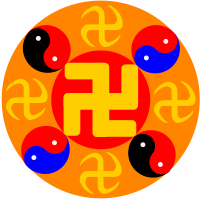
Falun Gong or Falun Dafa (literally means "Dharma Wheel Practice" or "Law Wheel Practice") is a spiritual discipline first introduced in China in 1992 through public lectures by its founder, Li Hongzhi. It combines the practice of meditatio and slow-moving qigong exercises with a moral philosophy.
|
The picture illustrates falun, a spinning body of energy, used as the swastika by Hitler’s Nationalist Socialist Party in Germany in The 1930’s. |
|
|
|
|
|
|
|
|
|
|
|
|
|
|
|
|
|
|
|
|
|
|
Falun Gong emphasizes morality and the cultivation of virtue in its central tenets of Truthfulness, Compassion, and Forbearance, Through moral rectitude and the practice of meditation, practitioners of Falun Gong aspire to better health and, ultimately, spiritual enlightenment.
Falun Gong emerged at the end of China's "qigong boom"—a period which saw the proliferation of similar practices of meditation, slow-moving exercises and regulated breathing. It differs from other qigong schools in its absence of fees or formal membership, lack of daily rituals of worship, its greater emphasis on morality
Falun Gong refers to five sets of movements, which include physical exercise and meditation, that practitioners believe heighten their physical well-being, spirituality, and moral awareness.
Falun Gong motions are done to rotate the falun, a spinning body of energy said to be located at the lower abdomen. The ancient symbol for this is the swastika, which was used in many cultures before it became identified with the Hitler’s National Socialist party in the 1930’s.
Although the practice initially enjoyed considerable support from Chinese officialdom, by the mid- to late-1990s, the Communist Party and public security organs increasingly viewed Falun Gong as a potential threat due to its size, independence from the state, and spiritual teachings. By 1999, some estimates placed the number of Falun Gong adherents in the tens of millions.
On 20 July 1999, after three years of mounting tensions between the group and the government, the Communist Party leadership initiated a nationwide crackdown and multifaceted propaganda campaign intended to eradicate the practice. In October 1999 it declared Falun Gong a "heretical organization" and blocked Internet access to websites that mention Falun Gong. Human rights groups report that Falun Gong practitioners in China are subject to a wide range of human rights abuses; hundreds of thousands are believed to have been imprisoned extrajudicially, and practitioners in detention are subject to forced labor, psychiatric abuse, torture, and other coercive methods of thought reform
Falun Gong adherents have emerged as a prominent voice in the Chinese dissident community, advocating for greater human rights and an end to Communist Party rule.
Li Hongzhi has lived in the United States since 1996, and Falun Gong has a sizable global constituency; inside China, some sources estimate that millions may continue to practice Falun Gong in spite of suppression. Hundreds of thousands are believed to practice Falun Gong outside China across some 70 countries worldwide.
Shen Yun was created in 2006 in New York by Chinese ex-patriates, with the mission of reviving the essence of 5000 years of Chinese culture, which it asserts to have been nearly demolished by the Chinese Communist government. The company's performers practice the Falun Gong (Falun Dafa) spiritual discipline.
Classical Chinese dance has three core components: bearing (yun), form, and technical skill.[5] Technical skill describes the physical techniques of jumping, flipping, and leaping. Form encompasses the subtle expressive movements and postures that make up Chinese dance. Finally, bearing is described by Shen Yun are referring to the "inner spirit…something resembling cultural DNA or an ethnic flavor" that allows the dancer's emotional state to be conveyed. Performances around the world are hosted by local Falun Dafa Associations.
“Shen Yun,” a Chinese Dance company that is touring the United States, tries to reestablish this renaissance in Chinese culture, bringing back the old values of nearly 5,000 years of culture. “Shen Yun” was started for the purpose of reviving Chinese culture through movement, dance, and historical story telling on stage. The traditional Chinese music use Chinese instruments to produce a unique Chinese sound . Backdrops use animated effects to help tell the story. Elaborate, handmade, historically authentic costumes are used, that represent 56 ethnic groups in China and 5000 years of history.
Every aspect of “Shen Yun” is part of “cultivation of cultural practice.” The dance, based on legends, uses scenery representing life in China, be it a village or a painting of a mountain as backdrop. Often it is taken from famous painting. The whole experience is one of opulent spectacle, color, form, movement, music.
“Shen Yun” is donating 10% of its ticket price to Rotary. If you call the box office, the codeword is Rotary. On Jan 18-30 it will be at the Segerstrom Center for the Arts in Costa Mesa, and from January 25-27 at the Dorothy Chandler Pavilion in Los Angeles. Call 800-880-0188 or go to www.LAspectacular.com for reservations.