Rotary Rose Parade Float
by Lorine Parks
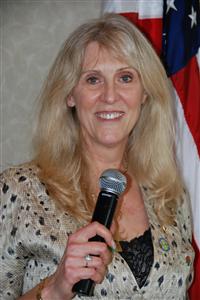
Our speaker today was Beth Anderson from the Palos Verdes Sunrise Club and the Public Relations and Marketing Representative for the Rotary Rose Parade Float.
Since we in Downey have had our own float in the Rose Parade for over fifty years, we could appreciate the finer points that Beth told us about the Rotary Float.
First, it is a U.S. and Canadian multi-district project, to promote Rotary International. We Rotarians have had a float in the parade since 1927, and this year marks our 34th consecutive participation. 32 Rotary districts participate.
Beth showed us pictures of past parade floats. The overall theme this year is “All the Places We Go,” taken from the children’s book, Oh the Places You’ll Go, by Dr. Seuss. Rotary will create “Bridging Continents,” with a spinning globe to represent the community and worldwide service of Rotary. From the picture we saw it looks like a winner. Last year, in fact, the Rotary float won the prestigious Princess Prize, for most beautiful entry under 35 feet.
Rotary uses outwalkers, people who escort the float by walking on either side, and this year they will be costumed in many nations’ distinctive garb, again showing how international an organization Rotary is.
Beth’s job includes making sure that as many major networks as possible have reviews about Rotary’s float. So far we can expect to see it on NBC, ABC, CNN, Hallmark and KTLA, all with features on their talk shows and the entertainment segments of their morning shows. The goal of her committee is to get Rotary’s name and story incorporated into the banter and scripts. It also helps to have celebrity announcers like Al Roker of NBC or our own Fritz Coleman on KNBC.
Good seats in Rotary’s section of the grandstands cost $90, and you can get yours through www.RotaryFloat.org, or by calling Beth at 818 262-2933. To make a float, after choosing the chassis and engine, welding the elements of the float into place, they shape chicken wire and mesh into the forms for the design. Then it is time to spray it with foam, which makes it completely solid.
Next comes decorating it with the dried materials: peas, beans, lentils. Then three days before the Parade, fresh flowers such as orchids, roses, and tulips are brought in and each blossom is placed by hand, by its stem, in its own individual flower tube which is filled with water, and then the flower is put in its place on the float. 1300 volunteers do this work, which takes 11,520 worker hours.
The Parade opens the doors for many public relations opportunities. On New Year’s Day the presidents of the core districts have breakfast and discuss mutual cooperation on projects. There is also a breakfast where representatives from the floats from other service clubs represented in the parade, such as Kiwanis, Lions and Optimists, meet.
The Float is funded by the districts, clubs and individual Rotarians. One question that many have wondered about was answered: how do you know where the float will be in the parade. The answer was that, in the interest of fairness, there are three sections to the parade, and each entrant takes turns rotating through these three sections. The announcement of the exact order is in mid-December, so we don’t have long to wait.
Rotary International has again selected Phoenix Decorating Company to build and decorate their float, and Downey-ites will be interested to learn it costs $140,000. Our Downey float is longer, built with all volunteer help, and the costs, mostly for flowers, are about $80,000. That Volunteer help is priceless.