Packages for Veterans
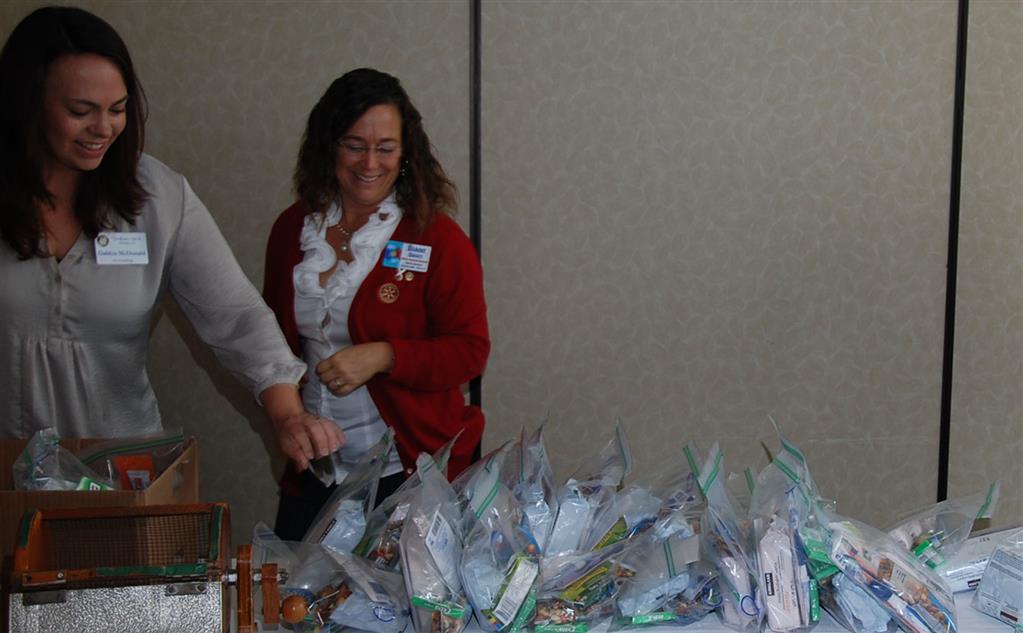
Dahlya had already arranged with the local Marine recruiting station to have our packages forwarded to service persons in combat zones. And the Club paid for the ‘essential” supplies, which were: first, a package of Handi Wipes – “the toilet paper here is the worst, coarsest you have ever seen,” was one GI’s comment. Next were snack packs of M & M’s, and chewing gum. Then came some personal hygiene items: toothbrush, toothpaste.
All this fit into a neat plastic bag, and we were soon composing letters of cheer to people who, far away from our sunny California November day, were enduring discomfort and hazards, on our behalf.
What an imaginative way to let us participate in this morale-raising effort, and to be reminded of how freedom is never free. Someone is always fighting for it. And thanks, Dahlya, for putting this together. The best club projects are always the hands-on ones. In no way could we have taken out check book and pen, and accomplished what we did with pen and letter.
And oorah, the Marine battle cry and affirmative response, to the Marines for seeing that these gift packages will get on military transport and be delivered to those who need them. Who knows, some long-term correspondences may come of it.
Seriously, what do you say to someone you will never see, who is protecting you? “Good luck?” “Thank you” doesn’t seem enough, but perhaps to a service man or woman in Afghanistan, it will seem like a lot.
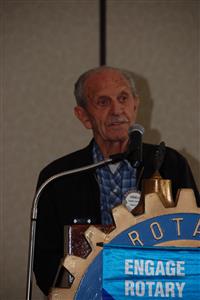
To finish the rest of the time of the meeting, veterans in the Club were invited to come to the open mike to tell just how they participated in service and what it had meant to them.
The first to speak to us was Johnny Croshaw, who said his experience as a Marine was the saving of him. He had been hanging out as one of four friends, the other three of whom later ended up in jail.
While he was stationed near Las Vegas on a “top secret desert operation,” he heard of an opportunity to go back to school and get his high school degree.
The only catch was that, instead of his report card going home to Mom, it went to his sergeant. And the Sarge would not accept any grade except an A.
Chuck Hutchinson shared his adventures in joining the Army. If you were still 17, you had to have a permission slip to join, signed by your parents.
After being inducted in Fort MacArthur in San Pedro, he went to St. Petersburg, Florida for basic training. There in 1942 he spent his first Christmas away from home. From Florida he was sent to Monroe, Louisiana for weather forecasting school, then to Great Falls, Montana for cold weather acclimatization.
Still in the dark about where he was to be stationed, he was put on what looked like a 1860’s model steam train, that took him to Calgary, Alberta. Never knowing until the last minute where he would go next, he eventually found himself crowded onto a brand new DC 3 bound for Nome, Alaska.
After several stops, including Fairbanks and an Eskimo outpost, probably Kotsabue, Chuck arrived just south of the Arctic Circle, in Nome. Chuck says he has seen pictures of Nome today, and it looks exactly as it did in 1942. This reporter has been to Nome, and can attest to the fact that the kindest thing one can say, is that it is in a place that time forgot.
Chuck had many experiences in Alaska and on the Kenai Peninsula and the thousand-mile long archipelago of the Kodiak islands. The Japanese did invade there at one point but were repulsed, and Chuck never saw combat. But he was there to predict what the weather was going to do, and he did perform valuable services.
When Angelo “Andy” Cardono was a young boy in New York City, he enlisted in the Navy within the first year after Pearl Harbor. He says he was inspired by movies in which John Wayne continually saved the United States in battle. He too was seventeen and had to get his parents’ permission.
He recalled how in those days families hung a flag in their window if they had a family member in service, one blue star for each one. To see a home with two or three blue stars on a flag was not uncommon. More touching was the gold stat on a flag. That meant someone in the household had given his life for our country. To see a flag with more than one gold star was heart-breaking. A movie was made about the Sullivan family, whose flag had four gold stars.
Angelo said he was feeling pretty sure his mother was going to get a gold star flag for him, because in August of 1945 he was on a shop heading for the invasion of Japan. The ship changed course after August 9, when the atomic bomb was dropped on Hiroshima. A few days later, one was dropped on Nagasaki, and the Japanese Empire surrendered.
Angelo said a ship eventually brought him back to San Pedro for discharge. It was his twenty-fifth birthday, and he decided then and here not to go back to New York but to settle in California. Downey is the richer for that decision.
Angelo took out his Navy ID card and showed us the muscle in his bicep today as he read it, “5’6”, 160 pounds.” Ready to go.