Jewels by Angelo

For his much looked-forward-to program on trends in jewelry, Angelo Cardono discussed an often over-looked product, the home-grown American gem stones found right in the United States.
The program was originally presented on Secretary’s Day, but that too has changed and now it is for the Executive Administrative Assistant. But as Shakespeare would say, “A diamond by any other name would shine as bright.” The beautiful gems in their artistic settings have not changed. Angelo, a highly respected person in the fine jewelry world, long ago coined the phrase that jewelry is the badge that society awards itself, for recognition of the important events in life. Jewelry in that connotation is not a luxury, but a form of respect for milestones achieved: think of Super Bowl championship rings and the Miss Downey crown (which Angelo designed), as well as graduation and anniversary presents. > “Jewels by Angelo” his company’s name, may be seen as prizes on “The Price is Right” television show, although Angelo says he has never watched the program. “Jewels by Angelo” can only be bought from a retail dealer, not directly from Angelo. “Gemstone” can mean more than the “big four,” diamond, sapphire, ruby, emerald. According to Angelo, there is no such thing as a “semi-precious” stone. All stones are precious. And they don’t have to come from all over the world, like Kimberly in South Africa for diamonds or Mayanmar (Burma) for rubies, or sapphires from Ceylon, and emeralds from Colombia.
Here in the United States we have tourmalines, from light green to red; fire opals in Arizona and Nevada, turquoise mines in Arizona and New Mexico, industrial diamonds in Arkansas, and, in the riverbeds of the southeast, freshwater pearls. As Angelo described the process, you make a bead from a clam shell and insert it inside an oyster’s shell, and that “mindless creature, a bivalve that just lies there taking in plankton, will spew out nacre” when its plump tender body is irritated. Voila, a pearl.
An interesting jewel Angelo chose to show us is the sunstone. Pale yellow to bright orange, it is a volcanically formed kind of feldspar, and when viewed from certain angles it has a brilliant spangled appearance. The optical effect is due to inclusions of red copper in the form of minute scales. It has a vitreous luster, is transparent to translucent, and is the official gemstone of Oregon. On the Mohs hardness scale, it is 6.-7.2, making it harder than turquoise and opal, but less easily scratched than amethyst or any of the “Big Four.” It can be faceted or polished as a caubuchon.
Angelo’s models then stood and walked around the room, showing his designs. Mary Stauffer was wearing a long double strand necklace of yellow polished sunstones with baroque fresh water pearls also in sunny yellow.
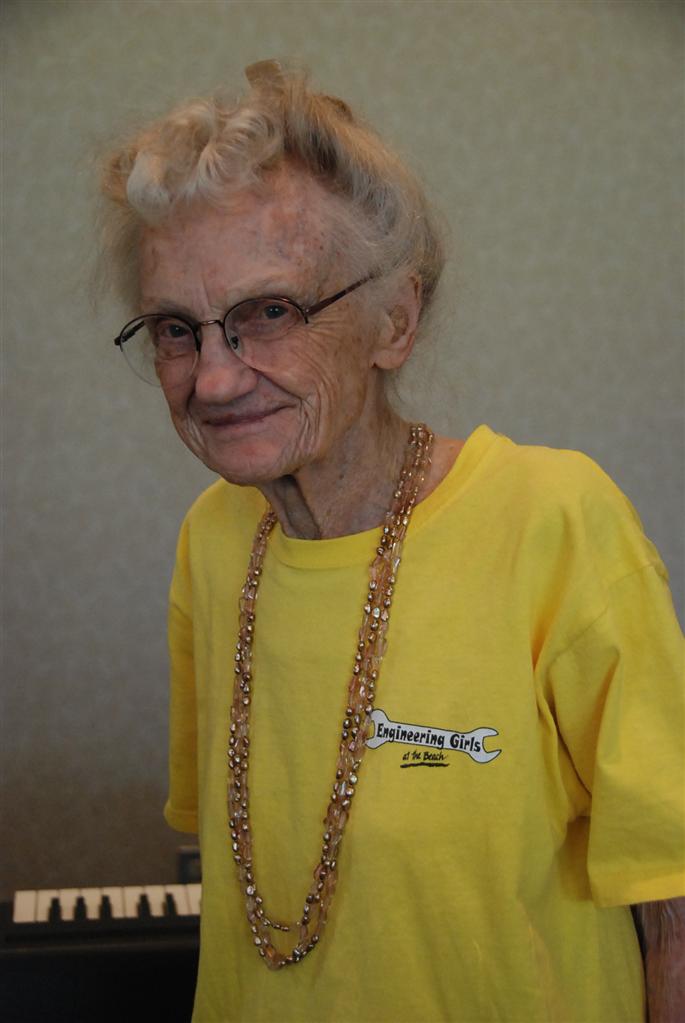
Heather Conwell wore a double strand of pinkish beads and pearls, and an intricate ring.
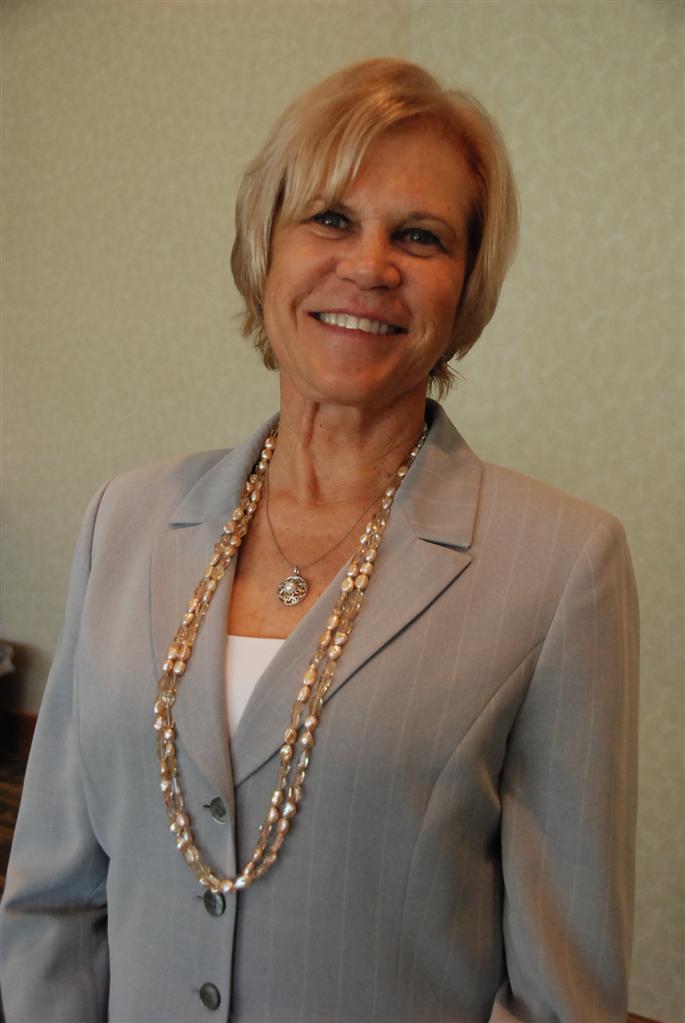
One of Bill Kirkwood’s visiting daughters, Jennifer, wore a fill-in-neckline necklace with sun stones and then baroque pearls shaped like leaves and butterflies and rings of sun stones.