Guatemala Litercy Project
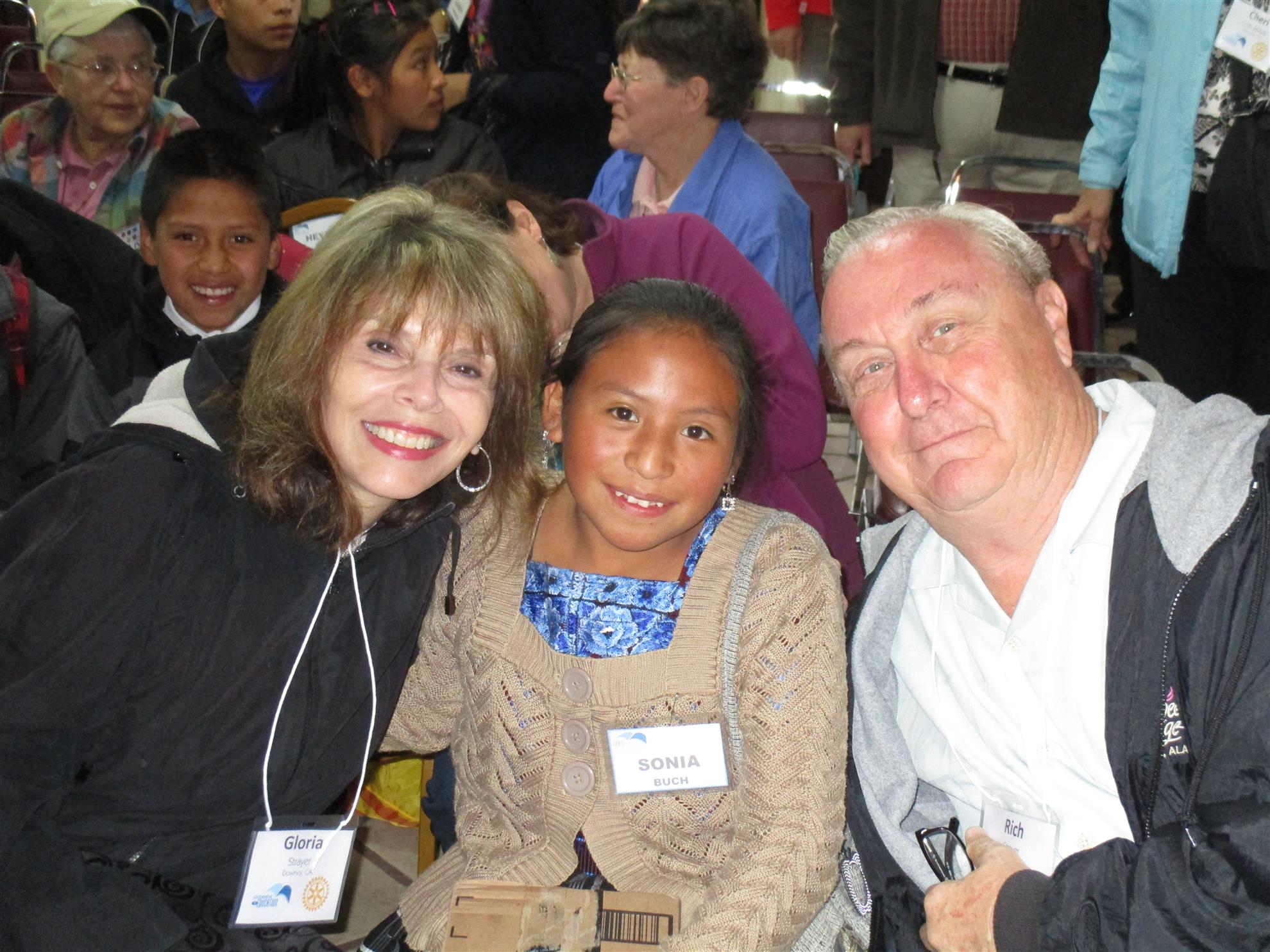
“We are blessed,” President Will Medina then said, “to have two programs today.” He introduced Rich Strayer, who with his wife Gloria, explained the Guatemala Literacy Project in which they participated this year.
Purpose of the program, said Rich, is “to reduce poverty through education.” Why Guatemala? Because it has one of the lowest literacy rates in the Western Hemisphere. 90% of schools lack textbooks: “How can I teach without textbooks,” one teacher said. Many schools have no functioning computers. There is near-absence of reading materials. This situation is satisfying for Rotarians to solve, because these are fixable problems.
Guatemala is as rich in scenery as it is poor in literacy, with imposing volcanoes with cloud-like plumes of smoke rising from the green jungles. Lovely old colonial churches and public buildings date from the early 1500’s, when the Spanish gradually subdued the local Mayans into the colonial Viceroyalty of New Spain.
The greatest change brought by colonialization was the sweeping aside of the pre-Columbian economic order and its replacement by European technology and livestock; cattle, pigs and chickens that largely replaced the consumption of game. New crops were also introduced. However, sugar cane and especially coffee plantations have economically exploited native labor by a semi-feudal oppression of the Mayan Indians.
With more than half the population living below the poverty line, many children – especially rural and indigenous children – are forced to drop out of school to help support their families. Over half of the Guatemalan population is indigenous and less than 30% of poor, rural indigenous girls are enrolled in secondary school. Most indigenous girls in Guatemala are Mayan and they are among the country’s most disadvantaged group with limited schooling, early marriage, frequent childbearing, and chronic poverty. The need to invest in education, particularly for underserved girls, is acute.
The Guatemala Literacy Project (GLO) is supported by several international Rotary clubs, who have partnered with Cooperative for Education, which actually purchases the books in Spanish, and brings the books to the classrooms.
Cooperative for Education was started by two brothers in Cincinnati, Ohio whose mission is to help Guatemalan schoolchildren break the cycle of poverty through education. “CoEd” accomplishes this mission by implementing sustainable textbook, computer, reading, and scholarship programs in impoverished schools.
The project is self-sustaining. Once the books have been purchased, the students in the villages rent them and within their five-year reusable book life, enough money can be raised to purchase more. Through the programs, CoEd strives to address the root causes of poverty in Guatemala, rather than merely treating its symptoms.
CoEd also addresses the international humanitarian problems of human trafficking in Guatemala, and the practice of sending of children unaccompanied to the United States, which puts their lives at risk during the journey north.
|
|
Researching Guatemala's turbulent political history, one sees how its indigenous people have suffered discrimination and severe poverty, which extends to schooling. Indigenous Guatemalans are particularly vulnerable to labor exploitation. Long-term, sustainable development and improved equity in Guatemala will only be possible if education of children and youth continues to improve.
This past year our Downey Club donated $2,500 from Club funds toward this project, and in return we were assigned to several village schools. Rich and Gloria visited that school district, and this next upcoming year, Rich plans to challenge the Club to double that amount, and donate $5,000 to continue and increase the project.
“I believe that giving is committing,” says Rich. “80% of students who complete school get full-time jobs.”
“Everywhere we went, they spread pine needles on the grass,” Rich continued. “We were like royalty. Our feet were never supposed to touch the ground.”
Pictures of Rich and Gloria showed how the whole village would come out to reception parties for the visiting Rotarians: parents and students, grandparents, aunts and uncles, the mayor, the teachers.
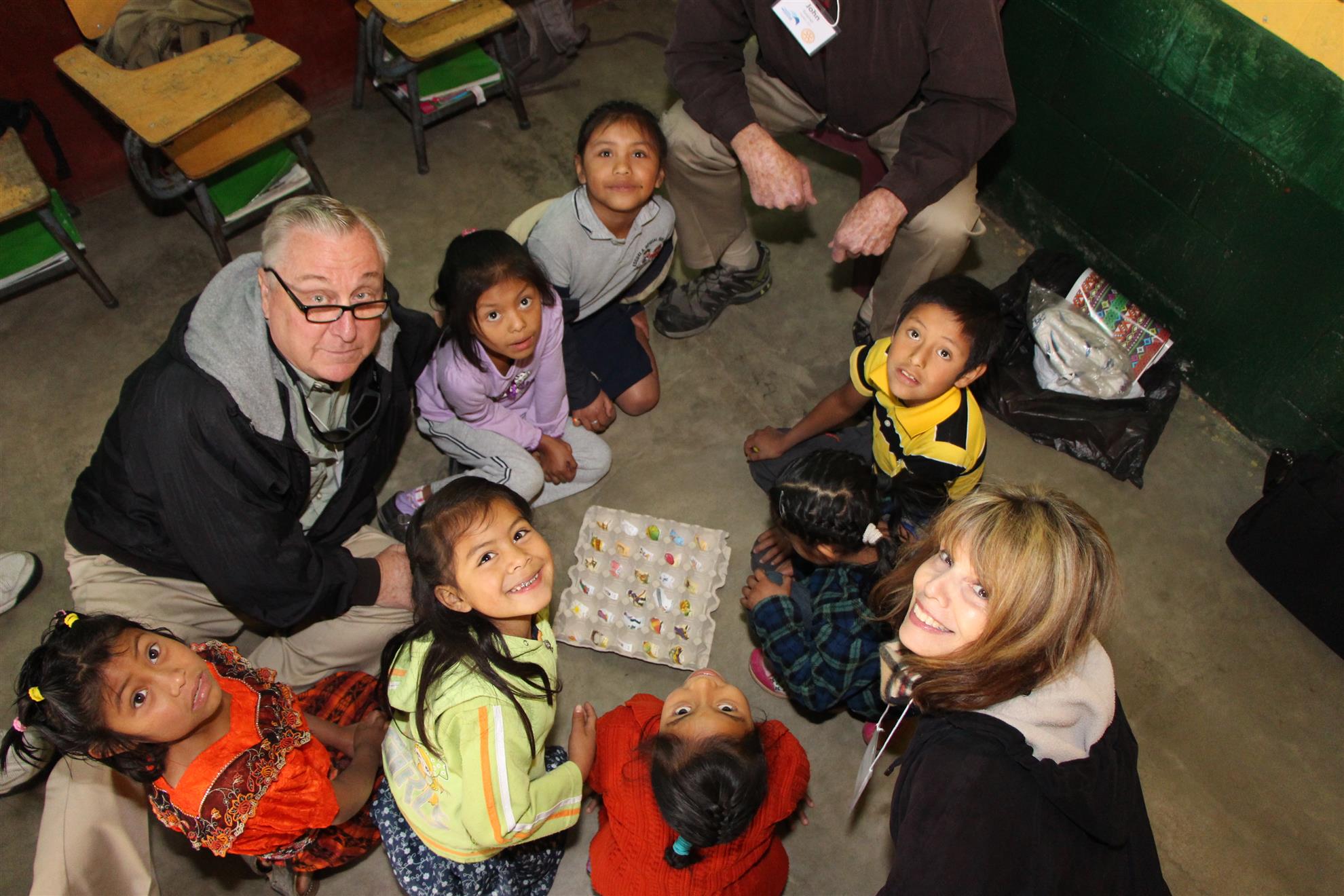
Rich exchanged our new club flag with clubs in Guatemala, and in his pictures yellow balloons and Guatemalan and United States flags fly together, along with a big Rotary flag with our rotary wheel logo, so that the Guatemalans can identify Rotary as the force behind the program.
One of Rich’s contributions to village prosperity appears to be autographing baseball cards, which kids then sell for more than usual, with his rock-star- like signature on them.
“Join us,” says Rich. “You’ll enjoy yourselves.” Next GLP trip to Guatemala will be February 17 next year, “so get your warm pajamas ready. It can be cold at a 5,000 foot elevation.” Gloria Strayer was the logical choice to sign the Speaker’s Presentation Plate in the book for the Library.