American Legion
Our speaker, fellow Rotarian John Quigliani from Downey Post 270 presented a program about the national volunteer organization, The American Legion, which has about 140 members locally.
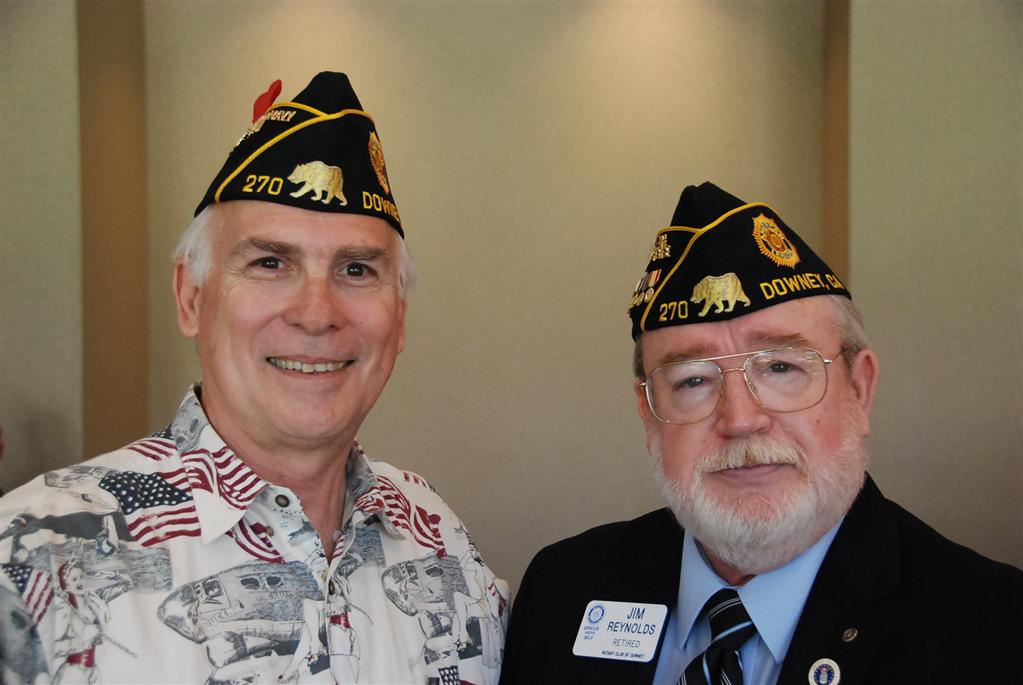
Dressed smartly in his khaki Legionnaire garrison cap, with Downey embroidered in gold thread on the side, a large golden California bear on the front and a red feather cockade, John told us that the Legion was chartered in 1919, as a patriot veteran’s organization. Originally open only to those who served our country in wartime, since 1990 any men and women who have served in our Armed Forces at any time, may join.
On the national level, the Legion lobbies in Washington D.C., to educate the legislators about veterans issues, and to produce testimony to promote veterans’ interests; such as better medical care, educational benefits, family support, morale, and psychological counseling. To the Legionnaires, “The veteran always comes first.”
The American Legion is a citizen volunteer group, as differentiated from the government agency, the Department of Veterans Affairs, or the VA, as it is known. The VA’s original mission statement was set in 1865 by President Abraham Lincoln in his Second Inaugural Address, “to care for him who shall have borne the battle and to care for his widow and children.”
The VA works with tax dollars, while the American Legion’s funds are volunteered from private contributions. The Legion works closely with the VA on behalf of veterans.
It helps to know the difference between the VA and the American Legion, so sympathetic citizens can see whom to address to get solutions for challenges facing veterans.
A pressing problem now is helping veterans overcome post-traumatic stress disorder. This condition has always been a companion of war, but only in the twentieth century, starting with World War I, did people begin dealing with it, giving it a name and recognizing it as a legitimate state.
It has been known to Heroditus and Homer, and Shakespeare described its symptoms, now known as shell-shock, battle fatigue, battle stress, and most recently the acronym PTSD. Dealing with it is part of helping combatants return to the peaceful and “healthful” mental attitude of civilian life.
On a local level, the two American Legion Posts in Downey, 270 and 723, promote values such as patriotism in youth, where it sponsors oratory contests in the high schools to teach young future voters how to speak clearly and articulately, to become better citizens.
The Legion monitors youth in sponsoring wholesome programs such as baseball teams and bike riding clubs and Boy Scout troops, “teaching young people who are franchised citizens” important American values.
The local Legion Posts sponsor many scholarships for achievement. They teach skills with weapons, emphasizing the basic elements of a safety and security.
There is an American Legion Auxiliary, for men and women who are spouses of veterans.
In Downey, Jim Reynolds, the local post information officer, is in charge of awards to outstanding police and fire fighter heroes, the honorees selected by their respective captains.
The Legion has a National Emergency Fund which raises about six million dollars a year, for needy Legionnaire families. John emphasized again that one of the most pressing concerns now is the need to help returning veterans to re-integrate into society.
The American Legion tries to help with finding jobs for veterans in a depressed economy, and helping them learn to cope with post-traumatic stress syndrome, acquired in Iraq, Afghanistan and other deployments around the world.