This World Water Day is about accelerating change to solve the water and sanitation crisis.
And because water affects us all, we need everyone to take action.
That means you!
You and your family, school and community can make a difference by changing the way you use, consume and manage water in your lives.
Your commitments will be added to the Water Action Agenda, to be launched at the UN 2023 Water Conference – the first event of its kind for nearly 50 years.
This is a once-in-a-generation moment for the world to unite around water.
Play your part. Do what you can. The three most popular actions:
Save water: Take shorter showers and don’t let the tap run when brushing my teeth, doing dishes and preparing food.
Stop polluting: Don’t put food waste, oils, medicines and chemicals down my toilet or drains.
Eat local: Buy local, seasonal food and look for products made with less water.
LEVEL 1 = THINGS YOU CAN DO FROM YOUR COUCH
💧Test your water knowledge with our Kahoot Quiz! Quiz details can be found here.
💧Turn off sleeping tech. Currently, 90% of power generation is water intensive. Turning off our devices when we’re not using them means less energy needs to be produced.
💧Build pressure. Write to elected representatives about budgets for improving water at home and abroad.
💧Create your action list – choose and share what you are going to do to help solve the water and sanitation crisis at unwater.org/bethechange
💧Get informed. Explore the water and sanitation crisis, read inspirational stories from around the world at www.worldwaterday.org, read a book from the suggested SDG Book Club list, and follow your local news on water and SDG 6 online or on social media at @GlobalGoalUN.
💧Use your social media voice. Amplify messages on SDG 6, participate in #WorldWaterDay to generate debate and raise awareness – available at www.worldwaterday.org/share
💧Shop sustainably. A typical pair of jeans takes 10,000 litres of water to produce, equal to what a person drinks in 10 years.
LEVEL 2 = THINGS YOU CAN DO FROM HOME
💧Take five-minute showers. With 44% of household wastewater not being safely treated, taking shorter showers is a great way to save this precious resource.
💧Flush safe. Fix leaking water and waste pipes, empty full septic tanks and report dumping of sludge.
💧Stop polluting. Don’t put food waste, oils, medicines and chemicals down my toilet or drains.
💧Don’t throw away edible food. An estimated 1/3 of all food produced globally is lost or goes to waste. Reducing your food wastage reduces demand on agriculture, which is one of the biggest water consumers. So, reduce food waste and save water.
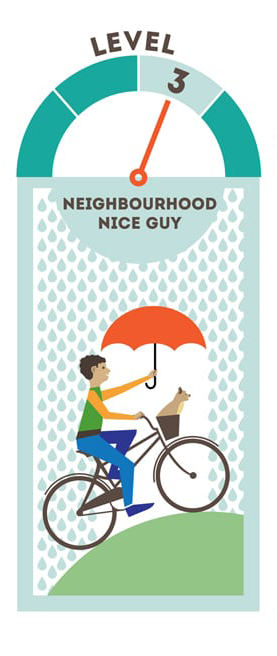
LEVEL 3 = THINGS YOU CAN DO IN YOUR NEIGHBOURHOOD
💧Take part in clean-ups of your local rivers, lakes, wetlands or beaches.
💧Protect nature. Plant a tree or create a raingarden – use natural solutions to reduce the risk of flooding and store water.
💧Be curious. Find out where your water comes from and how it is shared and visit a treatment plant to see how local waste is managed.
💧Host a concert, play a sports event to draw attention to local water and sanitation issues.
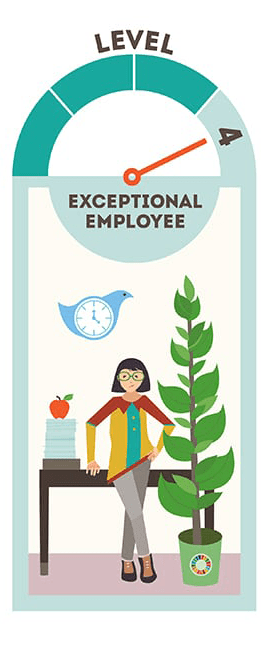
LEVEL 4 = THINGS YOU COULD DO AT WORK
💧Break taboos. Talk about the critical connection between toilets, water and menstruation.
💧Choose a plant-based meal. It typically takes between 3,000 and 5,000 litres of water to produce 1 kg of rice, 2,000 litres for 1kg of soya, 900 litres for 1kg of wheat and 500 litres for 1kg of potatoes.
💧If you are a teacher or student, organize/propose a lesson on water or get the whole school involved in water and sanitation-themed activities.
💧Get the office involved. Organize a Water Event (see ideas from our Be the Change toolkit), share facts and stories on SDG 6 in your internal newsletter if available, or participate in our suggested #WaterActions as a group.
“The same emotions I felt for my family in the U.S. I felt for my family in Brazil. Yes, we were culturally different. But there was so much in common.” Todd Jenkins spent three months in Brazil learning how Brazilian university administrators work with students while pursuing his doctorate.
“When we travel, this amazing thing happens. We let down our guard. You’re constantly exposed to new experiences and new people. I’m so grateful for Rotary for allowing me to experience that.” Tara Higgins spent eight weeks in Ireland visiting a number of classrooms to improve her skills as a teacher.
“The experience was beyond what I could have ever hoped for: Not only was the breadth of work experience completely unexpected, the hospitality I experienced was second to none.” James Kolasinski spent a month in Texas, USA, as a medical student in order to better understand international health care systems.
Younger professionals can work with Rotary members to have unique vocational or community service experience through a New Generations Service Exchange.
How to develop a service exchange program
Rotary clubs can design great programs by matching members’ skills and passions with professionals from different cultures. These steps can help you get started:
INTERESTED IN PARTICIPATING?
University students and professionals up to age 30 are encouraged to apply. You don’t have to be a member of Rotary to participate. Contact your local Rotary club to see what exchange opportunities are available and what the application process involves.
Organize a group of interested Rotary members in your club or district.
Find out what skills, interests, and networks your group can offer to create a meaningful exchange.
Ask young professionals what type of service could improve their professional skills.
Decide on your goals for the program.
Craft a program that lasts from a few weeks to six months. It could be one-way or reciprocal, or for individuals or small groups.
To reduce expenses, consider providing homestay options, arranging no-cost internship or job-shadowing opportunities, and offering other financial assistance.
Promote your program and find districts to partner in an exchange.
How to emphasize service
A good exchange gives participants an opportunity to learn new skills and put them into action.
Invite participants to join your community service projects to develop their skills and create new relationships.
Expand a vocational training program to include international participants, and design ways for them to practice their skills through community service.
Incorporate an exchange activity into your next global grant project. Invite young professionals from the community to help out and receive training or learn about project management.
Plan a reciprocal exchange of younger professionals or Rotaract club members as part of an international service project. Ask participants to speak to your club about ways to develop stronger international partnerships.
Applications and program formats
There is no standard application form or program format. You have the freedom to create a program that suits the skills and interests of your members and participants, and the needs of your community.
Are you a district contact for New Generations Service Exchange? We can provide you with a district chair directory to help you connect with your counterparts worldwide. Ask your district governor to report your role in Rotary Club Central or email us.
How districts can support exchanges
District contacts for New Generations Service Exchange and district governors work with other districts to plan and implement exchange programs and to strengthen international networks. Contact your district leaders to see how you can get involved.
How to connect with Rotary
Successful exchange programs rely on strong networks of Rotary members, community partners, program participants, and alumni. Here are some ways to build connections:
Contact your district governor to learn more about how you can get involved.
Search Rotary Showcase to find other clubs that have conducted an exchange, read success stories, and learn best practices.
Join the conversation in an exchange-related discussion group, or start your own.
Contact Rotaract clubs and Rotary Community Corps in your district to identify potential participants and to ask about any international connections within their networks who could serve as partners or hosts.
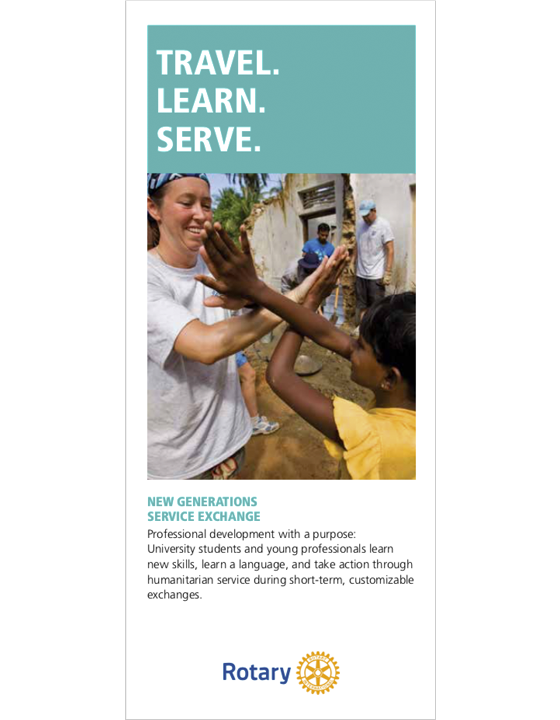
New Generations Service Exchange is a short-term, customizable program for university students and professionals up to age 30.
Participants can design exchanges that combine their professional goals with a humanitarian project.
What are the benefits?
Make connections with service-minded community leaders in another country
Learn another language
Build your professional skills and gain international experience
Travel and explore a new culture while giving back through service
What is an exchange like?
With your host Rotary district, you’ll plan activities that can include networking, relationship building, humanitarian service, professional development, and leadership training. Exchanges:
Last from a few weeks to six months
Can be arranged for individuals or groups
Need not be reciprocal
How much does it cost?
Costs vary by Rotary club or district. To reduce expenses, Rotary members often provide homestay options, arrange no-cost internship or job-shadowing programs, and offer other financial assistance.
Find a Rotary club near you that works with New Generations Service Exchange to find out what it would cost.
How do I apply?
University students and professionals up to age 30 — including current and former Rotaractors and former Interactors, Rotary Youth Leadership Awards participants, and Youth Exchange students — are encouraged to apply. You don’t have to be a member of Rotary to participate in an exchange.
Although each Rotary club determines its own eligibility criteria, all participants should demonstrate a strong commitment to service and the ideals of Rotary. Contact your local Rotary club to see what exchange opportunities are available and what the application process involves.
Our planet’s capacity to sustain human life is in dire danger. That’s a fact, and so is this: every Rotarian has the power to increase humanity’s ability to survive. Actions you take - from your kitchen to international summits – can help humankind return to sustainable living. ESRAG’s articles this month show Rotarians doing exactly that: combining who they are, where they serve, and who they know to help their communities live sustainably.
We start this month’s Sustainable Living stories by linking you to talks by business sustainability consultant and ESRAG Director Gunilla Östberg on Planetary Boundaries analysis. Insights from climate scientist Katharine Hayhoe explain how to overcome panic with hope - the theme for the upcoming Rotary year - by showing your community effective actions they can take. Next, accompany Rotarians who are mobilizing their values, knowledge, and networks to promote sustainable living around the world:
Jaideep Malaviya charts Rotary's road to revive rural India by helping farmers afford solar water pumps.
Jeff Smith reports how Rotarians are boosting green jobs to revitalize upstate New York.
Canadian Joey Smith shares how to woo the wary, to make giant sports events sustainable.
I report on how a regional faith community shared its resources to increase energy efficiency.
Discover sustainable packaging innovations in the March 29 Pack with Care webinar hosted by British Rotarian Jane Penson.
We'll link you to tools for choosing high-impact sustainability projects: Drawdown Solutions, the En-ROADS Climate Solutions Simulator, and the Global Footprint datasets, as well as an overview of emerging carbon markets by ESRAG Director Joey O'Brien. Finally, ESRAG Chair Pat Armstrong provides exciting updates on environmental events at the upcoming Rotary International Convention in Melbourne, and Karen McDaniels shares great advice on how to engage new Rotary leaders if you get the opportunity to represent ESRAG at your district's PETS training conference.
Graphic: Sign up for ESRAG's upcoming 15-Day Plant-Rich Diet workshop to discover one of the most powerful ways you and your community can help humanity live within our planetary means. Plant-Rich Diet is a top climate solution.
Over the last few weeks, I experienced two events that reminded me how important it is to keep funding the eradication of Wild Polio. The first occasion was a visit I had with a friend I’ve known since High School (I dated both of her daughters and her son is my legal counsel) . My friend will soon be 95 years old and during my visit we talked about living through the outbreak of Wild Polio during her childhood. She told me of her memories about the pools, playgrounds and later the movie theaters being all shut down due to the spread of Wild Polio.
The next event was the Salute, Inc.20th year celebration. Salute, Inc. is an organization that helps military families at multiple stages of their service careers. The event featured several individuals that have benefited from donations to Salute, Inc. It is very powerful to hear first-hand how an organization comes beside someone in need and changes their lives. If you have someone in your Rotary Club that has been on an immunization trip, please ask them if they would give a presentation of their experience. Hearing from those who have seen the faces of mothers getting their children immunized may inspire one of you to “get in the game” and join the “Polio Plus Society”.
Below is this weeks Polio report. Thank you in advance for your continued support of theeradication of Wild Polio.
"The positive mind has extra problem solving power"
No new Wild Polio cases reported this week. We are now 26 weeks since the most recent reported Wild Polio Case - on 9/15/22 in Pakistan.
What is that Polio Picture? Confidence in surveillance essential for certifying a polio-free world - Latest recommendations from independent global certification body - The Global Commission for the Certification of Poliomyelitis Eradication (GCC) met recently in Amman, Jordan, to review progress towards interrupting wild poliovirus type 1 (WPV1) transmission in polio-endemic Pakistan and Afghanistan, implementation of the Global Surveillance Action Plan, and to hear from the six regional certification commissions on current regional priorities and issues.
“It will be the quality of poliovirus surveillance that will allow the GCC to certify the eradication of WPV1 with the highest possible level of confidence,” said Professor David Salisbury, GCC Chair.
Support water, sanitation, and hygiene efforts on World Water Day (March 22)
A Win Against Polio is a Win For Global Health!
2023 Circulating Vaccine Derived Polio Case Total - 13, Benin - 1, Chad - 2, Indonesia - 2, Israel - 1, Madagascar - 5, Nigeria - 1, Somalia - 1.
2022 Circulating Vaccine Derived Polio Case Total - 826 Afghanistan - 43, Algeria - 3, Benin - 11 (3 in 2021), Burundi - 1, Cameroon - 3 (3 in 2021), Central African Republic - 5, Chad -44 (0 in 2021), DR Congo - 433 (28 in 2021), Republic of Congo - 1, Eritrea - 1, Ethiopia - 1, Ghana - 3, Indonesia - 1, Israel - 1, Madagascar - 14 (13 in 2021), Malawi - 4, Mali - 2, Mozambique - 21 (2 in 2021), Niger - 15 (18 in 2021), Nigeria - 48 (415 in 2021), Pakistan - 8, Somalia - 5 (1 in 2021), Sudan - 1, Togo - 2, United States - 1, Yemen - 162 (69 in 2021) .
New Polio Cases & Samples reported in the last week - Benin - 1 (2023) cVDPV2 Case, Burundi - 1 cVDPV2 Case + 5 Samples, Chad - 2 (2023) cVDPV2 Cases, DR Congo - 6 cVDPV2 Cases, Niger - 1 cVDPV2 Case, Pakistan - 1 WPV1 Sample.
Quote of the Day - "Everybody is a genius. But if you judge a fish by it's ability to climb a tree, it will live it's whole life believing that it is stupid. Albert Einstein
The Final Two Polio Endemic Countries:
2023 Wild Polio Cases - 0
Pakistan No new Wild Polio cases reported this week. Twenty Wild Polio cases reported in 2022. One Wild Polio Case reported in 2021. The most recent case had an onset of paralysis on 9/15/22. Pakistan reported 83 Wild Polio cases in 2020. One WPV1 Sample and no cVDPV2 Positive Environmental Samples were reported this week in Pakistan.
Afghanistan No new Wild Polio cases reported this week. Two Wild Polio Cases reported in 2022. Four Wild Polio cases reported in 2021 The most recent case had an onset of paralysis on 8/29/22. Afghanistan reported 56 Wild Polio cases in 2020. No WPV1 Samples and no cVDPV2 Positive Environmental Samples were reported this week in Afghanistan.
Our Goal is Global Polio Eradication!!
"The positive mind has extra problem solving power"










.png)