Women in Rotary Series
HERSTORY
Women are active participants in Rotary, serving their communities in increasing numbers and serving in leadership positions in Rotary. The 1989 Council on Legislation vote to admit women into Rotary clubs worldwide remains a watershed moment in the history of Rotary.
“My fellow delegates, I would like to remind you that the world of 1989 is very different to the world of 1905. I sincerely believe that Rotary has to adapt itself to a changing world,” said Frank J. Devlyn, who would go on to become RI president in 2000-01.
The vote followed the decades-long efforts of men and women from all over the Rotary world to allow the admission of women into Rotary clubs, and several close votes at previous Council meetings. The response to the decision was overwhelming: By June 1990, the number of female Rotarians had skyrocketed to over 20,000. The number of women members worldwide reached 195,000 in July 2010 (about 16% of Rotarians) and surpassed 277,000 in July 2020 (about 23% ).
A top priority for Rotary is growing and diversifying our membership to make sure we reflect the communities we serve. We know that our capacity to increase our impact and expand our reach is larger when more people unite with us, which is why we value diversity, equity and inclusion. Rotary celebrates and welcomes the contributions of people of all backgrounds, regardless of their age, ethnicity, race, color, abilities, religion, socioeconomic status, culture, sex, sexual orientation, and gender identity.
Our timeline highlights historic milestones and senior leadership firsts that have helped build greater diversity in Rotary. These leaders and all our female members are making positive change in communities around the world.
# # #
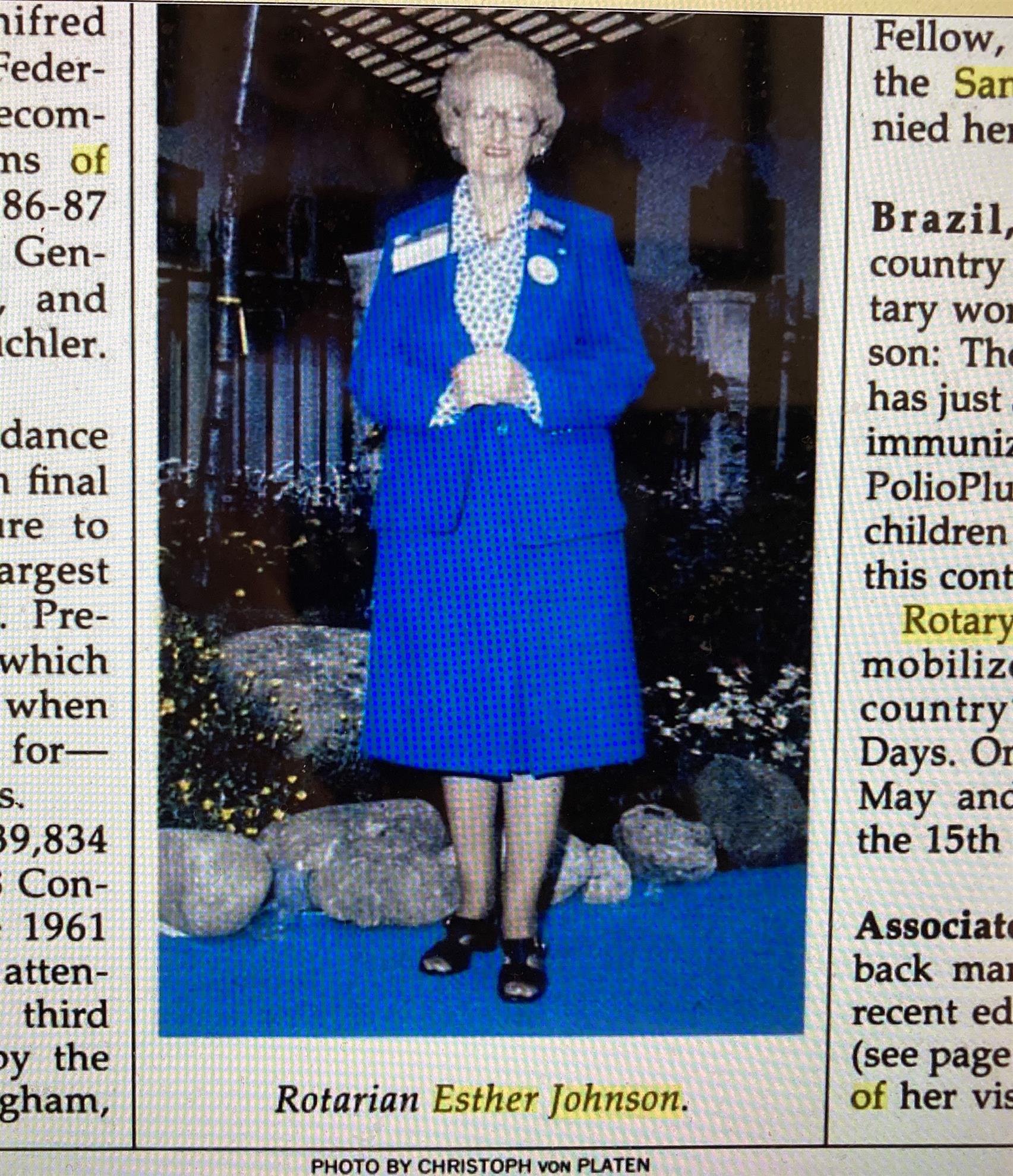
On March 25, 2004 Mary Rourke, Times Staff Writer shared this obituary of Esther M. Johnson, 89; with the headline “First to Join When Rotary Agreed to Admit Women.”
Esther M. Johnson, the first woman admitted to the Rotary International club after it opened its doors to women in 1986, has died. She was 89.
Johnson died of natural causes Sunday at a convalescent home in Santa Monica, according to her daughter, Sharon Johnson. She said her mother fell and broke her hip four years ago and never fully recovered. For 10 years before she was admitted to Rotary International, a community service organization with chapters around the world, Johnson was the executive secretary of the Santa Monica chapter. She also played piano at the club’s weekly luncheon meetings while it was still an all-male organization.
She was finally invited to become a member in November 1986, the year a state appellate court upheld a controversial action by members of the Duarte chapter of the club, which had admitted three women to the group in 1977. At the time, Rotary International responded by revoking the Duarte club’s charter.
“Our records show that Esther Johnson was admitted immediately after the appellate court decision was made in 1986,” Jack Siegal, a past president of the Santa Monica chapter, said in an interview Wednesday. “She was already working with us as the executive secretary, and that got her through the admission process right away.”
The U.S. Supreme Court affirmed Rotary International’s integrated status in a 1987 ruling. The decision officially overturned a club policy in place since 1905, the year Rotary International was founded. Early reactions were mixed. At the reception for the first female member of the club’s Pacific Palisades chapter, one longtime Rotarian compared the occasion to Armistice Day, the official end of World War I. Some long-standing members, however, threatened to quit the club over the issue. One 77- year-old retired realty agent from Claremont told The Times that he would never have joined 32 years earlier if he had thought Rotary International would ever allow women. Others who originally opposed an integrated membership changed their minds once it became law.
“They can’t force me out of the club by bringing in a few women,” several of them told the district governor from Encino during meetings to discuss the change.
Johnson remained above the fray. “I was at the club for lunch every day, so it didn’t make much difference if they made me a member or not,” she said in a 1987 interview. “I think everyone’s prepared for it now.”
Born in Brookline, Mass., Johnson relocated with her family to Denver before World War II. After high school, she became a treasurer for the Denver public school system and met her future husband, Oliver, at church. She was playing piano for the choir when he was invited to sing as a guest soloist.
They married in 1936 and moved to Santa Monica in 1944. Esther Johnson started her own business as a bookkeeper and in the mid-1950s a Rotary member whom she knew professionally asked her to fill in as the club’s pianist. She kept the job until she retired from her executive position at the club in 2000.
“My mother was honored to be invited to be a Rotarian, she so admired the work of the club,” Sharon Johnson said. Johnson became a sort of den mother and the keeper of the club’s historic memory, Siegal said this week. He also said that Johnson’s husband was an honorary member until his death. Her obit included asking that memorial donations may be made to here church, or to the Rotary Club of Santa Monica Foundation, Box 586, Santa Monica, CA 90405.
# # #
From the June 1987 LATimes: "Bombshell at Rotary Club: 1st Woman Joins"
Beverly Ann Collier didn’t blink an eye when her installation as the first woman member of the Pacific Palisades Rotary Club was compared to a list of memorable events, including the bombing of Pearl Harbor and the nuclear destruction of Hiroshima said Dr. Celon A. Peterson, who conducted the Tuesday ceremonies...read more here
Timeline of Women in Rotary:
1950: An enactment to delete the word “male” from the Standard Rotary Club Constitution is proposed by a Rotary club in India for the Council on Legislation meeting at the 1950 Rotary Convention. 1964: The Council on Legislation agenda contains an enactment proposed by a Rotary club in Ceylon (now Sri Lanka) to permit the admission of women into Rotary clubs. Delegates vote that it be withdrawn. Two other proposals to allow women to be eligible for honorary membership are also withdrawn. 1972: As more women begin reaching higher positions in their professions, more clubs begin lobbying for female members. A U.S. Rotary club proposes admitting women into Rotary at the 1972 Council on Legislation. 1977: Three separate proposals to admit women into membership are submitted to the Council on Legislation for consideration at the 1977 Rotary Convention. A Brazilian club makes a different proposal to admit women as honorary members. The Rotary Club of Duarte, California, USA, admits women as members in violation of the RI Constitution and Standard Rotary Club Constitution. Because of this violation, the club’s membership in Rotary International is terminated in March 1978. (The club was reinstated in September 1986.) 1980: The RI Board of Directors and Rotary clubs in India, Sweden, Switzerland, and the United States propose an enactment to remove from the RI and club constitutions and bylaws all references to members as “male persons.” 1983-86: In a lawsuit filed by the Duarte club, the California Superior Court in 1983 rules in favor of Rotary International, upholding gender-based qualification for membership in California Rotary clubs. In 1986, the California Court of Appeals reverses the lower court's decision, preventing the enforcement of the provision in California. The California Supreme Court refuses to hear the case, and it is appealed to the U.S. Supreme Court. 1987: On 4 May, the U.S. Supreme Court rules that Rotary clubs may not exclude women from membership on the basis of gender. Rotary issues a policy statement that any Rotary club in the United States can admit qualified women into membership. The Rotary Club of Marin Sunrise, California (formerly Larkspur Landing), is chartered on 28 May. It becomes the first club after the U.S. Supreme Court ruling to have women as charter members. Sylvia Whitlock, of the Rotary Club of Duarte, California, becomes the first female Rotary club president. 1988: In November, the RI Board of Directors issues a policy statement recognizing the right of Rotary clubs in Canada to admit female members based on a Canadian law similar to that upheld by the U.S. Supreme Court. 1989: At its first meeting after the 1987 U.S. Supreme Court decision, the Council on Legislation votes to eliminate the requirement in the RI Constitution that membership in Rotary clubs be limited to men. Women are welcomed into Rotary clubs around the world. 1990: As of June, there are about 20,200 female Rotarians worldwide. The Rotarian runs a feature on women in Rotary. 1995: In July, eight women become district governors, the first elected to this role: Mimi Altman, Gilda Chirafisi, Janet W. Holland, Reba F. Lovrien, Virginia B. Nordby, Donna J. Rapp, Anne Robertson, and Olive P. Scott. 2005: Carolyn E. Jones begins her term as the first woman appointed as trustee of The Rotary Foundation. 2008: Catherine Noyer-Riveau begins her term as the first woman elected to the RI Board of Directors. 2012: Elizabeth S. Demaray begins her term as RI treasurer, the first woman to serve in this position. 2013: Anne L. Matthews begins her term as the first woman to serve as RI vice president. 2019: Brenda Marie Cressey begins her term as the first woman to serve as vice-chair of The Rotary Foundation. In April-June 2019 she serves as chair of the Foundation, the first woman appointed to this role. 2020: In October, Jennifer E. Jones becomes president-nominee, the first women to be nominated to be Rotary International President. Her term as president will begin 1 July 2022.