RI Article By Dave King Photography by Monika Lozinska
A young bagpiper parades out of a hotel banquet room playing the familiar refrain of "Scotland the Brave." Behind him, carrying a plated ceremonial haggis and wearing blue, green, black, and yellow Gordon Modern tartan, is 2023-24 Rotary International President Gordon McInally.
It's Burns Night, celebrated every January with folk music, drams of Scotch whisky, enthusiastic renditions of the songs and poems of Scotland's greatest poet, Robert Burns, and, of course, haggis with neeps and tatties (turnips and potatoes). It is quintessentially Scottish, and McInally is in his element with friends as he marks the occasion in Galashiels, a town in Scottish Borders close to his home in Yetholm.
Heather McInally, his wife of 42 years, is wearing a sash of tartan — checks of green, light blue, and dark red — created for the 1997 Rotary International Convention in Glasgow. A classically trained former professional opera singer and music teacher, she belts out songs by Burns learned from childhood.
Contented wi' little, and cantie wi' mair,
Whene'er I forgather wi' Sorrow and Care,
I gie them a skelp as they're creeping alang,
Wi' a cog o' gude swats and an auld Scottish sang
Now the haggis is something else.
It is made of a sheep's pluck — the heart, liver, and lungs — minced with onions, oatmeal, suet, salt, pepper, and other spices, mixed with stock and then, originally, boiled in the animal's cleaned stomach. It sounds like a culinary nightmare, but on their travels the McInallys have been spreading word of haggis's appeal throughout the Rotary community.
Heather McInally explains how, on their visits to the States, they have sourced local supplies of haggis and even warmed up the Scottish delicacy in their hotel room microwave. "The smell of haggis lingered in the room the entire week," she recalls. "We served it to other RI Board members while in Chicago.
Everyone seems to love it, even though they were not quite sure what they were eating."
Gordon McInally grew up in Portobello, a picturesque seaside area of Edinburgh, notable for its beautiful beach with light-colored sand and wooden groynes (barriers to protect the shoreline) jutting out into the water of the Firth of Forth. His mother owned and operated a private nursery, and his father worked for Macdonald & Muir, which makes Glenmorangie whiskies. His late brother, Ian, was three years younger, and the two spent much of their childhood playing and watching rugby.
Gordon and Heather met in their late teens, and their relationship blossomed on a trip to Florence, Italy, with a combined choir from their separate schools in Edinburgh. "We're not in each other's pockets; we do our own thing," Heather McInally says. "Even with Rotary, I belong to the Borderlands passport club [a satellite club of the Rotary Club of Selkirk], and Gordon is a member of South Queensferry. Our lives have always worked like that, largely due to work commitments, where we go off in different directions. We're both independent people, but we always come home at night and tell each other what we've been doing."
Her husband agrees. The couple have two daughters, Rebecca and Sarah, and two grandchildren, Ivy and Florence. He describes Heather as "a very, very tolerant lady who has been a great support to me over the years."
He adds: "She's always a good sounding board. I can rely on Heather to tell me it as it is. If I give a presentation, everyone's going to tell me it was great, but Heather will always tell me the truth! I know I couldn't do this job without her support."
When they married at Craigsbank Parish Church in Edinburgh, Gordon McInally became a member of the Church of Scotland, having previously been a member of the Methodist Church. Now an elder and trustee in the church, he has also served as a presbytery elder, chairman of his parish congregational board, and a commissioner to the church's general assembly.
"My parents instilled in me and my late brother a sense of helping and caring for others that has remained with me for life," he says. "My personal faith, and my upbringing within a family with a similarly strong faith, has definitely impacted my life choices and career."
McInally owned and ran a busy dental practice in Scotland's capital for more than three decades, retiring in 2016. He held teaching and examining posts and served as a branch chairman of the British Paedodontic Society (now the
British Society of Paediatric Dentistry). After living for many years in South Queensferry, the McInallys relocated to Scottish Borders when he stepped back from day-to-day practice. The move was over 30 years in the planning.
"All the time I was working as a dentist, we said it would be nice to ultimately make our home in the Borders, because it's where my forebears came from," he says. "My mother's family were farmers, and my mother was born on a farm about 15 miles from here. I've said to people since we came here that I feel as if my DNA has come home."
For McInally, this is a night off, listening to youngsters from Galashiels' schools deliver dramatic recitations of Burns' works, including the "Address to a Haggis" read by young Poppy Lunn, who then theatrically cuts it open. There's more pipe music and fiddle playing, plus community singing, until the evening rounds off with a hearty rendition of "Auld Lang Syne."
A few days later, McInally is at Abbotsford House, which towers over the gently flowing River Tweed in the heart of Scottish Borders country. The countryside is a tapestry of greens, and in the distance loom the three conical peaks of the Eildon Hills, steeped in Roman history. It's a beautiful spot and one of McInally's favorite places to take visitors, as he has done today.
Abbotsford House was the home of Sir Walter Scott, the novelist, poet, and historian, who popularized the wearing of tartan, created the historical novel, and counted Queen Victoria among his fans. Abbotsford's architectural style inspired many buildings in Scotland, including Balmoral Castle, Queen Elizabeth II's summer home. Now, Scott's works such as Ivanhoe and Rob Roy have been adapted for the screen.
On this day, the 19th century Scots Baronial building with its crow-stepped gables, "pepper-pot" bartizans, and elements taken from medieval structures in Scotland, is shut to the public for the winter. Dust sheets hang over the furniture, and one poor soul is in the middle of cleaning the 9,000 books that line the library's shelves.
Scott's connection to the Borders began when he contracted polio at 18 months old. He was paralyzed in the right leg, and so his parents sent him to recover at his grandfather's farm outside Kelso. "It was because of polio that Sir Walter was brought to the Borders where he heard the stories and songs which would inspire his writing," explains Mary Kenny, Abbotsford's heritage engagement officer. McInally and Kenny agree that Scott would have made a great Rotary member.
PHOTOS:
TOP:
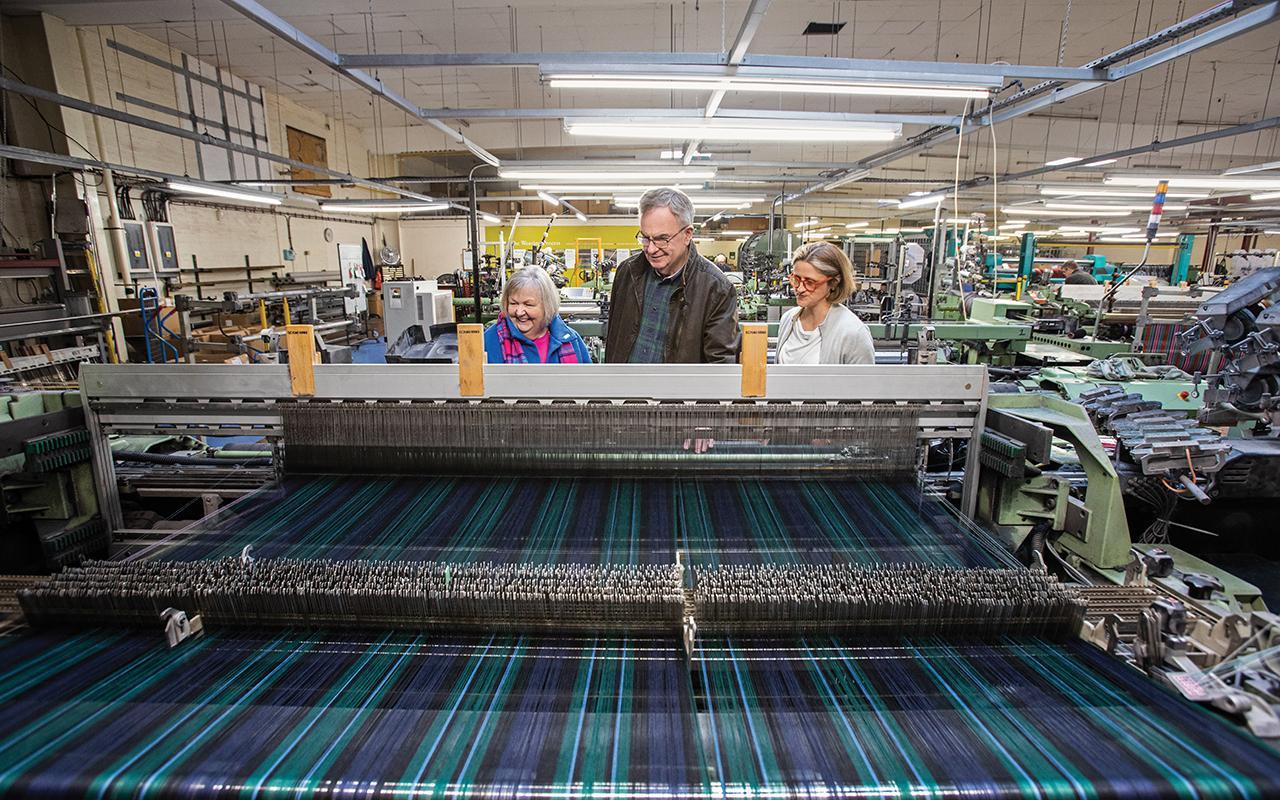
The McInallys talk with Anna Hinnigan, senior operations manager at Lochcarron of Scotland, a manufacturer of tartan cloth in Selkirk.
BOTTOM:
McInally at The Borders Distillery in Hawick, Scotland.