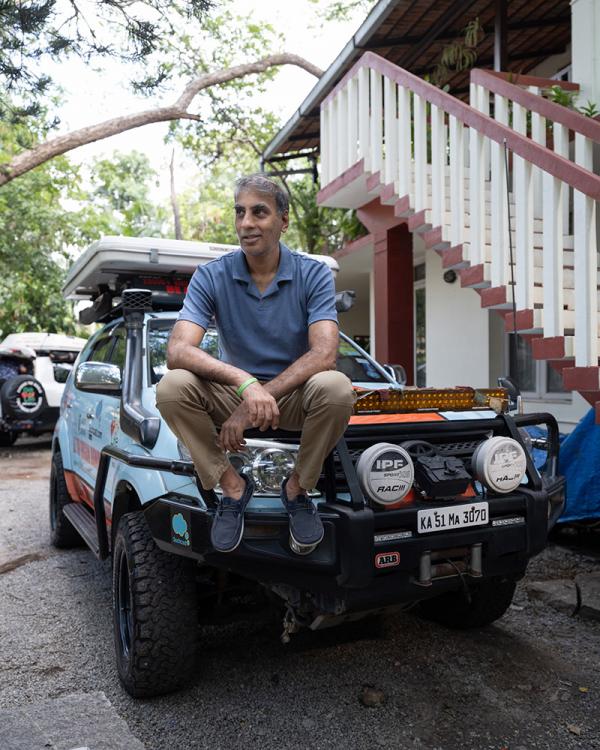
By Neil SteinbergAnil Srivatsa drives an SUV plastered with stickers and slogans across India on a quixotic mission: to teach as many of the country’s 1.4 billion people as he can about the importance of organ donation. He’s one man in his truck, often accompanied by his wife, driving from town to town for several weeks each year to try to increase India’s organ donation rate, because it ranks among the world’s worst. “There is a deep cultural bias against organ donation in India,” says Srivatsa, a media entrepreneur who helped found the Rotary Club of Organ Donation in 2022. “There is much work to be done in this space, to counter misinformation and fear.” For Srivatsa, the mission is intensely personal. Ten years ago, he donated his left kidney to his brother, Arjun Srivatsa, a neurosurgeon and a member of the Rotary Club of Bangalore, who had chronic renal failure. On his driving tours, Srivatsa sleeps in a rooftop pop-up tent on his SUV. One of its decals says “Kidney donors are sexy!” He speaks to a Rotary club if there is one in town — there are more than 4,000 in the country — or he assembles what residents he can when there’s not. India trails most of the world in organ donation for varied, sometimes complicated reasons, including a simple lack of information, inadequate transplant care hospitals in rural areas, and distrust among families of potential donors about how organs will be used. But major shifts are happening with donation regulations and initiatives in India and other countries, giving organ donation its strongest spotlight in years. That includes attention affixed on early experiments in the U.S. and China with transplanting gene-modified pig organs into humans as one potential solution for shortages. And a 2023 U.S. law that will overhaul the national donation system to try to break up an inefficient monopoly and reduce organ shortages. Education and accessFor years, Rotary members have taken a lead position in expanding access to kidney and liver surgeries and coordinating transplant training for medical staffs. That includes a project led by clubs in District 3640 (Korea) to teach surgeons in Myanmar and Mongolia advanced skills to transplant organs from deceased people, a source of organs that is growing but lagging its potential to save lives. With walkathons, social media campaigns, and more recently a chatbot that answers organ donation questions, Rotary members contribute to a movement to educate people about how important the gift of their organs and tissues can be — whether after death or in life with a kidney or part of a liver. READ THE ENTIRE STORY IN ROTARY MAGAZINE or online https://www.rotary.org/en/its-time-consider-organ-donation |