The Rotary Club of Skokie Valle is holding all meetings, including membership meetings, virtually. Committee meetings may meet via teleconference or video conference. We are following the guidance/directions of Rotary International, and all in-person meetings are cancelled until further notice.
Skokie Valley Club is following COVID 19 directions and guidelines given by Illinois Governor Pritzker and the Center for Desease Control (CDC).
JOIN US THIS COMING TUESDAY AUGUST 11, 2020 FOR OUR WEEKLY VIRTUAL MEETING VIA ZOOM. MEETING RUNS FROM 12 NOON UNTIL 1:00 P.M.
AN INVITATION MEETING ID NUMBER & PASSWORD WILL BE SENT TO ALL CLUB MEMBERS VIA EMAIL. VISITING ROTARIANS WHO WANT TO ATTEND THE MEETING, PLEASE CONTACT JOHN JEKOT AT JOHN@GMPD.ORG TO RECEIVE YOUR ZOOM INVITATION LINK.
TO JOIN THE MEETING FOLLOW THESE STEPS:
IF DO NOT ALREADY HAVE ZOOM ON YOUR DEVICE CLICK HERE TO DOWNLOAD AND INSTALL IT.
OPEN YOUR MEETING INVITATION EMAIL.
COPY OR JOT DOWN THE PASSWORD.
CLICK ON THE “JOIN ZOOM MEETING” WEB LINK.
PASTE OR WRITE THE PASSWORD, AND CLICK ON "CONTINUE".
CLUB MEMBERS, CHECK BELOW TO VIEW WHEN ITS YOUR TURN TO PROVIDE THE SPEAKER AND FUN & FROLIC
Project Hero's one-of-a-kind program has made us a leader in adaptive cycling and outdoor recreational therapy for injured veterans and first responders. With 98% of our participants experiencing increased overall health and fitness and 63% eliminating or lessening prescription use due to cycling. During these unprecedented times of uncertainty and change, we appreciate your commitment now more than ever to helping our healing heroes.
We recently had to adapt our programs and move our group rides indoors and into safe environments so participants can continue their therapy. With our dedication to getting more riders riding more often, we know we had to act immediately. Shifting our programs during this pandemic requires different equipment and access to new virtual training programs. At the end of March, we announced that we were adapting our programs so that riders could participate indoors, virtually, and in safe environments. The support of the Skokie Valley Rotary Club in this program was very helpful.
As of the end of July, we've accomplished a lot indoors since the end of March:
More than 935 total therapy hours. That's equivalent to nearly 40 full days of therapy!
Over 14,029 group therapy miles, which is the same distance as riding across the continental United States 5 times.
We have consistently hosted one or two virtual rides a day, totaling 153 group rides.
We have had our Project Hero wounded veterans and first responders participate more than 750 times.
We've burned a total of 475,020 calories, or, as we like to say, that's equivalent to 659 1/2 pound hamburgers!
Our total elevation gain is 804,010 feet, which is like climbing Mount Everest more than 27 times.
"Thank you to the Skokie Valley Rotary Club's continued support to allow us to pursue our critical, therapeutic mission and get more riders riding more often".
Three Skokie Valley Rotary Club members, Diane Krier-Morrow, Barbara Meyer, and Al Rigoni) attended the first Out Back Concert in the back parking lot of the North Shore Center for the Performing Arts in August 1 to hear Brit Beat do a Beatles concert. Dave Wasserman attended since Ralph Paddor is a member of the Board and the sponsor of the event.
Two hundred were able to attend safely distant. We encourage members to call 847-673-6300 for future tickets.
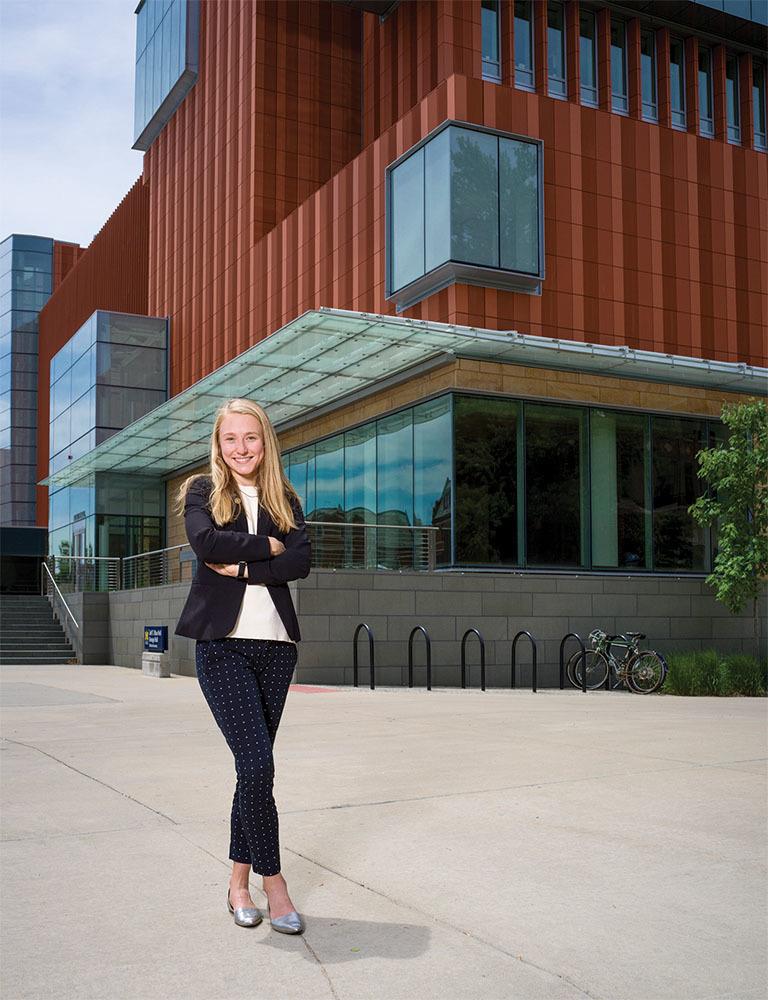
Lauren Heinonen, Rotary Club of Ann Arbor, Michigan
Fresh Perspective
Even as a child, Lauren Heinonen was a scientist at heart, an answer-seeker, a problem-solver — by age six she was dissecting lobsters her mother brought home from the store. "She would entertain any kind of scientific question or interest that I had," Heinonen says of her mother, a clinical researcher. Heinonen is now a project manager for DalCor, a small pharmaceutical company developing personalized medicine for patients with cardiovascular disease.
"I loved the idea of helping people in a tangible way," says Heinonen, who began working for the company in 2016 while she was still a biological anthropology student at the University of Michigan. In 2017, she had her dream job but still felt that something was missing. "I wasn’t having the impact that I wanted to see every day in my life," she says. "I stumbled upon Rotary."
Rotary’s Four-Way Test sealed the deal. "I had never seen a group of people or an organization that held themselves to such high standards," she says. "It gave me a reason to trust the people and trust the work that they were engaging in."
Still, Heinonen hesitated; at 22, she would be the youngest member of the Ann Arbor club. "But so many people came up to me and said, ‘You have such a unique perspective and so many skills that we don’t have. We would love to learn from you.’"
Since joining, she has taken on a twoyear stint as the club’s public image director. "I figured, ‘OK, I can probably figure this out quickly. Why don’t I see if they can use my help?’" Heinonen says.
"Lauren’s willingness to take a risk has rubbed off on the club," says club member Rosemarie Rowney. "We are now more willing to try new things and become more technologically astute."
Heinonen hopes the club’s enhanced online presence — along with recent shifts such as using video technology during the COVID-19 crisis — will help attract more young members. She’s also launching a satellite club that meets in the evenings to make Rotary more accessible to young professionals.
"I’m interested to see how Rotary will change in the next decade, or even sooner," she says. "I hope it will continue to accommodate the desires and needs of young people." — NIKKI KALLIO
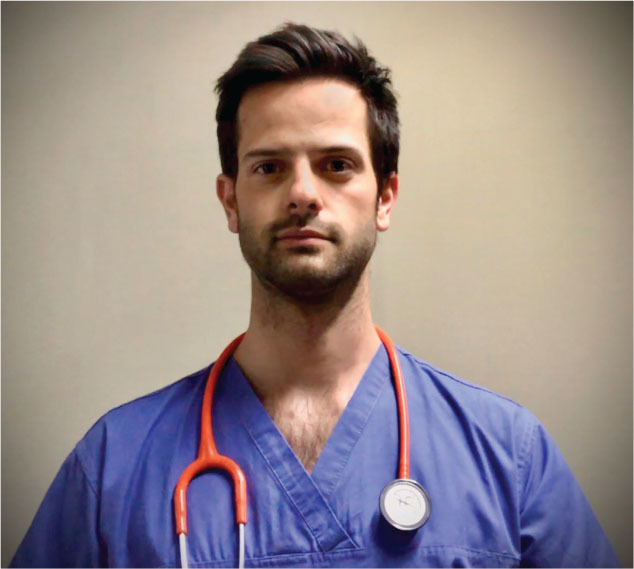
Giovanni Cappa, Emergency room physician Rotaract Club of Pavia, Italy
The World Stopped. They Didn’t These 10 workers put service above self when it counted most
I am a medical resident in one of northern Italy’s university hospitals. We’re a big emergency room, one of the biggest in Italy. We’re at the epicenter of this huge storm.
When the coronavirus hit Italy, the first cases in China had been recorded just two months before. A lot of research came out day by day, so we had briefings every morning. Guidelines about drugs and ventilation parameters would change daily. We would discover new things about the disease’s pathology and have to adapt.
In the first days, we had waves of patients. Many emergency rooms in the region collapsed — hospital personnel got infected, or the hospital didn’t have the ability to accept coronavirus patients. So we received patients from other parts of the region too. We didn’t have space. We had patients everywhere. We set up a new emergency room in a day, but we were lacking things we were used to having, like computers for administering the logistics. That was just a little thing. There were many times we didn’t have enough oxygen supply for everybody.
We had to make many difficult choices. Many coronavirus patients cannot breathe when they come in. They’re in respiratory distress and they need ventilation. We had patients walk into our emergency room and collapse. People were so scared. The small number of beds in intensive care were filled instantly. Coronavirus patients don’t spend one or two nights there; they spend weeks.
We were used to giving all the best medical care to anybody who needed it. That wasn’t the case anymore. We needed to use our resources with common sense. We needed to prioritize care to the people who would survive. It was catastrophic medicine. Shortly after, the Italian society for anesthesiologists published guidelines to help make those decisions.
We would tell families that their loved ones didn’t make it, and we couldn’t let them see the body. They would implore us for a farewell, but we couldn’t let them. Those were some of the hardest moments.
We are used to working in cotton scrubs. They’re really comfortable. The emergency room is quite hot, and we need to move a lot. At the end of February, we got the orders that we had to wear full gear every day, for 13 or 14 hours in a row. It’s like full body armor, and it makes you sweat. It’s challenging because in an emergency room you have to move fast and make precise maneuvers, and now you have to do those things in bulky gear. And you can’t even make your patients feel better with a smile. You'll lose the human connection.
Opens in modal lightbox
The silver lining is that we’re learning a lot. We keep facing really strange and difficult situations. We are working together, young residents and more experienced physicians. There is real teamwork; the whole hospital is collaborating because we have a common enemy.
It’s not easy. It’s something none of us were prepared for. The huge amount of work distracts you from the emotional aspect. There is so much to do. Even though we see a lot of death, we are saving a lot of lives. You try to be strong for your patients and for the families you are trying to help.
Many doctors and nurses are burned out. Many got sick. Many of my colleagues have not seen their families since the beginning of the outbreak. Many moved to another flat, away from their loved ones. They’re scared they might infect family members.
We’ve had huge support from the community. We’ve had help from Rotary clubs and Rotaract clubs. Every day we receive donations from restaurants, or people buy pizzas and have them sent to the emergency room. These are simple acts, but it makes us really happy to know that outside these walls, the community is thanking us for the work everyone is doing. We feel the gratitude.
This weekly electronic bulletin is intended to keep club members, friends of Rotary and bulletin subscribers up to date with weekly luncheon meetings and other club activities. Feedback, (positive or negative), is welcome!