Dictionary Project
Posted by Edward Covelli
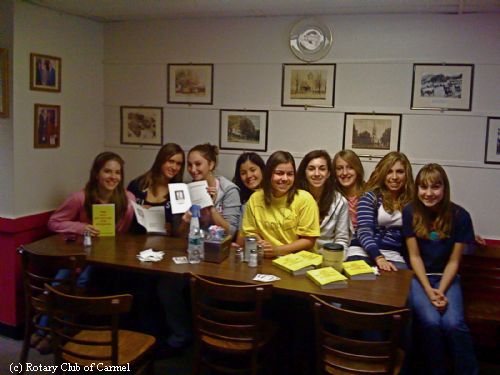
An army of helpers from the Interact Club came to help place the decals in the front cover of the dictionaries.
The club expects to distribute them within a week or so.
The club expects to distribute them within a week or so.
The Carmel Rotary Club first got involved with the Dictionary Project when Amy Covais was Presdent and has participated enthusiastically ever since. The goal of this program is to assist all students in completing the school year as good writers, active readers and creative thinkers by providing students with their own personal dictionary. Over 300 dictionaries are given as a gift to each 3rd grade student in the Carmel Central School District to use at school and at home for years to come.
The idea for the Dictionary Project began in 1992 when Annie Plummer of Savannah, Georgia gave 50 dictionaries to children who attended a school close to her home. She didn't stop there. In her lifetime she raised the money to buy 17,000 dictionaries for children in Savannah, Georgia. Annie Plummer died December 23, 1999, but her dream did not die with her. She left an idea that has developed into The Dictionary Project, a nonprofit organization.
Once a board was founded, the original goal was to provide dictionaries to all of the third grade students in South Carolina each year. In 1997, they expanded their mission to include all of the students in the United States. The purpose of The Dictionary Project is to provide dictionaries to students to keep to use as their own personal reference books. A dictionary is an essential tool for a quality education. Most children do not own a dictionary, nor do they have access to one in their home. This agency seeks to provide dictionaries to all of the children who are in school. The program is typically implemented in the third grade each year.
The goal of the Dictionary Project is to improve the reading ability and comprehension of all children, everywhere. It is our goal to encourage children to use dictionaries so that they will be able to use the English language effectively. A student cannot do his or her best work without a dictionary. By providing this tool we assist teachers in making all students active readers, good writers and creative thinkers.
The program has been adopted and refined by civic organizations all over the country. Groups such as Rotary Clubs, Kiwanis Clubs, Granges, Lions Clubs, The Republican Federation of Women and The Jewish Council of Women have implemented The Dictionary Project where they live. Anyone can participate in this project by sponsoring a program to provide dictionaries to children in their community. The dictionaries are a gift for the children to keep.
Students can use the dictionaries throughout their school career. Each year we offer new dictionaries that have been improved by sharing suggestions from teachers, students and parents with the publishers. The ideas we receive from sponsors, students and teachers are an integral part of this project because they give our Board of Directors direction. Research has shown that one book is shared by at least four people. A dictionary in the home serves as a resource for the whole family. It improves everyone's vocabulary and it encourages children to learn more words.
The Dictionary Project is funded through donations and sponsors who introduce the program in their local schools. All donations and contributions are tax deductible. The Dictionary Project is registered as a 501 (c ) (3) nonprofit Association in all 50 states.
The idea for the Dictionary Project began in 1992 when Annie Plummer of Savannah, Georgia gave 50 dictionaries to children who attended a school close to her home. She didn't stop there. In her lifetime she raised the money to buy 17,000 dictionaries for children in Savannah, Georgia. Annie Plummer died December 23, 1999, but her dream did not die with her. She left an idea that has developed into The Dictionary Project, a nonprofit organization.
Once a board was founded, the original goal was to provide dictionaries to all of the third grade students in South Carolina each year. In 1997, they expanded their mission to include all of the students in the United States. The purpose of The Dictionary Project is to provide dictionaries to students to keep to use as their own personal reference books. A dictionary is an essential tool for a quality education. Most children do not own a dictionary, nor do they have access to one in their home. This agency seeks to provide dictionaries to all of the children who are in school. The program is typically implemented in the third grade each year.
The goal of the Dictionary Project is to improve the reading ability and comprehension of all children, everywhere. It is our goal to encourage children to use dictionaries so that they will be able to use the English language effectively. A student cannot do his or her best work without a dictionary. By providing this tool we assist teachers in making all students active readers, good writers and creative thinkers.
The program has been adopted and refined by civic organizations all over the country. Groups such as Rotary Clubs, Kiwanis Clubs, Granges, Lions Clubs, The Republican Federation of Women and The Jewish Council of Women have implemented The Dictionary Project where they live. Anyone can participate in this project by sponsoring a program to provide dictionaries to children in their community. The dictionaries are a gift for the children to keep.
Students can use the dictionaries throughout their school career. Each year we offer new dictionaries that have been improved by sharing suggestions from teachers, students and parents with the publishers. The ideas we receive from sponsors, students and teachers are an integral part of this project because they give our Board of Directors direction. Research has shown that one book is shared by at least four people. A dictionary in the home serves as a resource for the whole family. It improves everyone's vocabulary and it encourages children to learn more words.
The Dictionary Project is funded through donations and sponsors who introduce the program in their local schools. All donations and contributions are tax deductible. The Dictionary Project is registered as a 501 (c ) (3) nonprofit Association in all 50 states.