GUEST SPEAKER - RICHARD ROZEN OAM
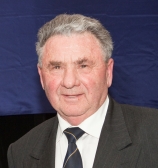
Guest Speaker: Richard Rozen OAM C.V.
Duncan Stalker introduced the guest speaker Richard Rozen OAM C.V. saying he is a personal friend with a truly amazing life story to tell. Richard’s story was indeed moving and those of us who heard him speak felt privileged to be in the presence of man who processed such grace and humility despite having endured horrific hardships and loss in his early life. Richard explained his talk is in two parts – he delivered the first part and it is hoped he will be invited to return to tell us the second half of his life story.
Richard is Jewish. He was born in Poland on 15 April 1935. War broke out and when Richard was six years old he and his mother and father hid in a cupboard for 13 months. When their money ran out they were forced out of their hiding place and asked to leave. From here they moved to the Lublin getto. On the way to Treblinka Extermination Camp the Rozencwajg family was smuggled out by the Partisans. Richard's father was a doctor and although he was Jewish the Partisans in the forest needed doctors. Richard and his mother Rose went to live in a Polish village where in order to protect him Richard was disguised as a little girl. Later Richard joined his father and the Partisans in the forest where he remained for 18 months until liberation. Richard’s father was taken by the Germans in 1944 and never seen again. Richard was eight and a half years old the last time he saw his father. Richard told us how on his tenth birthday he was given a loaf of bread, made mostly of sawdust but he kept it in his shirt and when hungry he would scratch a piece off and eat it – it lasted for many weeks.
After liberation between 1954 and 1951 Richard re-joined his mother and spent 3 months in a sanatorium in Otwock, then 3 months in Lodz, then one year in a displaced persons camp in Stuttgart Germany. He then went to stay with an uncle and aunt in Paris and instead of being welcomed and cared for the family sent him to a French orphanage for four and half years. Richard believes they did this because he ate with his hands and ate too much – during the telling of his life story this was the only time Richard hinted at any feelings of bitterness about all that happened to him.
In 1951 Richard and his mother Rose arrived in Australia and went to live with an Uncle in Caulfield. Richard said he could not believe the food that was on the table when he sat to eat his first breakfast on 14 March 1951. After his experience of being sent to the orphanage when he ate too much food at relatives in Paris, this time Richard sat on his hands and did not eat. His uncle and aunt persuaded him to have milk and toast with honey on it. Richard knew he had truly come to the land of milk and honey!
Richard attended Melbourne High School and went on to study Electrical Engineering at RMIT. He established the RMIT chess club, and later the St Kilda Chess club. In 1956 Richard married for the first time and established a knitting factory. In 1956 Richard became a naturalised Australian citizen. In 1959 he established a wholesale confectionary business which operated until 1982.
In 1970 Richard married for the second time and he now has two married sons, and two grandchildren.
In 1982 Richard represented Australia in the World Bridge Championships in France.
In 1997 Richard was awarded the Order of Australia Medal for services to chess, bridge and the community through work with the Jewish Holocaust Museum and Research Centre.
Richard has worked hard and made a good life for his family since coming to Australia but he has never forgotten the 1.5 million children who died in the war. His war experiences were recorded in Jane Mark’s New York novel “The Hidden Children” and Dr Paul Valent’s ”Child Survivors” - both books were launched in 1994. Richard has continued to speak out about the atrocities committed against children and the Jewish people during WW2. He has been interviewed on radio, TV and by the print media both in Australia and the USA and despite being 80 years old he is regularly a guest speaker. In 2001 Richard’s testimony was included in the “Book of Life” published by the New York Museum of Jewish Heritage. In 2005 a play based on Richard’s war experiences called “The Feather Body” was staged by students of St Martin’s Theatre in Melbourne.
In addition to his speaking and media engagements, Richard continues to be actively involved in community life and serves on numerous committees including being president of the Brighton Residents for Urban Protection and a committee member of Bayside Older Adults Advisory Group.