The Vaiola Hospital program 25 years on
THE ambulance surged along the main  street of Nuku’alofa in Tonga, sirens blasting, heading for the Vaiola Hospital. I had collapsed following a mismatch of medication, exercise and hot weather. I was recovering as the ambulance filtered through the crowded streets, but welcomed eventual arrival at the Vaiola Hospital Emergency department.
It was early June 2017. I was in Tonga with RN John Macdonald, the International Health Project Officer at St John of God Hospital, Ballarat to review the hospital after nearly 25 years of the twinning program that John and I had set up between St John of God Hospital and Vaiola Hospital in Tonga
John Macdonald had led his last team visit to Vaiola over the previous two weeks. 132 delegates from Ballarat had visited Vaiola, and 134 Tongans had spent 4 weeks or more in Ballarat over the last 25 years, two exchanges a year for 24 years. An enormous educational program, driven by John, and encompassing developments of nursing, medical, radiology, engineering, pharmacy, medical records, etc., quietly raising not only the clinical profile of the hospital, but also the maintenance infrastructure. John has also consigned thirteen containers of pre-loved hospital equipment, mostly via The Rotary “Donations in Kind” Facility in Geelong to help build up the equipment level of the chronically underfunded hospital system.
I was whisked into a cubicle in the A&E, connected to monitoring (donated by St John of God Hospital, Ballarat) and capably assessed by a nurse. The A&E physician asked for an ECG, and I was later reviewed by a senior physician. No damage done, take it easy, keep up the fluids, etc. Time to think about the miracle that has happened at Vaiola over those years, and to reflect on the role of that very quiet achiever, RN John Macdonald.
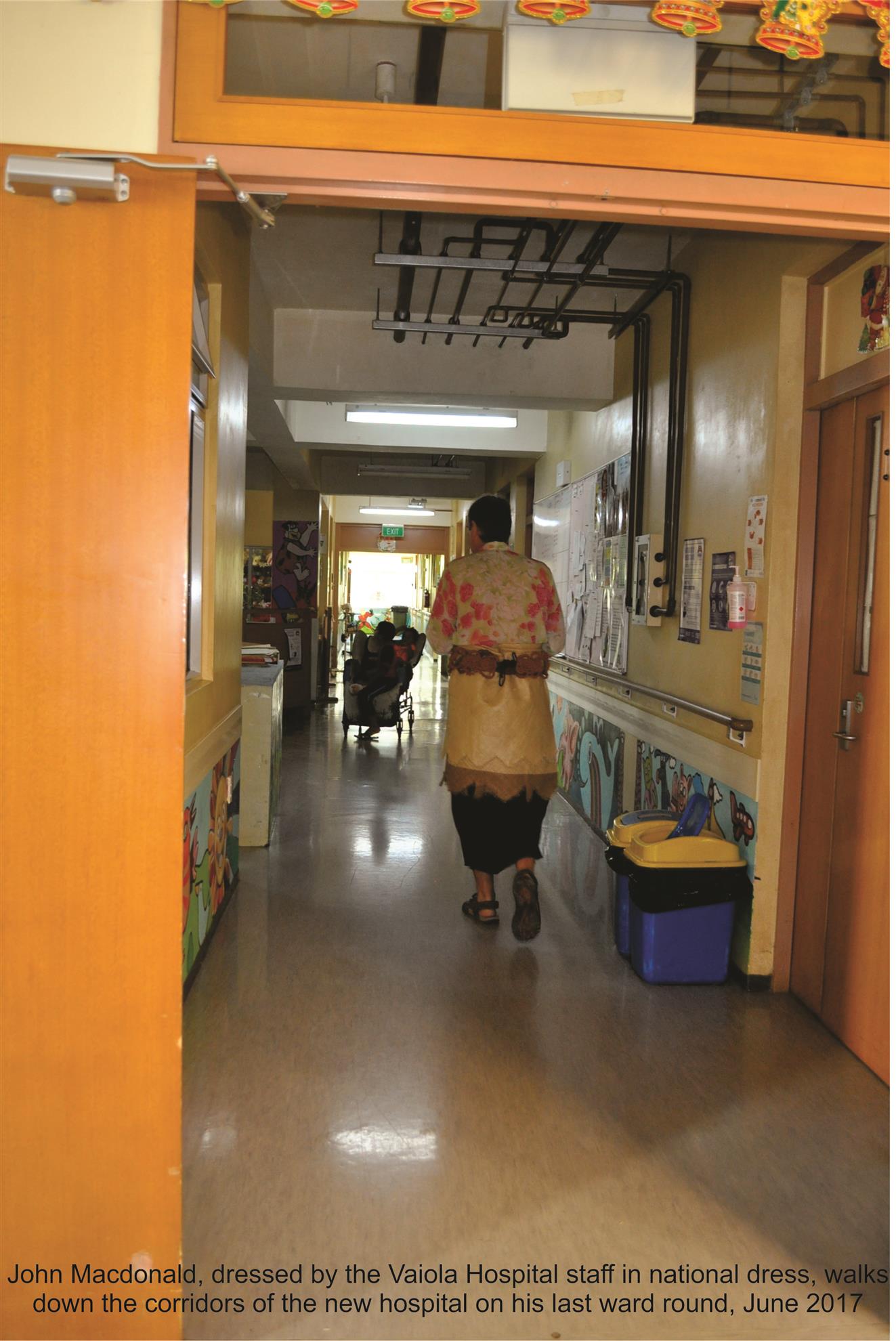
Across the entire staff of Vaiola hospital, emotions ran high when they learnt that it was to be  John’s last trip as head of this unique program. Nurses broke into tears, even the Minister of Health was saddened by this eventuality. This had been a very long partnership, which had seen the hospital move into the 21st century, and to be a leader amongst Pacific Island hospitals
The Beginnings
In 1991-92, a young Tongan Anaesthetic registrar, Talia’uli Afeaki, spent 18 months training in Ballarat Health Services. He visited our club (the Rotary Club of Ballarat West), and explained a little about his country, and the difficulties his hospital faced in lack of equipment and in a generally impoverished health care system. Talia’uli said that he would appreciate the support to set up an ICU when he returned to Tonga. John Macdonald suggested shipping retired ICU monitoring to Nuku’alofa. This was arranged through our club. We were invited to visit Tonga to address the 50th Tongan Medical Association ASM in July 1992.

The Problems
The Vaiola Hospital, Nuku’alofa Tonga was in crisis at the time that Talia’uli worked in Ballarat. The hospital had run out of money for food and drugs, and had borrowed on the following year’s budget to keep the ship afloat. Pigs roamed the hospital grounds, and rubbish was dumped out the windows by staff. There had been 65 amputations of legs performed at the Vaiola hospital in the preceding three years for complications of diabetes.
We took the opportunity to visit the Vaiola Hospital and confirmed the tragedy that was the Vaiola Hospital; electrical cabling was exposed and broken, roofs leaked and ceilings lay on the floor. Staff (often very skilled and trained in Australia and NZ) worked in a dank, primitive, regressive hospital.
As well as the obvious infrastructure problems, diseases such as Diabetes were rife in the community. Patients would not come into hospital to be treated, because they believed that if they did, they would die. Diabetes sufferers put off their admission till they were nearly dead, then had to be admitted, died and fulfilled the prophecy.
The Rotary Club of Nuku’alofa 
We visited the Rotary club of Nuku'alofa. They were aware of the plight of the hospital, thanks to a damming series of articles that Talia’uli and Dr Bill Tangi (later Lord Tangi) had engineered in the local news bulletin. This was the start of the long involvement in Tonga for the Rotary Club of Ballarat West and St John of God Hospital in Ballarat, together with the Rotary Club of Nuku’alofa.
The population of Tonga was determined to improve the situation, and had formed a committee, involving the Rotary Club of Nuku’alofa, the government and the hospital to raise funds and to examine ways to upgrade their hospital. They believed there needed to be an overall plan to develop the hospital. They had raised the equivalent of Aus$50,000! An enormous amount of money in a small impoverished community.
Involvement of St. John of God Hospital Ballarat
The CEO of St. John of God Hospital, in response to our report on that visit, undertook a review of the Vaiola hospital and suggested that the $50,000 be used principally to establish a 5 year "Twinning Programme” between the two hospitals.
St. John of God Hospital pledged $25,000 per year for the next five years to a fund that was to be set up to cover living and transport costs for staff involved in the project. Two groups of four Tongan staff would be selected on a needs basis from Vaiola Hospital each year, to spend four weeks at St. John of God Hospital.
In turn, similar groups of health professionals from St. John of God Hospital would visit Vaiola each year to teach, mentor, to support their opposite numbers and to prepare the next team from Tonga.
In September 1993, an agreement was signed between the Ministry of Health in Tonga, and St. John of God Hospital in Ballarat, and the first teams from Ballarat went to Tonga. This agreement has been renewed several times, and in 1996 AusAID agreed to contribute to funding the exchanges.
The Twinning program and Rotary supporting FAIM teams achieved many early successes, such as the repair of the Oxygen Concentrator. FAIM volunteer Trevor Chapman (Rotary Club of Ballarat South) got this machine working again, in the face of previous failed attempts of commercial companies to repair it. This alone saved the Department of Health many, many thousands of Pa’anga (dollars) per year as all supplies of Oxygen had to be brought into the kingdom in cylinders.
FAIM teams (RAWCS teams nowadays) and the Rotary Foundation.
 As well as spurring this twinning programme, Rotary sent several FAIM teams (maintenance volunteers), to teach as they repaired solar hot water systems, installed new roofs and guttering etc. over theatre and other departments. The Rotary Club of Ballarat West also organised and shipped several consignments of goods, donated by numerous sources both inside and outside of Rotary, from a “Wish List” developed by medical staff at Vaiola.
Matching grants of several hundred thousand Australian dollars were obtained from the Rotary Foundation to help fund the purchase of equipment that could not be obtained as superseded equipment. Support for these grants came from the USA, New Zealand and other clubs in Ballarat and Victoria.
The role of DIK (Donations in Kind, Geelong)
DIK in Geelong have been very supportive of our program over the years, facilitating it by shipping thus far 13 containers of much needed equipment from St. John of God Hospital and other hospital sources via the Twinning Program to Vaiola Hospital. We are very grateful to Anton van Doornik, his team, and his predecessors Barry Bell and Hank Nydam,.
The Development of Dental, Ophthalmological, Radiological and (perhaps a) Prosthetic Twinning Programs
Contacts sourced through the program led to the development of the Dental Program to Vaiola by our Rotary club in 1996, which, over the last 20 years, has continued to provide support for the oral health professionals in Tonga. Driven by current president of the Rotary Club of Ballarat West, David Goldsmith, it has its own exchange program, bringing dental professionals to Ballarat and Melbourne over the years for further education, sending teams of dentists/educators and enormous quantities of surplus dental equipment (consigned by DIK), to Tonga.
Dr Michael Toohey, Ophthalmologist has been supporting the program for many years
A radiological twinning program has also recently been set up by Lake Imaging in Ballarat
A recent prosthetics/orthotics visitor from Ballarat Health Services has determined a dire need in this area with potentially more visits in the future.
An ambulance service from SA, supported by a variety of SA Rotary Clubs, has provided ambulances to support the much-developed Emergency Department
So generally, the program spurred initially by the Rotary Club of Ballarat West in 1992 has blossomed to an hospital wide support service from St John of God Hospital Ballarat , with each year still bringing major advances.
The Current situation
 I was blown away when I first saw the new hospital, 10 years after it was rebuilt by the Japanese, and refurbished by Chinese funding. Many other agencies have been involved; DFAT and NZ government support, visiting surgical programs etc. But the Twinning program remains central to this development and continues after nearly twenty-five years.
 The British government had refurbished the hospital in the 60’s but had not provided any support or educational programs. Lack of empowerment of nursing staff, and women in particular meant that promotion of staffing was more dependent on tribal mores than on merit.
Why had this 21st century development succeeded when the 1960’s development did not? I believe it was the role of the twinning program, providing relief from isolation, and allowing the very committed and professional staff to develop their own hospital. By promoting education, empowerment and maintenance the program has brought this hospital up to a standard where cardiac surgery can be undertaken, where premature children have as good a chance of surviving as they would in Australia, and where staff morale is sky high. 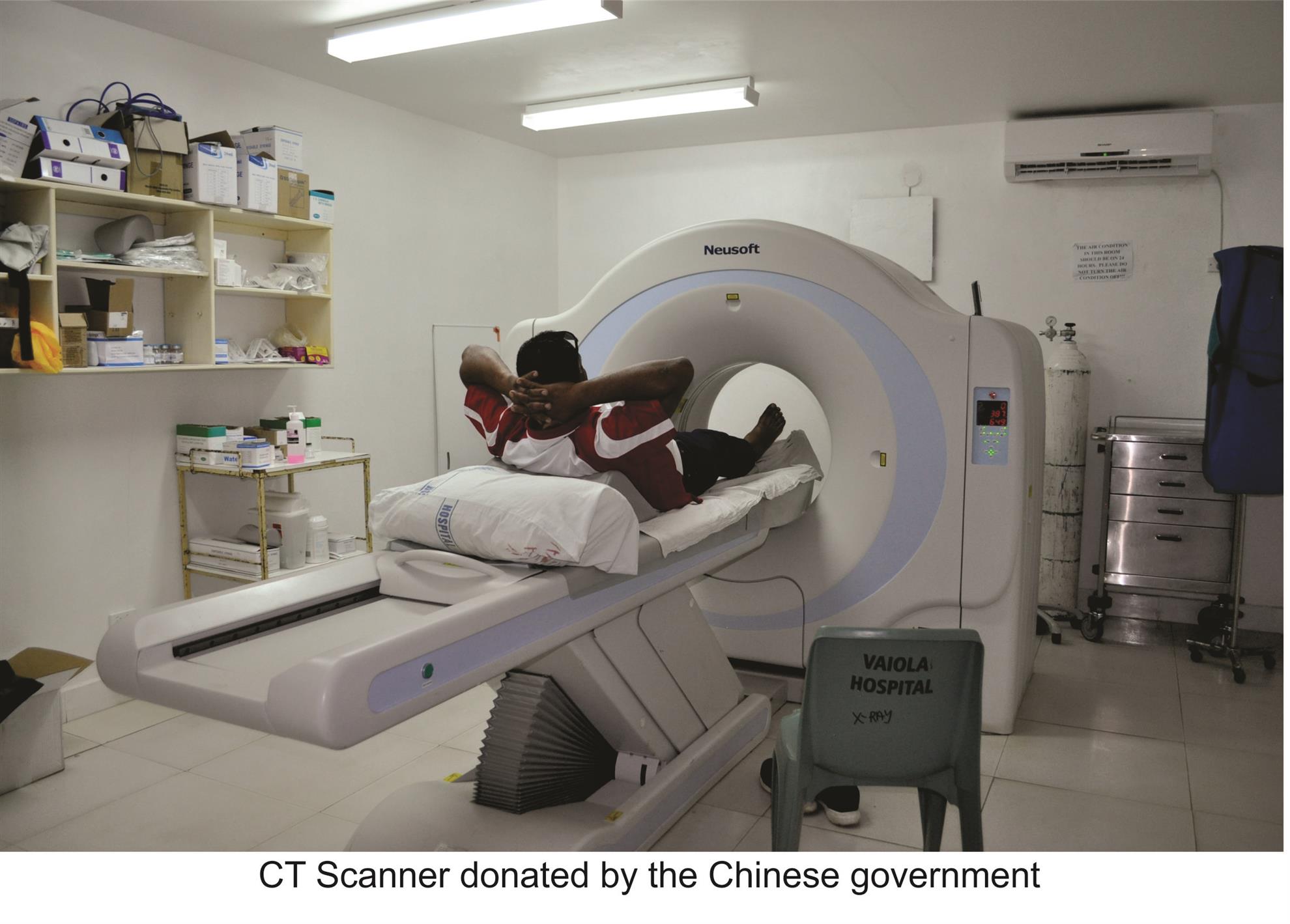
The architect of this program was RN John Macdonald, who with persistence and skill encouraged communication with the Department of Health, where in 1992, our requests for engagement were met with a taciturn if not overtly negative response. He at the same time worked with the nursing staff to determine what their needs were, gradually getting to the stage we are now at, where the ability to communicate in both directions makes further needs assessment and management a breeze.
There have been dramatic improvements in the ICU, in Wound Care, Nursing, Administration, in Medical records, in Engineering, in fact in all aspects of the hospital over the course of the last 24 years. Much of this improvement is due to the on-going Twinning Program, but also could not have happened without the hard work of the staff of the Tongan Ministry of Health and other international aid agencies.
The tremendous relationships between the staff of the Vaiola Hospital and St John of God Hospital, Ballarat built up over the 24 years is the oil that makes this program work.
RN John Macdonald has had significant support over the last 10-15 years from RN Carolynne Murnane (Surgical Nurse) and Michelle Frank (medical records) of St John of God Hospital Ballarat.
Rotary’s role these days is limited to DIK and the co-existent Dental Twinning Program set up by our Rotary Club.
Summary,
John announced his retirement to the staff of Vaiola hospital during this last visit. 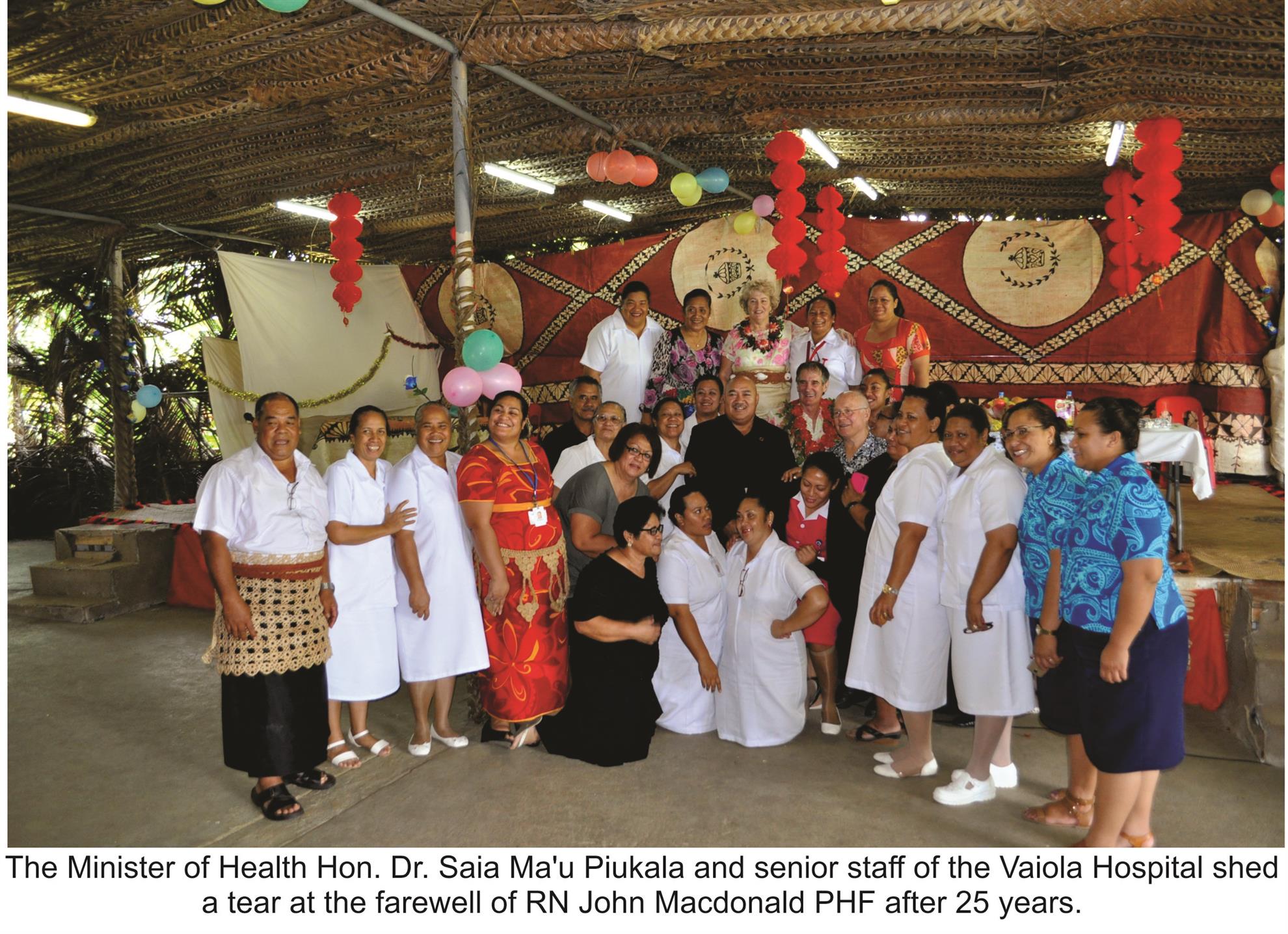 There was widespread sadness across the staff of the hospital and the Department of health, and there were many tears, from the minister of Health down to the many am
Who would have believed twenty-four years ago, that the hospital (where pigs roamed the grounds, waste lay everywhere, beds were piled in fire escapes and the rooves of theatre etc. leaked) that today they would be doing open heart surgery, or that the hospital could become the example it is to the rest of the Pacific.
There have been many reasons and many other supporters from Australia, NZ, Japan and other parts of the world for this improvement, but the skills and abilities of the Tongan Clinicians and support staff of the hospital have been allowed to develop and drive reform. I believe the Twinning program has provided a direction, wide support and fellowship which has allowed this development.
When considering recent developments with the Dental, radiological and perhaps prosthetic programs, Lord Tangi (surgical registrar in 1992, and more recently Minister of Health and Deputy Prime Minister), said “The Program has been a cooperation between not only the hospitals, but also the communities of Ballarat and Tonga”.
So, this program has ticked all the boxes. It has developed capacity, it has graduated from a Rotary supported program to a Private (AusAID / DFAT supported) program and it has, with 25 years’ experience, seen significant friendships develop between the two communities, allowing for well-considered requests for targeted aid. We in the Rotary Club of Ballarat West are very proud of our involvement with this great program, and watch in awe as it develops further.
John Oswald PHF OAM FANZCA
Co-ordinator, Vaiola Hospital Program
The Rotary Club of Ballarat West D9780